
1. Introduction
There are several types of penhold table tennis rackets, each with its own strengths and weaknesses.
In this article, we compare the main types of penhold rackets and discuss which one is the best choice for players who want to use Reverse Penhold Backhand (RPB) with rubber attached to both sides of the blade.
2. Types of Penhold Rackets
(1) Japanese Penhold
(2) Chinese Penhold
(3) Reversed Penhold
The main features of each type are summarized below.
(1) Japanese Penhold
The grip features a cork block that supports your fingers.
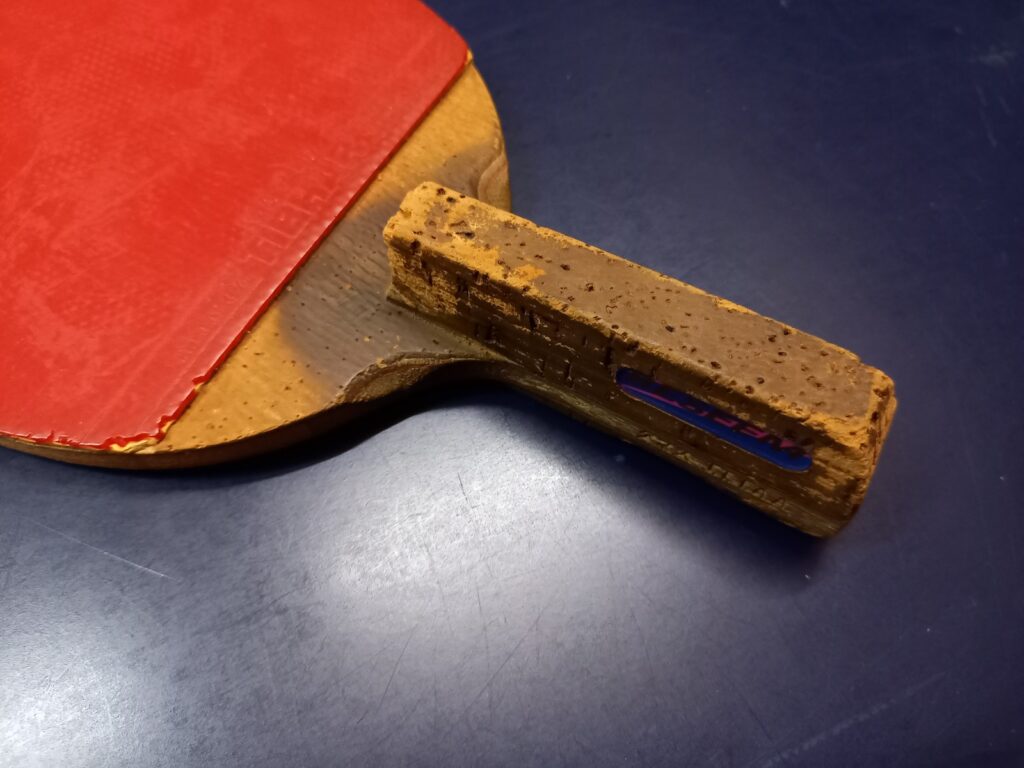
Many world-class champions have used this style of racket. However, today it is a minority choice among penhold players.
I switched to a Chinese Penhold racket to play Reverse Penhold Backhand (RPB), but I still admire the traditional Japanese Penhold style. Strong Japanese Penhold players have a unique fighting spirit that reminds me of the “samurai” of table tennis.
Most players use this type of racket with rubber on only one side of the blade.
Adding rubber to both sides naturally increases the racket’s weight. More importantly, its center of gravity is closer to the tip of the blade, making the racket feel much heavier than its actual weight.
As a result, maneuverability is significantly reduced.
(2) Chinese Penhold
There is no cork block on the grip for finger support.
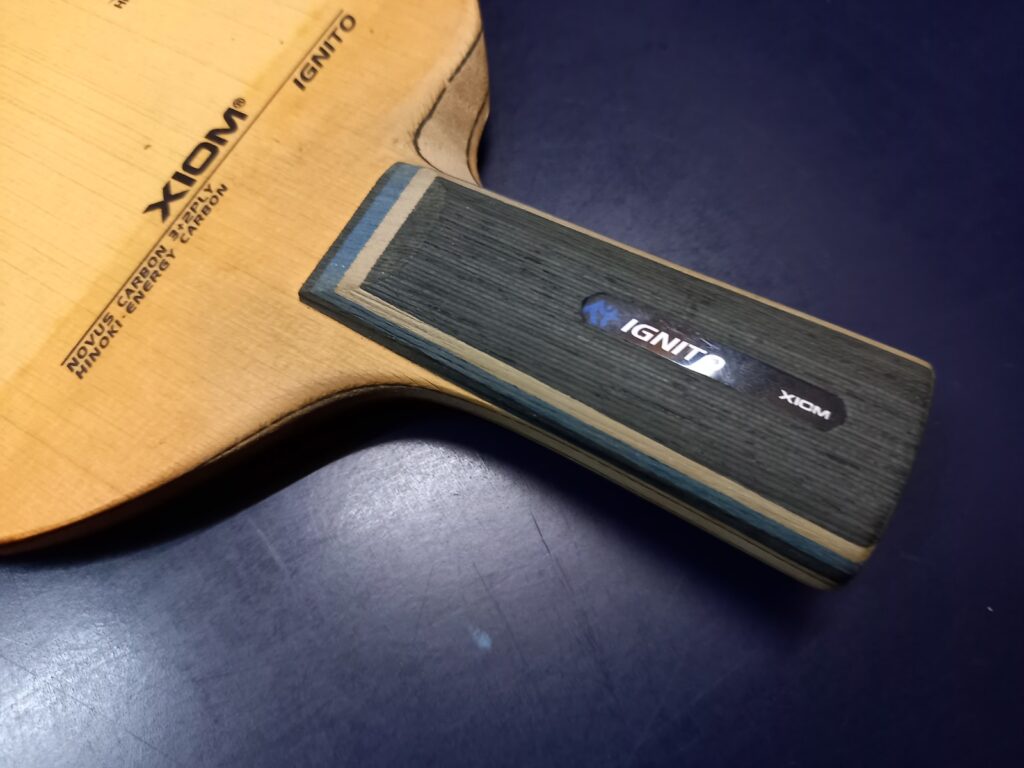
This type of racket is designed to be used with rubber on both sides of the blade.
Today, most penhold players use a Chinese Penhold racket.
As a result, it offers a much wider range of models than any other type of penhold racket, giving players plenty of options to find the one that best suits their playing style.
(3) Reversed Penhold
The grip is equipped with a cork block for finger support.
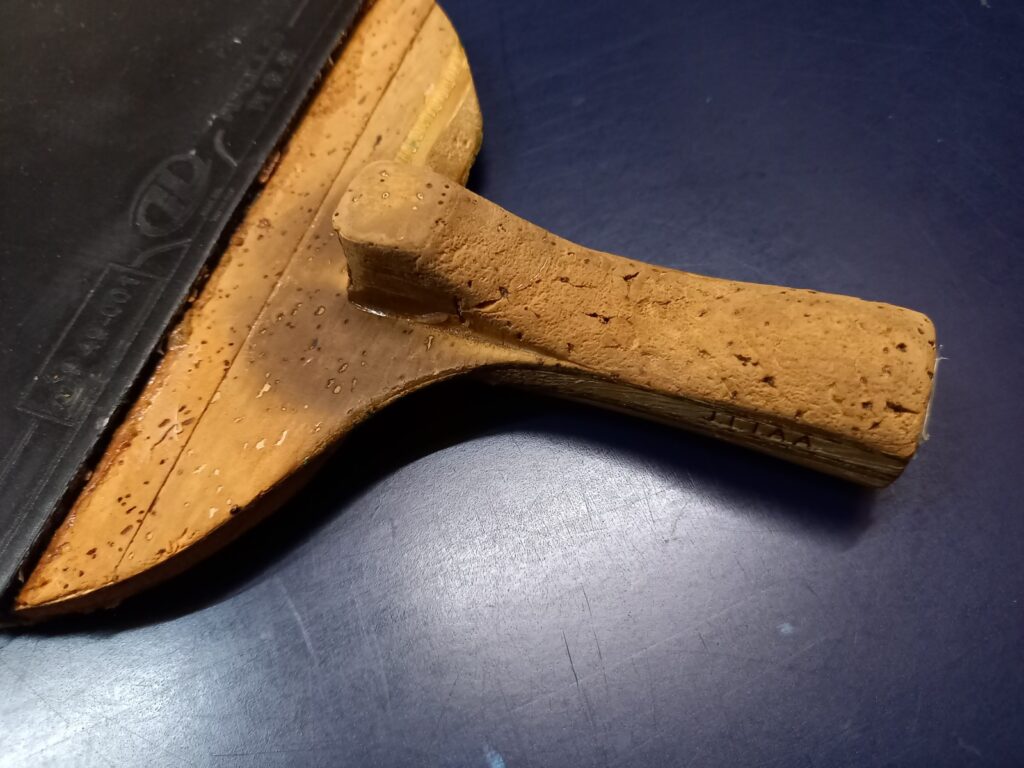
This type of racket is designed to be used with rubber on both sides of the blade.
It is designed so players can twiddle the racket during rallies and make full use of both rubber surfaces.
Because these rackets are specifically designed for use with rubber on both sides, most modern models are very lightweight.
However, due to limited market demand, the number of available models is relatively small.
3. Blade Shapes
Penhold racket blades can be broadly divided into three main shapes.
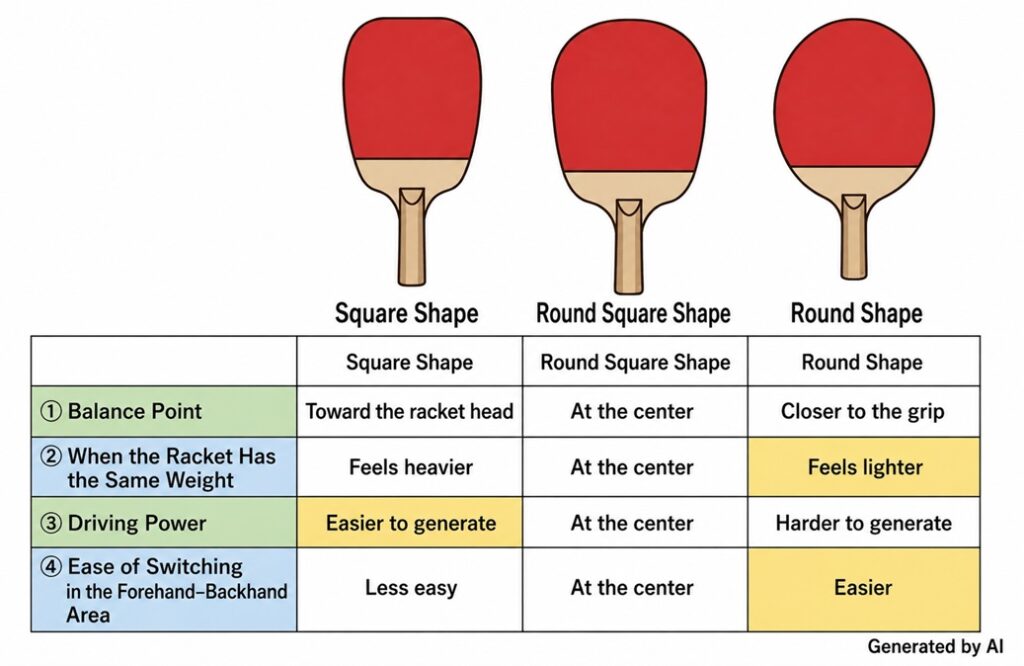
(1) Round Blade
Because the center of gravity is closer to the grip, switching smoothly between the forehand and Reverse Penhold Backhand (RPB) is much easier.
The grip-side balance also makes the racket feel lighter during play.
In my opinion, keeping the racket as light as possible is the most important factor for players learning RPB.
For this reason, I recommend choosing a round blade if you plan to use Reverse Penhold Backhand (RPB).
(2) Square Blade
A square blade delivers excellent power on forehand drives.
However, using rubber on both sides for Reverse Penhold Backhand (RPB) makes the racket feel much heavier because its balance is closer to the tip. This requires greater arm strength and places more stress on the wrist.
To the best of my knowledge, no world-class player has reached the highest level using a square-blade penhold racket with rubber on both sides.
(3) Round-Square Blade
A round-square blade combines the characteristics of both round and square blades, offering good power while remaining suitable for Reverse Penhold Backhand (RPB).
However, there are relatively few models available, so choosing a lightweight racket is important.
If you do not use RPB, this blade shape offers a good balance between the power of a square blade and the maneuverability of a round blade.
4. Which Blade Is Best for Reverse Penhold Backhand (RPB)?
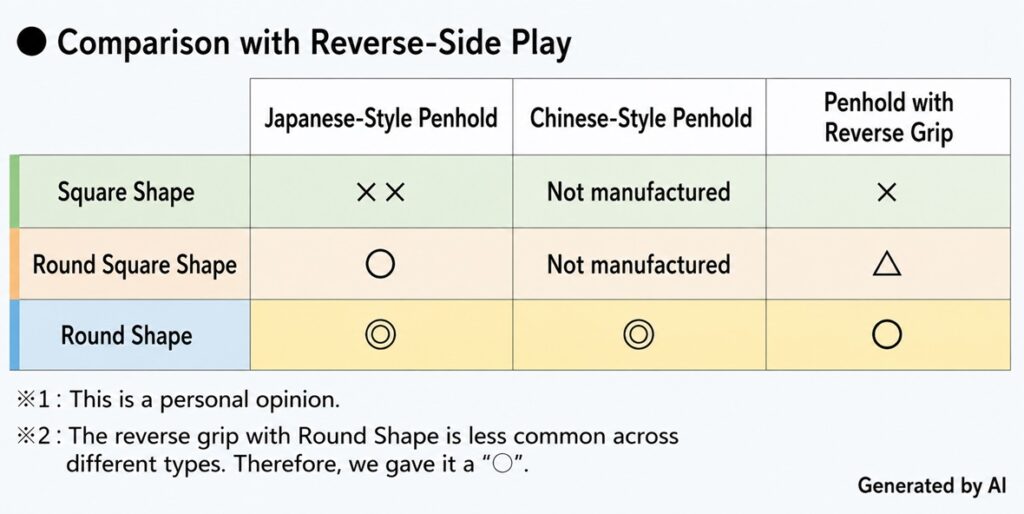
As discussed above, a square blade becomes noticeably heavier when rubber is attached to both sides.
Since quick transitions between the forehand and RPB are essential, I do not recommend a square blade.
A round-square blade also becomes less maneuverable with rubber on both sides, and there are very few models specifically designed for this setup. For these reasons, I do not recommend it for players learning RPB.
This leaves two practical choices: a Chinese Penhold or a Round Japanese Penhold.
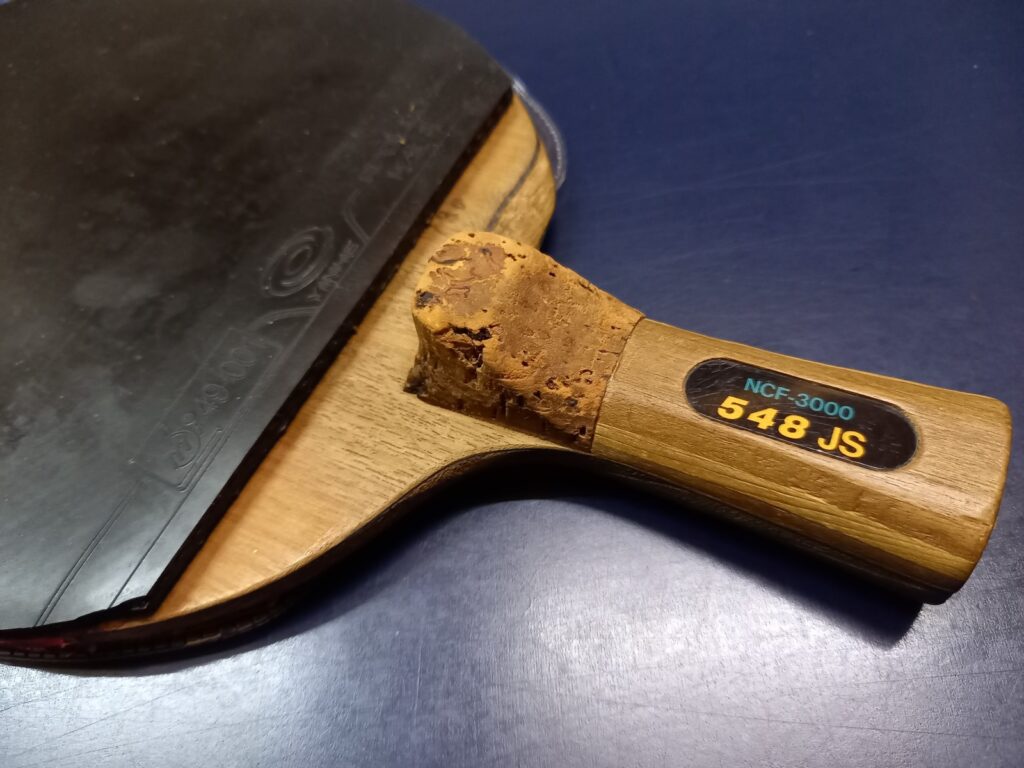
The main difference is whether the grip has a cork block for finger support.
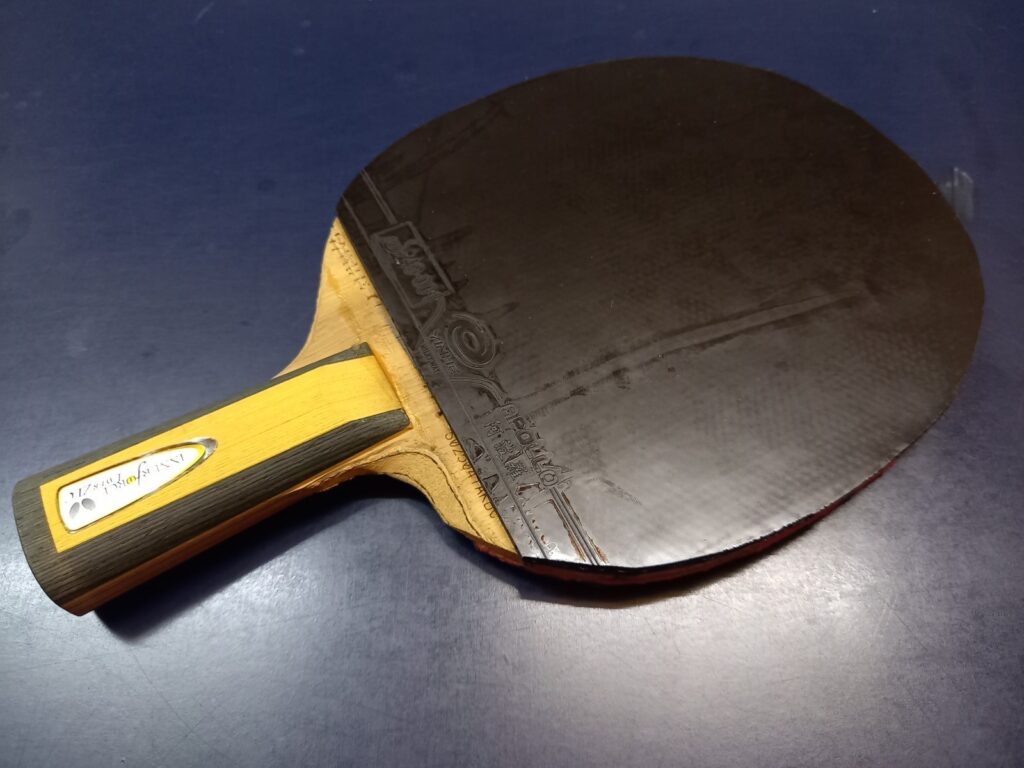
↓ Chinese Penhold (available only with a round blade)
↓ Round Japanese Penhold (features a cork block on the grip)
5. Conclusion: My Recommended Chinese Penhold Blade
I recommend a Chinese Penhold blade.
Here are the main reasons:
(1) A Deeper Grip Improves RPB Stability
For Reverse Penhold Backhand (RPB), holding the grip deeper—especially with the thumb—provides better stability.
Because of this, a cork block on the grip can get in the way.
However, a deeper thumb grip makes it more difficult to perform a traditional penhold backhand (PBH).
Wang Hao, widely regarded as one of the greatest RPB players in history, rarely used the traditional penhold backhand and held the racket with a very deep thumb grip.
(2) A Wide Selection of Rackets
Chinese Penhold rackets are available from many manufacturers, giving you far more options than other penhold styles. With a wider selection of grips, weights, blade designs, and appearances, it’s much easier to find a racket that suits your playing style.
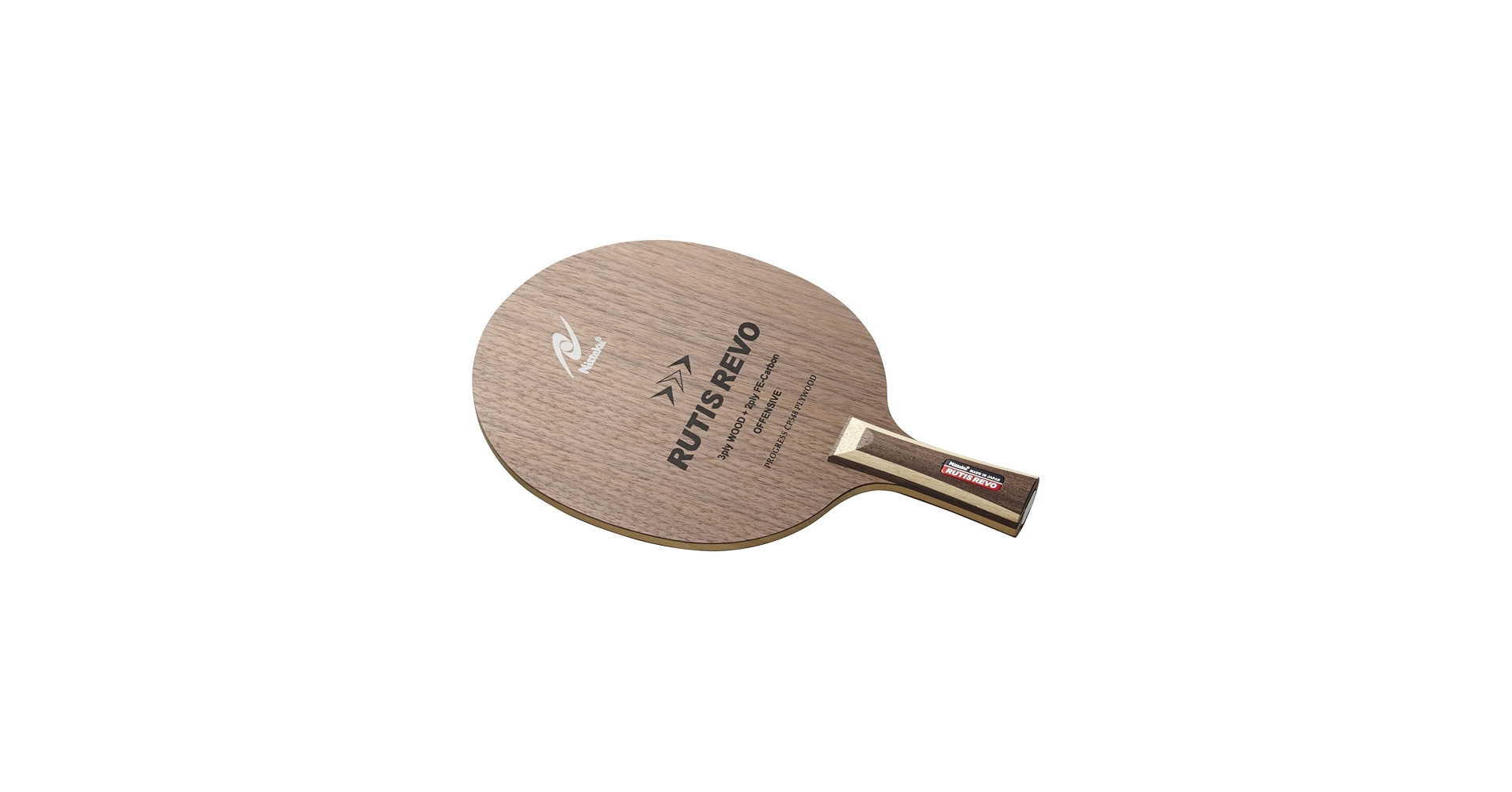
One racket I recommend is the Nittaku Rutis Revo C.
With an average weight of just 75 g, it remains lightweight even with rubber on both sides. Its carbon construction provides a good balance of speed and control, making it an excellent choice for RPB. Several players at my club also use and recommend this racket.

(3) Alternative: Reversed Penhold
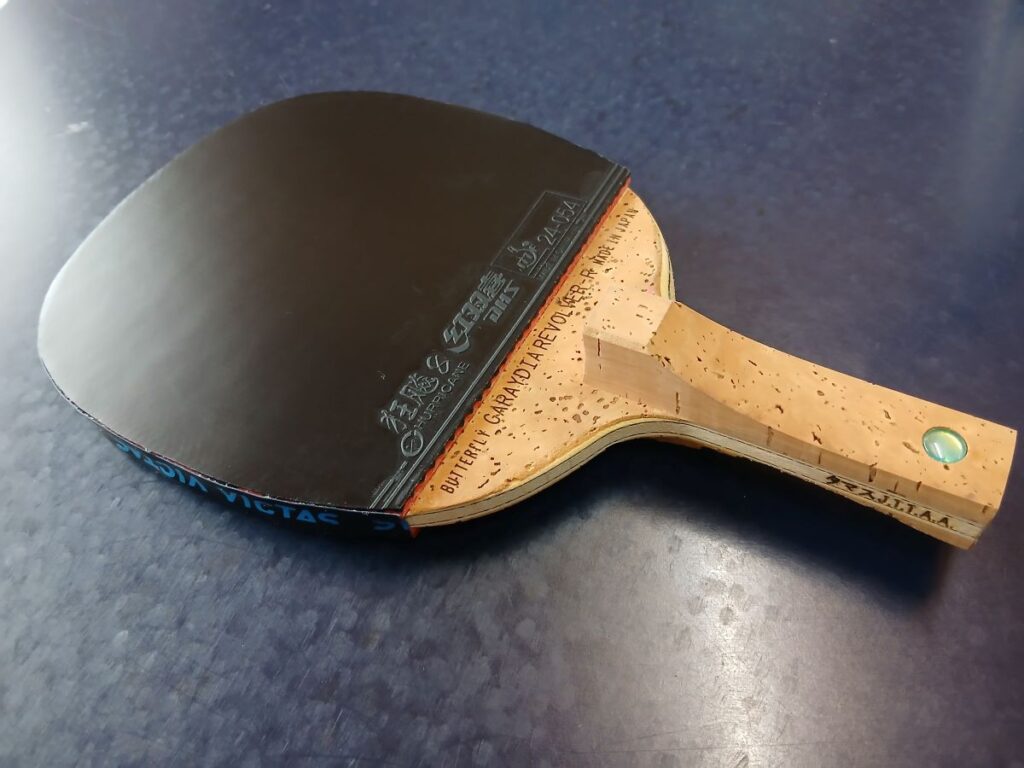
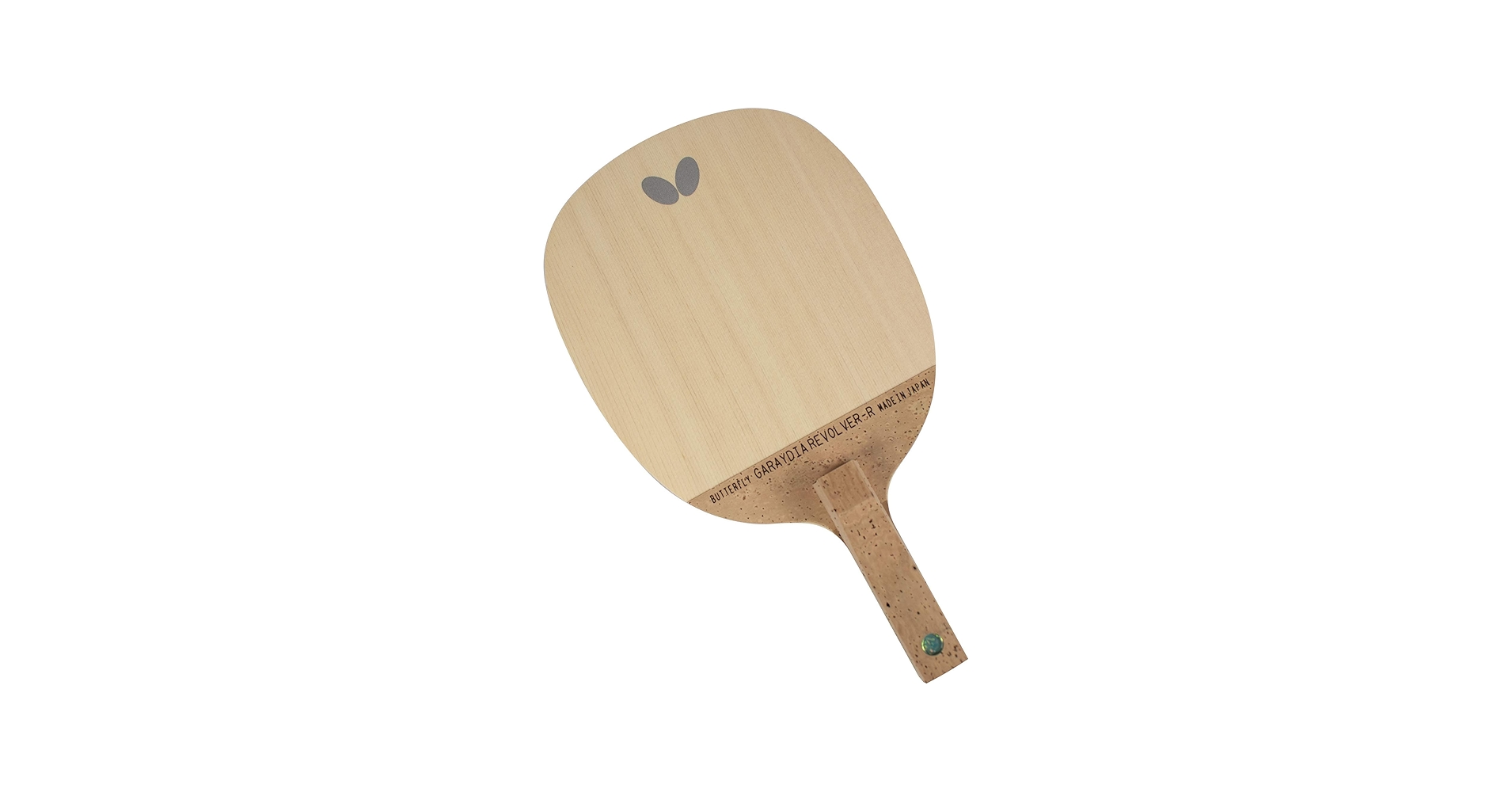
If you prefer a cork grip for a more secure hold, a Reversed Penhold racket is also a good option for playing Reverse Penhold Backhand (RPB).
Although the selection is limited, most Reversed Penhold rackets are lightweight. The model below is my personal recommendation for players looking for a powerful and easy-to-use RPB racket.

6. Final Thoughts
After testing many different penhold rackets with rubber on both sides, I have found that a round Chinese Penhold is the best choice for players who want to focus on Reverse Penhold Backhand (RPB).
Félix Lebrun has shown that Reverse Penhold Backhand (RPB) with a Chinese Penhold racket can be just as effective as the backhand of shakehand players at the highest level of the sport.
Of course, this recommendation may not be the best choice for everyone. Every player has a different grip, playing style, and preference.
Félix Lebrun and Taisei Matsushita are both exciting penhold players who demonstrate the great potential of modern RPB.
If you’d like to learn more about Félix Lebrun, be sure to check out the related article below.
I hope this guide helps you choose the right penhold racket for your playing style.
Related Articles
Why Félix Lebrun Is One of the World’s Most Exciting Penhold Players

How to Choose a Chinese Penhold Blade
-320x180.jpg)
What Is the Ideal Weight for a Chinese Penhold Racket?



コメント