1. Introduction
Have you heard of Yuna Oshio?
Oshio is a young rising star who is a member of the JOC Elite Academy and also competes in the T.League.
In 2026, she helped Japan win the U19 Women’s Team event at the Asian Youth Table Tennis Championships. In the final against China, Oshio herself won her match 3–1.
This victory was a remarkable achievement, as it marked the first-ever gold medal for Japan in the U19 Women’s Team event.
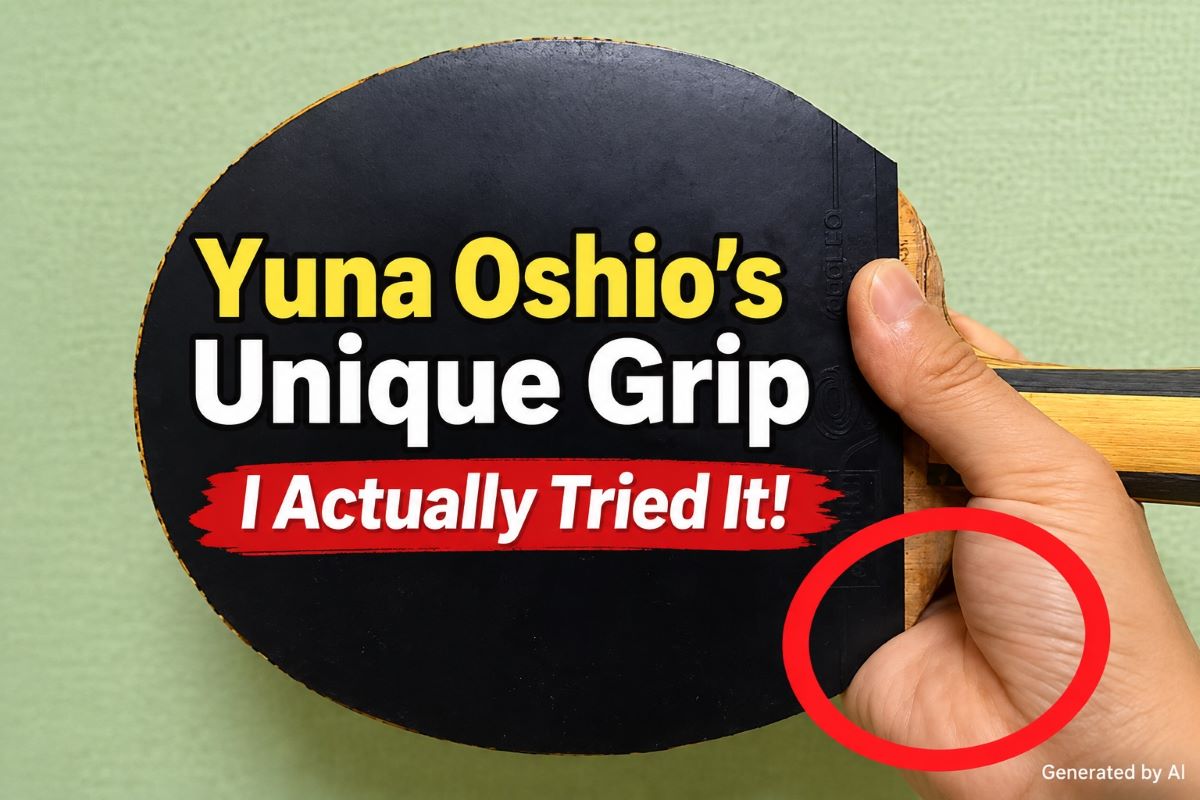
Oshio has attracted attention not only for her achievements, but also for her unique racket grip and distinctive playing style.
It is not unusual to see recreational players with unconventional grips. However, it is extremely rare to see a player competing at the world-class level using such a unique grip in actual competition.
2. About Yuna Oshio
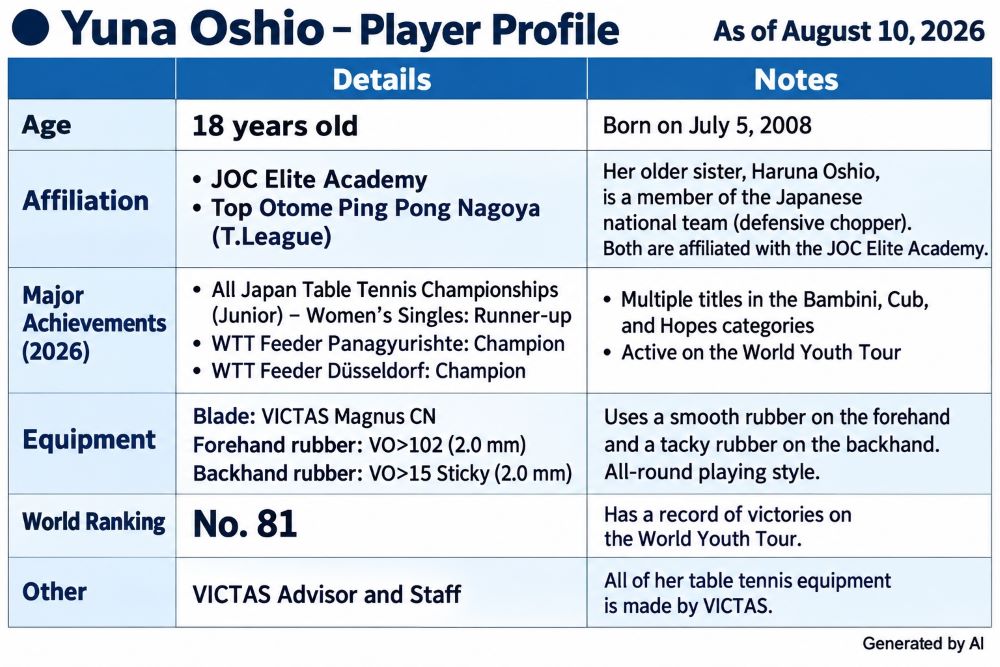
As of 2026, Yuna Oshio is a member of the JOC Elite Academy and also plays for Top Otome Ping Pong Nagoya in the T.League.
Oshio has already achieved notable results on the international stage, including victories on the World Youth Tour as well as at international events in her age category.
At the same time, she has not yet had many opportunities to compete in senior international events, so her current world ranking is not yet as high as those of the world’s top players.
However, this is also one reason why her ability should not be judged by her world ranking alone.
As she gains more opportunities to compete in senior international events, I believe she is a player with plenty of potential to rise significantly in the world rankings and compete at the highest level of international table tennis.
What I find particularly interesting is that she has achieved these results while using such a unique grip and playing style.
Here is an overview of Yuna Oshio’s major achievements and profile.
What do you think?
Yuna Oshio has achieved all of these results with a truly unique grip.
In the past, she might have been quickly encouraged to switch to a more conventional grip. I would like to applaud those who have supported her while allowing her unique style to remain intact.
With that in mind, I would like to take a closer look at Yuna Oshio’s grip and related techniques, while also sharing my own observations from trying it myself.
For the purposes of this blog, I will refer to Yuna Oshio’s grip as the “Oshio Grip.”
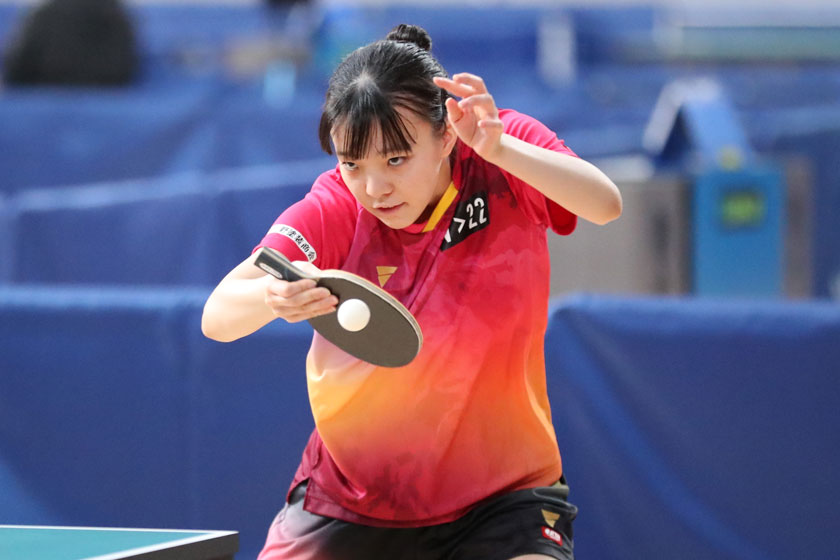
Yuna Oshio is also featured in detail on the VICTAS website below. *The page is in Japanese, so please use a translation tool if necessary.
3. Features of the “Oshio Grip”
Personally, I consider the “Oshio Grip” to be somewhere between a penhold grip and a shakehand grip.
The reason is that part of the racket is supported by the palm.
As I will explain later, because part of the racket is supported by the palm, the racket feels considerably lighter than with a traditional penhold grip, and switching between forehand and backhand is also very smooth.
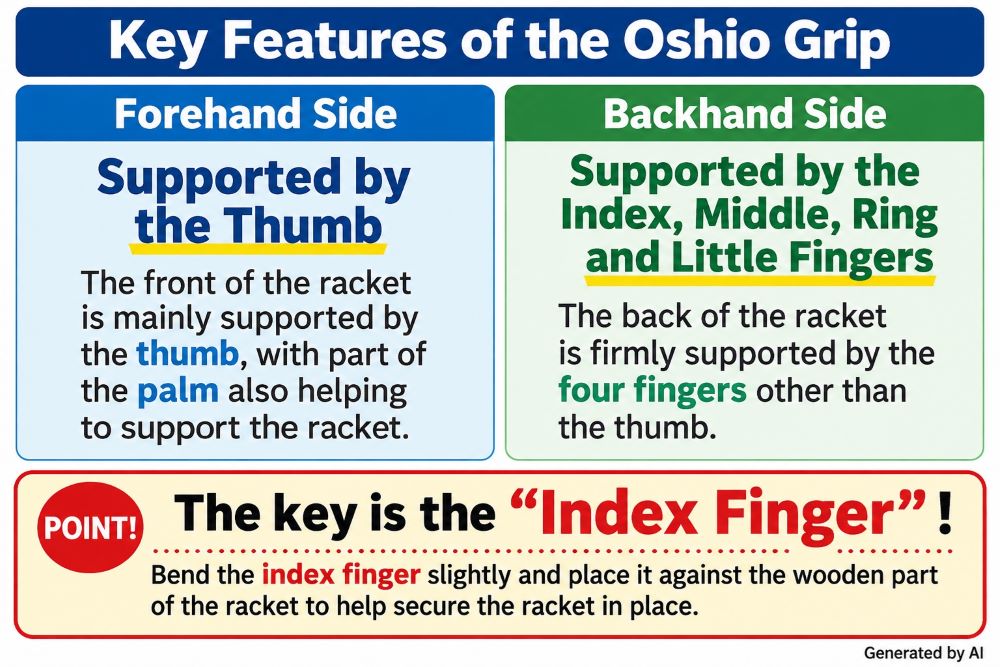
Let me explain how this grip works with the help of the images below.
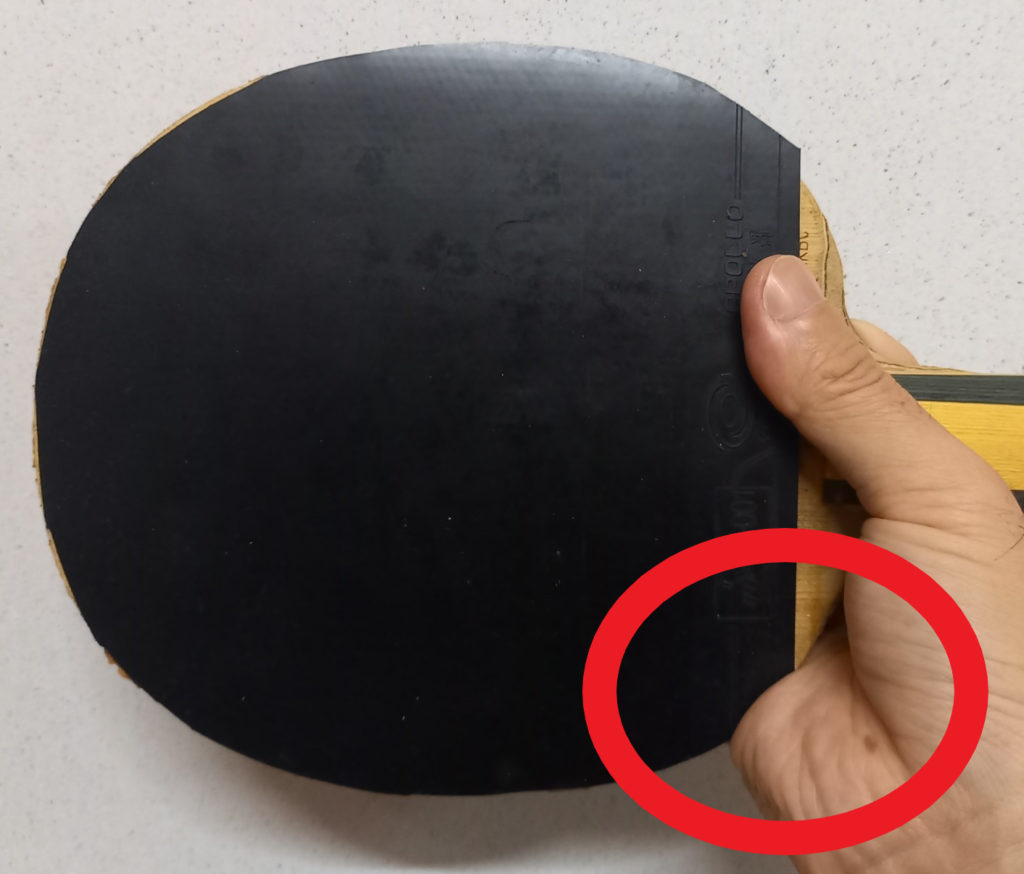
On the front side of the racket, the thumb provides support, while part of the palm also helps support the racket. *The red circle indicates this area.
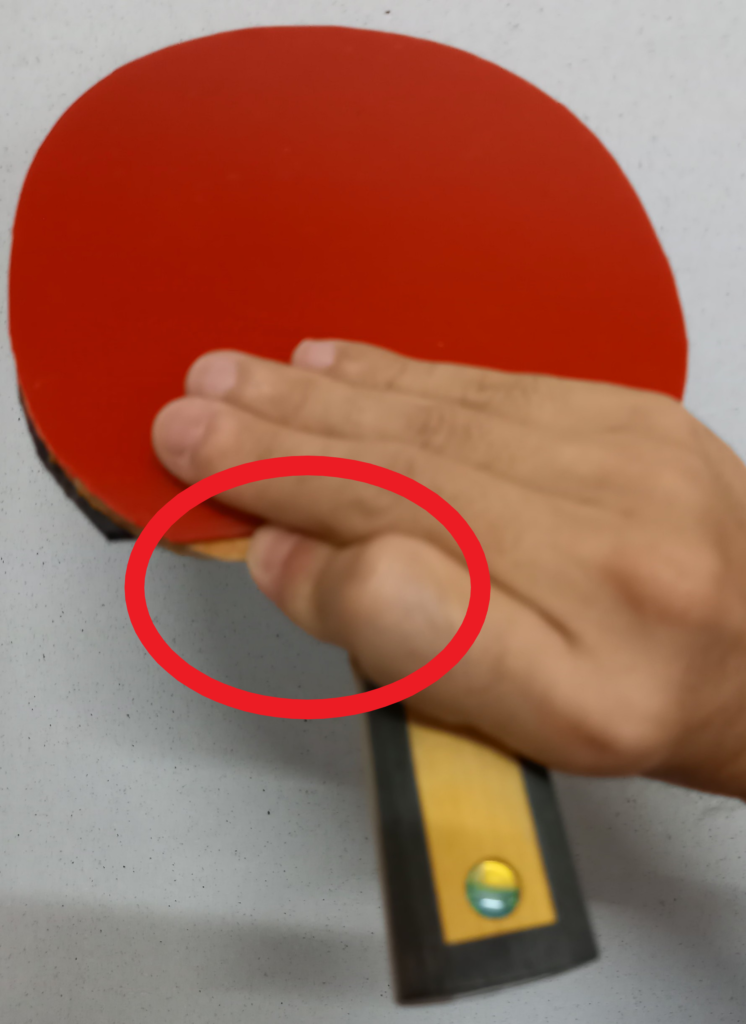
On the back side of the racket, the four fingers other than the thumb provide support.
The index finger is particularly important. It is slightly bent and placed against the wooden part of the racket to hold it firmly in place. *The red circle indicates this area.
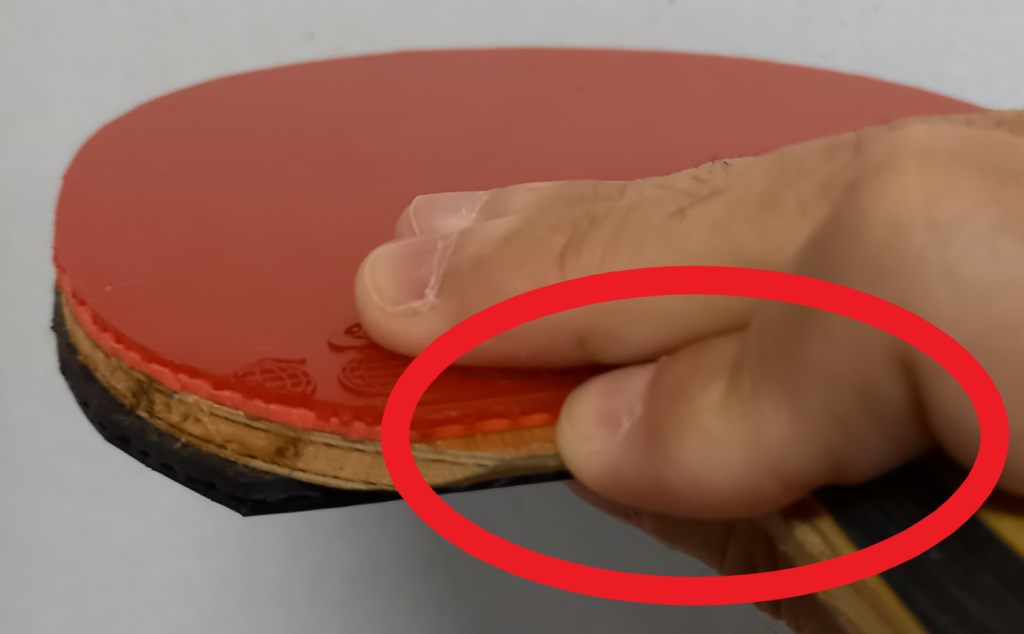
Next, let’s take a closer look at the advantages and disadvantages of the “Oshio Grip.”
4. Advantages of the “Oshio Grip”
For this article, I deliberately prepared a racket with a heavier setup and actually tested it using the “Oshio Grip.”
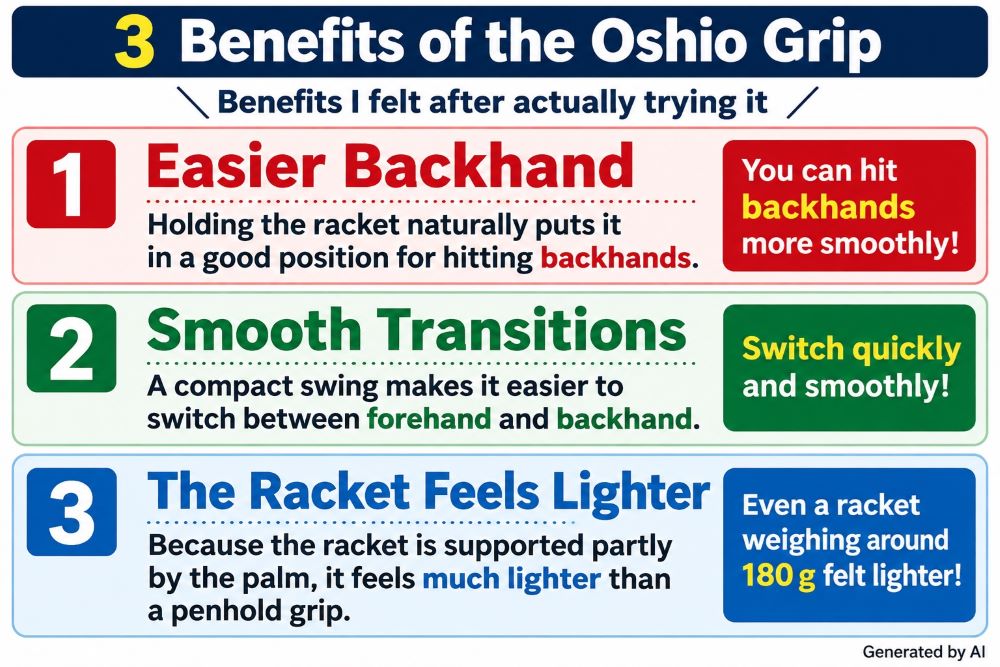
Based on my experience playing with it, I found three main advantages of the “Oshio Grip.”
1. Easier Backhand
Strictly speaking, it is not a conventional penhold grip, so it may not be accurate to call this a “reverse penhold backhand.” However, the racket is naturally held at an angle that is already well suited for hitting a backhand, making the stroke very smooth.
2. Smooth Transitions
When swinging with the “Oshio Grip,” the stroke becomes very compact. As a result, it is very easy to switch between forehand and backhand, making this a grip well suited to fast-paced play.
3. The Racket Feels Lighter
As explained in the previous section, part of the racket is also supported by the palm. Therefore, compared with a penhold grip, which relies mainly on the fingers to support the racket, the racket feels considerably lighter.
The racket I used for the grip demonstration weighed around 180 g, which is quite heavy for a penhold racket. However, it actually felt surprisingly light when I played with it.
Therefore, for players who use rubbers on both sides of a penhold racket and struggle with a racket that feels too heavy, this grip may be worth considering.
5. Drawbacks of the “Oshio Grip”
Next, let me explain the drawbacks I experienced while using it.
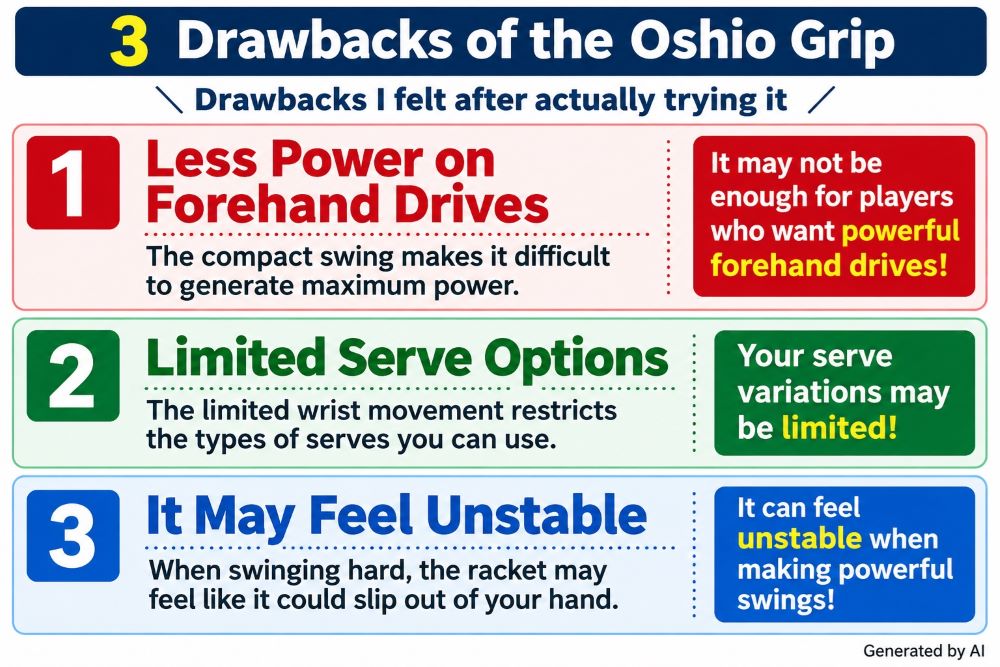
1. Less Power on Forehand Drives
Because the “Oshio Grip” produces a compact swing, it generates less centrifugal force during the swing. Therefore, players who are used to generating powerful shots with a penhold grip may find it less satisfying.
Yuna Oshio uses short pips on her forehand. When she attacks strongly with her forehand, she appears to rely mainly on smash-type shots, hitting the ball flat rather than using a powerful topspin drive.
2. Limited Serve Options
Because the “Oshio Grip” limits wrist movement during serves, I found serves that require a quick wrist snap, such as the YG serve, difficult to execute.
As a result, players may need to make adjustments, such as changing their grip specifically when serving.
Yuna Oshio, on the other hand, appears to mainly use reverse pendulum serves that do not require as much wrist snap.
3. It May Feel Unstable
Because the front side of the racket is supported mainly by the thumb, I felt some concern that the racket might slip out of my hand when making a powerful swing.
*This may simply be a matter of getting used to the grip.
6. Can You Actually Play with the “Oshio Grip”?
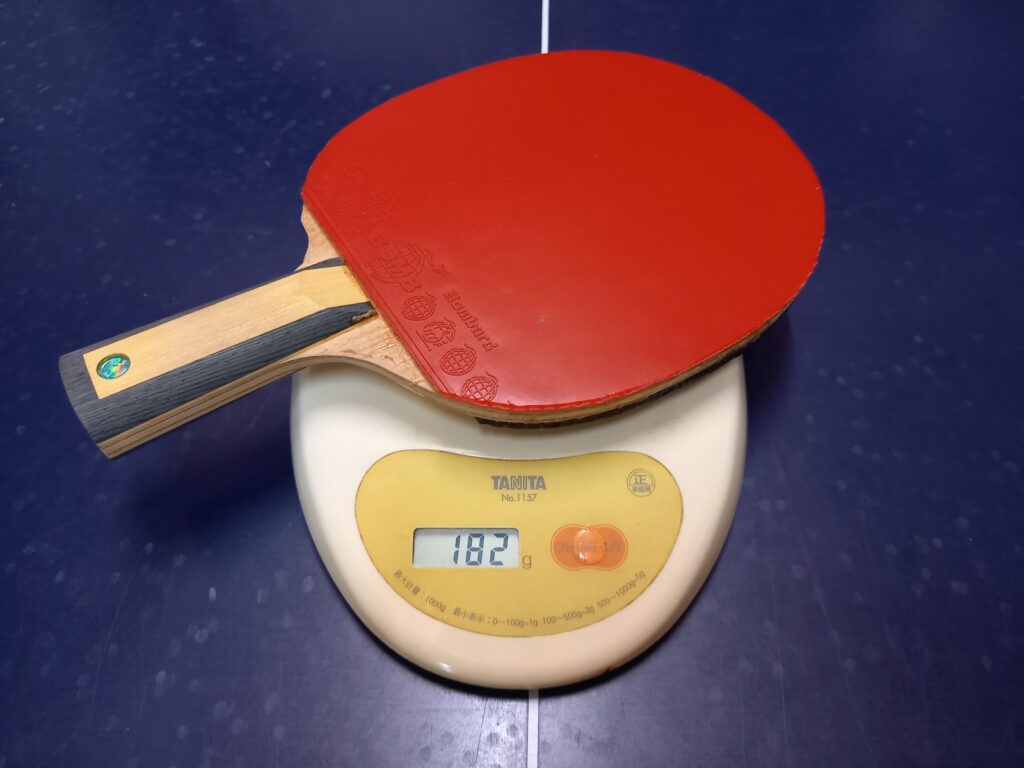
For this article, I deliberately used a heavy 182 g Chinese penhold racket and actually tried playing with the “Oshio Grip.”
In conclusion, I found it difficult to make a smooth transition from a conventional penhold grip to the “Oshio Grip.”
- The compact swing changes the point of contact with the ball
- Because wrist movement is more restricted, the feel of the forehand drive is different
As a penhold player, I found the grip extremely unfamiliar. To give you an idea of how difficult it felt, I found it so challenging that I thought switching to a shakehand grip would actually be easier.
On the other hand, I personally feel that if you started with the “Oshio Grip” from the beginning, as a beginner, you might be able to get used to it without feeling much discomfort.
7. Conclusion
What did you think?
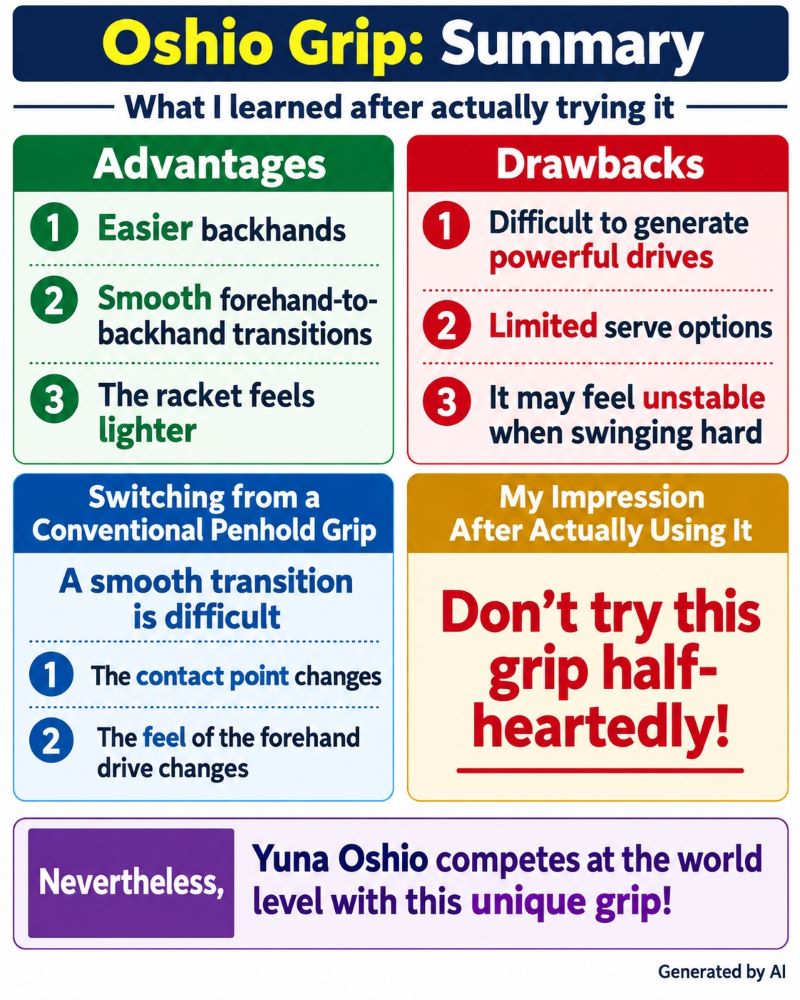
I actually tried the “Oshio Grip” for this article, and I found it quite difficult to make a smooth transition from a conventional penhold grip.
In particular, because the point of contact and the feel of the forehand drive are significantly different, my honest impression is that this grip is not something you should try half-heartedly!
On the other hand, I was also able to experience the unique advantages of the “Oshio Grip”, including easier backhands, smooth transitions between forehand and backhand, and the feeling that the racket is lighter.
That is precisely why I am once again impressed by Yuna Oshio’s ability to master this unique grip and compete on the world stage.
Oshio is a unique player not only in terms of her grip, but also in her playing style. As she gets more opportunities to compete in senior international events, I am very excited to see how she performs on the biggest stages of international table tennis.
I will personally continue to support Yuna Oshio and look forward to her future success.
That’s all for this article. I hope you found it helpful.
Related Articles
Felix Lebrun (France): Grip and Playing Style

Qiu Dang (Germany): Grip and Playing Style

コメント