1. Introduction
Have you ever adjusted the balance point of your table tennis racket?
A racket is not simply about being “heavy” or “light.” How a racket feels to play can also change depending on where its balance point is located.
In this article, I will explore how to adjust the balance point of penhold rackets, with a focus on Chinese penhold rackets.
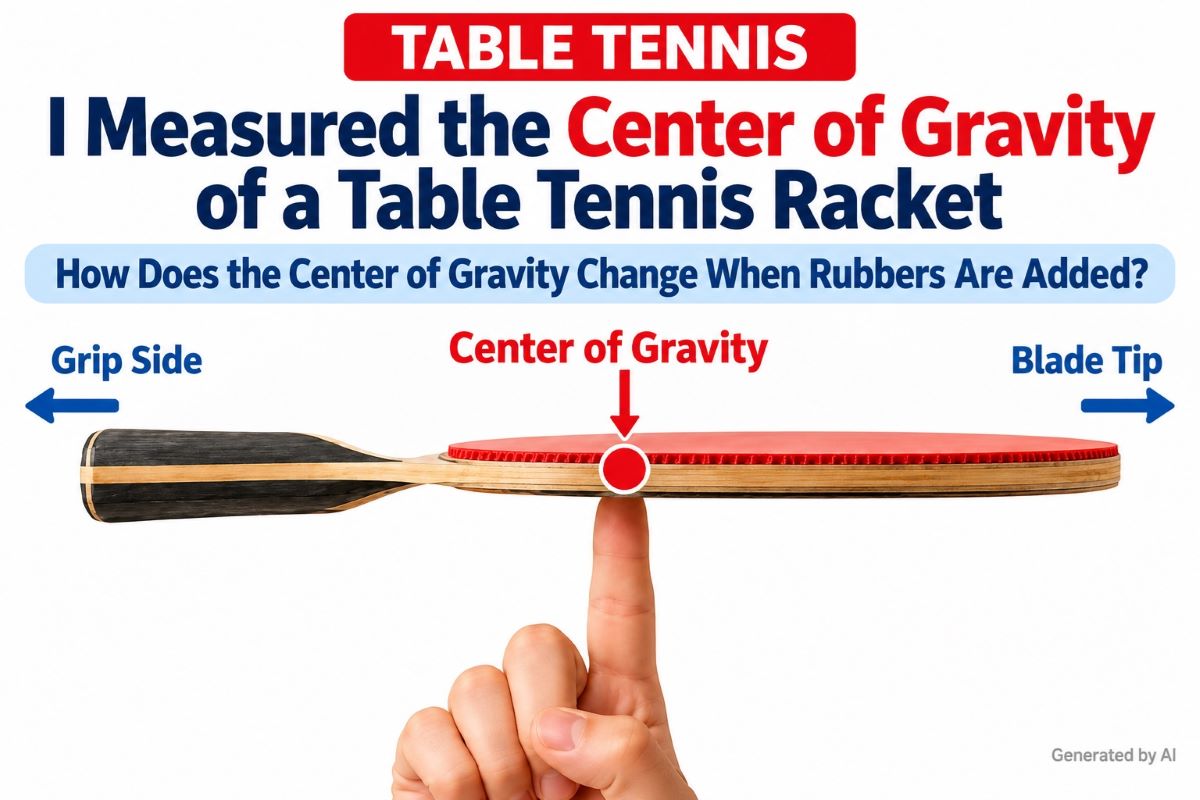
I have also tested how the balance point changes when rubbers are attached to a racket. You can read about the experiment in the article below.
2. Why Adjust the Racket Balance Point?
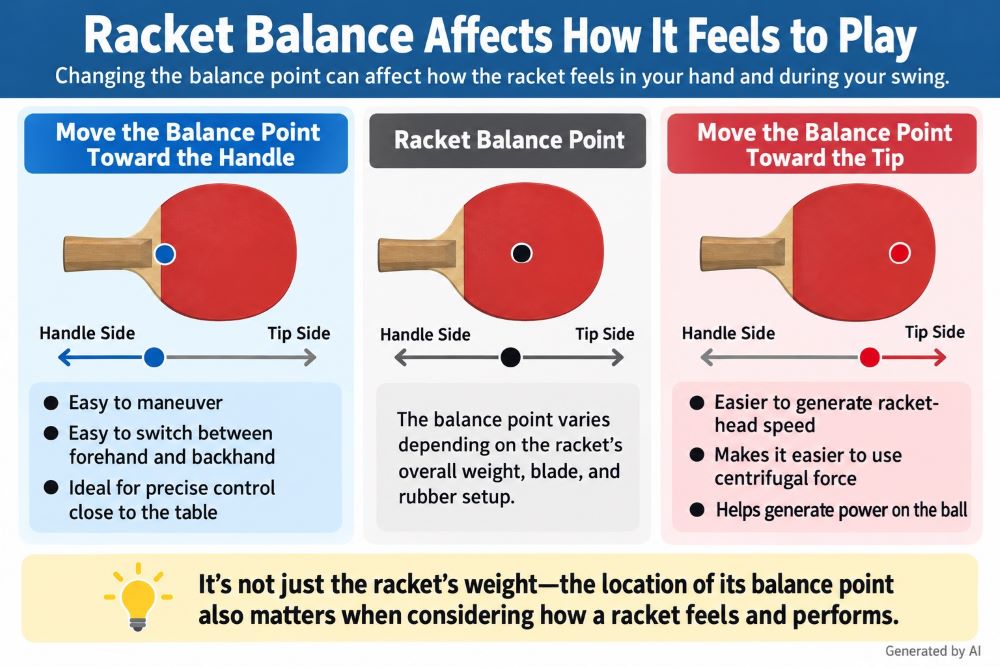
By adjusting the racket’s balance point, you can change how the racket feels to match your playing style.
In general, moving the balance point toward the tip tends to make the racket head more effective during the swing, while moving it toward the handle tends to make the racket easier to maneuver.
You can also adjust the balance from side to side to change the stability and feel of the racket when preparing for a shot.
3. How to Adjust the Racket Balance Point
There are several ways to adjust a racket’s balance point.

1. Add Weight to the Racket
Adding weight to the side of a table tennis racket is one way to adjust its weight and balance.
By adding a small amount of weight to the racket, you can adjust both the racket’s balance point and overall weight.


The product above is a self-adhesive lead tape designed for pickleball paddles. It is not a table tennis-specific product, but it can be used as an alternative for adjusting the weight and balance of a table tennis racket.
In my case, I attach a Side Balancer to the side of the racket to fine-tune the balance and improve maneuverability.
Because this product is a tape rather than a dedicated table tennis accessory, you can cut it to the length you need and adjust the amount of added weight.
Note: This is an alternative product, not an official table tennis accessory. If you use a modified racket in an official competition, the racket must comply with the applicable competition rules and pass any required racket inspection.
2. Adjust the Rubber Placement
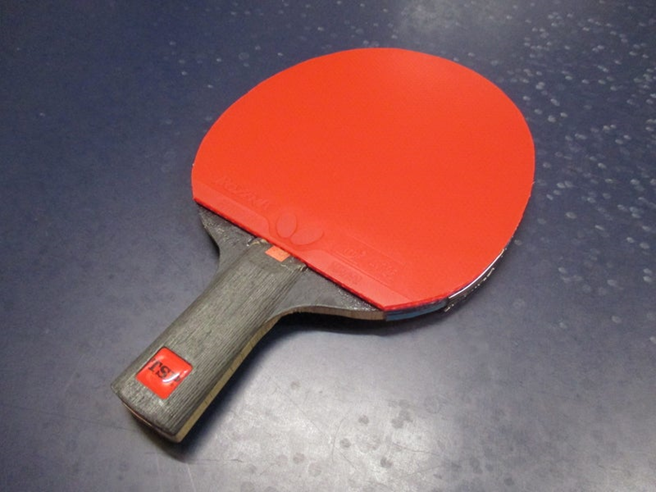
You can also adjust the racket’s balance point by changing the vertical position of the rubber.
For example, the balance point changes depending on whether you place the rubber farther away from the handle or cover the entire blade.
In my case, I cover the entire blade with the rubber on the back side as part of my approach to adjusting the balance point.
3. Apply the Rubber at an Angle
This is a method I learned from someone I know. I was told that former Japanese national team player Harumitsu Iseki used this method to adjust his racket’s balance point.
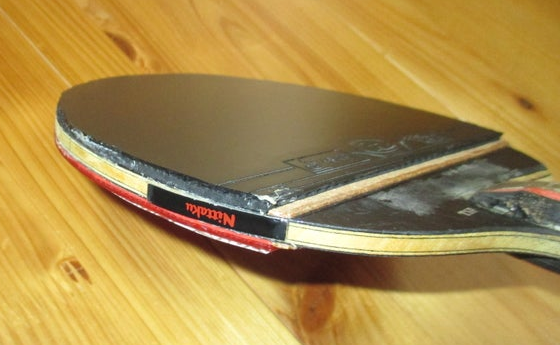
Take a look at the image below.
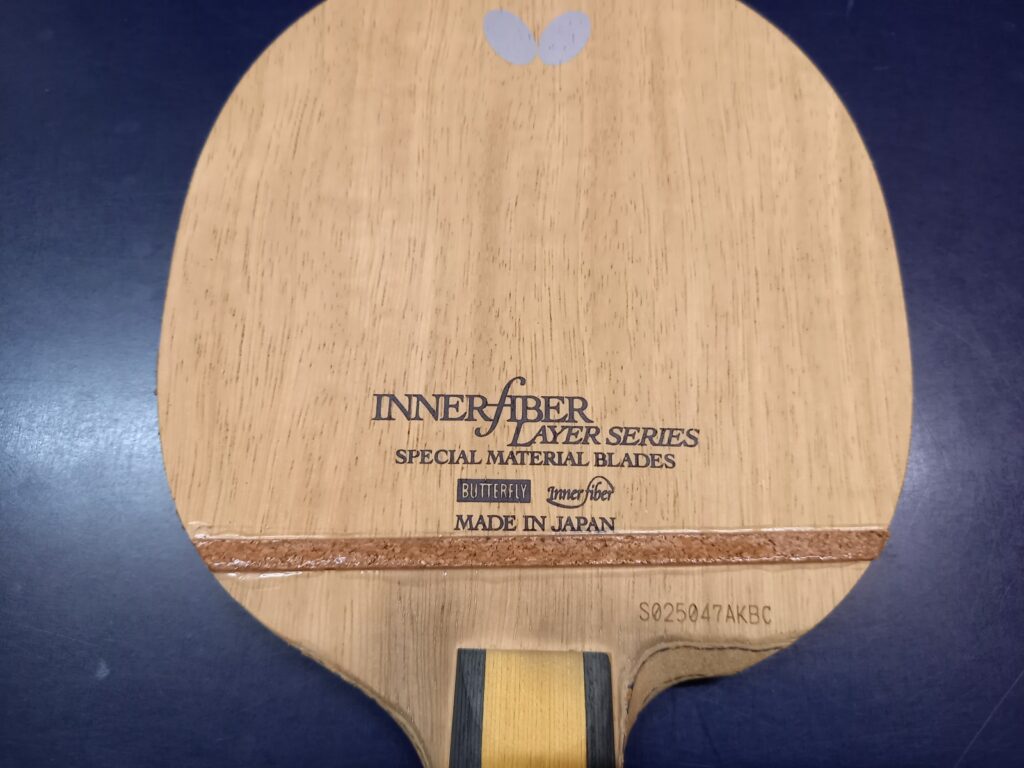
I attach a piece of cork as a guide for positioning the rubber, because I place the rubber on the front side farther away from the handle.
As you can see in the image, the cork is slightly angled.
This is not a mistake. By intentionally applying the rubber at an angle, I adjust the racket so that its balance point shifts toward the left side.
For a right-handed player, the left side of the racket tends to be lower when preparing for a shot. By shifting the balance point toward the left, I adjust the racket’s stability when preparing to hit the ball.
Column: The Side Balancer Was Less Effective Than Expected
I sometimes use a Side Balancer to adjust the overall weight of my racket.
So, I decided to test how much the balance point would actually shift by attaching weight near the tip of the racket.
The measurement method and equipment are explained in detail in the article below.
-1024x431.jpg)
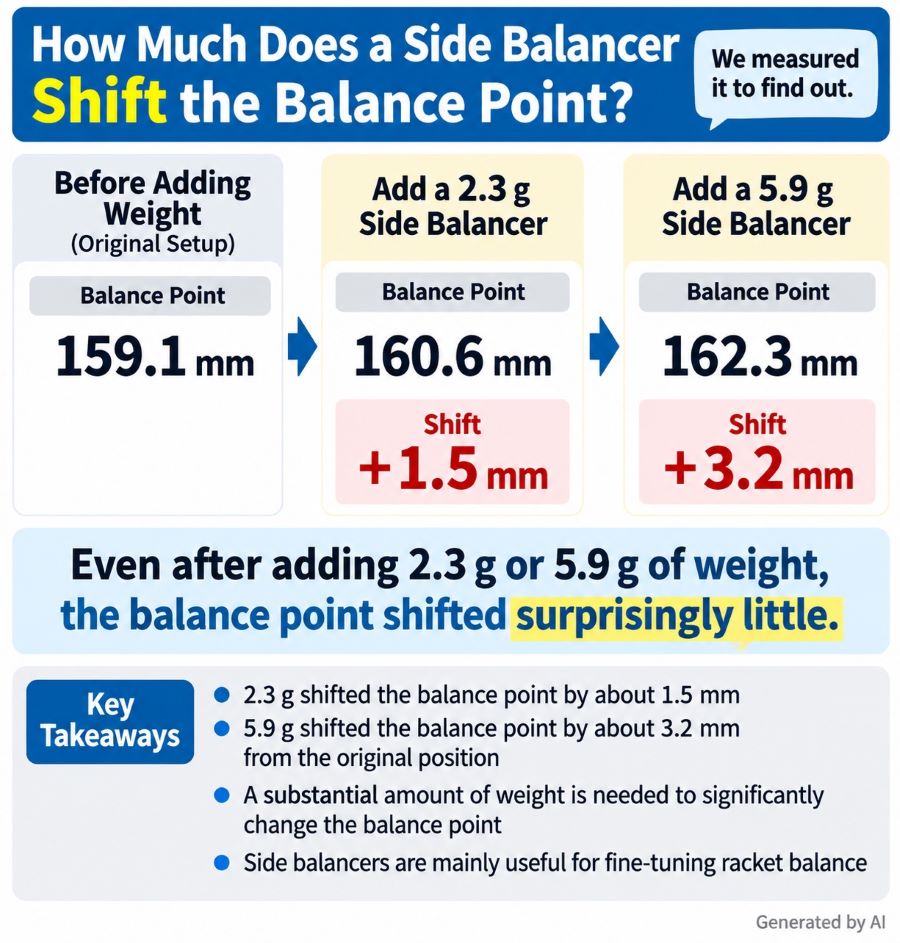
I expected the added weight to adjust the balance point as well. However, when I actually measured it, the balance point shifted much less than I expected.
Adding 2.3 g shifted the balance point by only 1.5 mm. Even with a total of 5.9 g of Side Balancers, the shift was just 3.2 mm.
The results may vary depending on the racket, but based on this test, a considerable amount of weight is needed to make a significant change to the balance point.
For now, I plan to continue using Side Balancers mainly to adjust the overall weight of my racket.
4. Conclusion
With a Chinese penhold racket, you can do more than simply attach rubber. There are many ways to customize the racket to suit your playing style.
When I heard about Harumitsu Iseki’s method of applying the rubber at an angle, I thought, “That makes sense!” I was impressed.
I had never thought of using such a method myself. It was one of those ideas that seems obvious once you hear it, but that you would never have thought of on your own.
Table tennis equipment has so much depth, and that is part of what makes the sport so enjoyable. Chinese penhold rackets are especially versatile, which makes them even more fun to experiment with!
I plan to continue trying different ideas that might help improve the quality of my play.
I hope you found this article helpful.
Related Articles
Measuring the Balance Point of a Racket: How Does It Change When Rubber Is Attached?
Chinese Penhold: Where Should You Place the Rubber? A Detailed Comparison of Three Patterns

Chinese Penhold: Where Should You Place the Rubber? Part 2 — How Far Should the Forehand Rubber Extend?


コメント