【新プロジェクト始動!】 50代からの再挑戦を綴る雑記ブログを開設 | Kindle本「裏面打法による逆襲」好評発売中!

Table Tennis Basics: Choosing Your Rubber Thickness

※This site contains affiliate links. Please note that some visuals are created with the help of AI.

【Basics & Beginner Guides】
About the Author

・Table Tennis Experience: 40+ years (Insights from a veteran's perspective)
・Playstyle: Chinese Penhold / Attacker (Exploring Reverse Penhold Backhand)
・Owner: Administrator of "Table Tennis Lab," with a Master’s degree in Physical Chemistry.
・Mission: Articulating the unique characteristics of equipment and technical tips through an original lens, sharing information to deepen the enjoyment of the sport.

1.Introduction

The “thickness” of table tennis rubber is an extremely crucial factor that determines both the racket’s bounce and its overall weight.

Even within the same model, a change in thickness can transform the rubber into what feels like a “completely different piece of equipment.” Being able to select the optimal thickness based on your skill level and the specific techniques you wish to master is a clear sign of progress.

Furthermore, by understanding the characteristics of your gear and gaining the knowledge to find the perfect match for yourself, you can enjoy the sport of table tennis with greater depth and excitement.

In this article, I will summarize the fundamentals of thickness and the key points for selection to ensure you can choose your equipment without making mistakes.

2.The Limit of Rubber Thickness

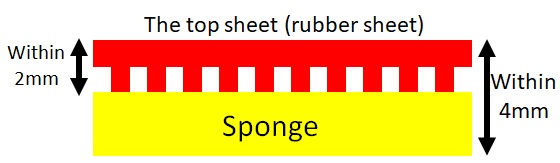
Table tennis rubber has a two-layer structure consisting of the “top sheet (rubber surface)” and the “sponge.” There are strict, internationally established rules regarding the thickness of the rubber.

  • Top Sheet: Must be within 2.0mm as a standalone component.
  • Total Thickness: The combined thickness of both layers must be within 4.0mm.

Note: Rubbers consisting only of a top sheet are also permitted and are referred to as “Single Rubber” or “OX (O-X).” Their main characteristic is the ability to minimize bounce to the absolute limit.

Because of these strict limitations, it is impossible to increase the rubber’s thickness indefinitely to enhance bounce. This is precisely why manufacturers engage in fierce daily research and development, striving to maximize the performance players demand within the constraints of the established rules.

💡[Column] Evolving Rubber: Manufacturers Challenging the 4mm Limit

For instance, the “Rasanter” series by andro, which debuted in 2017, sent shockwaves through the table tennis world by designing a thinner top sheet to accommodate a 2.3mm sponge (ULTRAMAX) that pushed the rules to their absolute limit.

Nearly a decade later, this design philosophy has become a major option for high-end rubbers. Today, products following this concept have been released by several major brands, evolving into a common technology that supports top-level play.

Butterfly, a manufacturer renowned for its thorough quality control, released “Xiah 03” in October 2025 as a symbolic product of this era. By thinning the sheet with the newly developed “Rico Sheet,” they succeeded in securing the maximum possible sponge thickness.

3.How Rubber Thickness is Displayed

The methods for displaying rubber thickness vary depending on the manufacturer. Generally, most brands indicate the “thickness of the sponge alone.”

For example, the major Japanese manufacturer “Nittaku” uses the following designations:

Sponge Thickness Lineup

  • MAX: 2.1mm – MAX
  • Super Thick (Tokuatsu): 1.9mm – 2.1mm
  • Thick (Atsu): 1.7mm – 1.9mm
  • Medium Thick (Chu-atsu): 1.5mm – 1.7mm
  • Medium (Chu): 1.4mm – 1.7mm
  • Thin (Usu): 1.2mm – 1.4mm
  • Super Thin (Goku-usu): 0.9mm – 1.2mm
  • Ultra Thin (Cho-goku-usu): 0.4mm – 0.7mm
Quoted from the 2026 Nittaku Comprehensive Product Digital Catalog.

The reason sponge thickness is used as the standard is that, within the same product line, the top sheet thickness is typically identical across all versions. By comparing only the thickness of the sponge, it becomes simple to judge how much bounce that specific rubber will provide.

However, as mentioned in the previous column, caution is required today because some modern products utilize a “thinner top sheet to accommodate a thicker-than-usual sponge.”

Representative examples of such products are as follows:

  • Butterfly: Xiah 03 A new flagship model from Butterfly that brings together their latest technologies. It is designed to directly transmit the energy of the thick sponge through a thin top sheet.
  • STIGA: DNA Platinum A product where the sheet has been thinned to the limit to increase the sponge thickness to “MAX (2.3mm).” It achieves both an overwhelming “bite” and powerful resilience.
  • andro: Rasanter Series A pioneer of the current trend, they were among the first to realize thinner sheets and thicker sponges under their “ULTRAMAX” standard.

4.What Changes Based on Rubber Thickness?
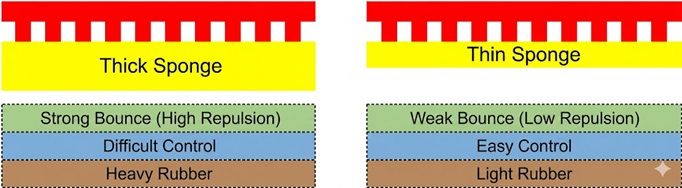
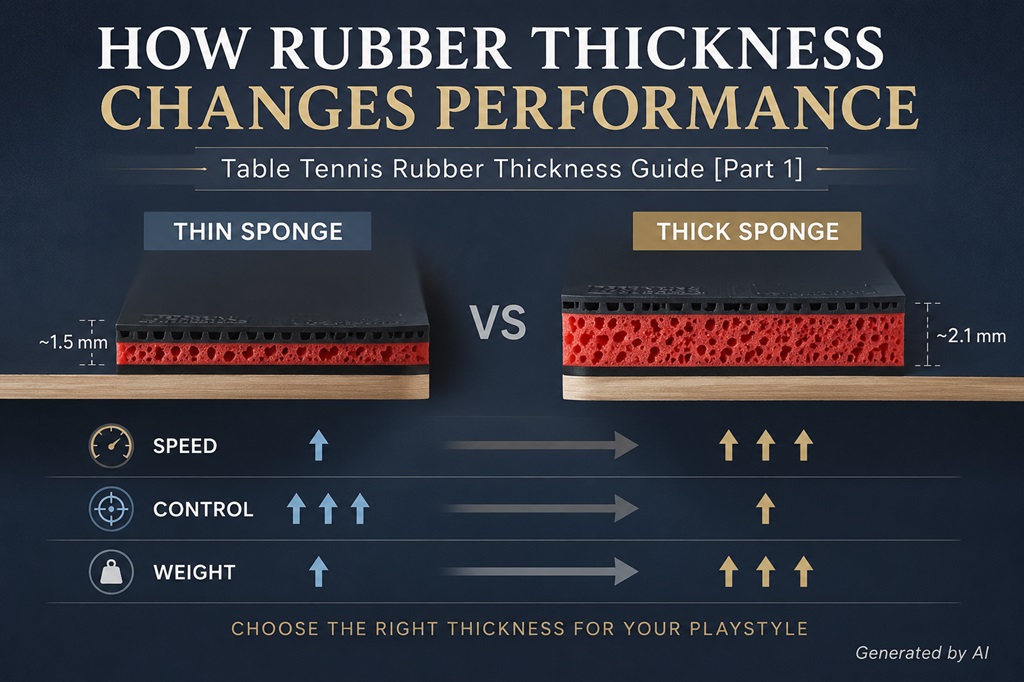
The thicker the sponge, the greater the repulsion upon impact, which makes it easier to generate speed. Additionally, as the sponge becomes thicker, the weight of the rubber increases accordingly.

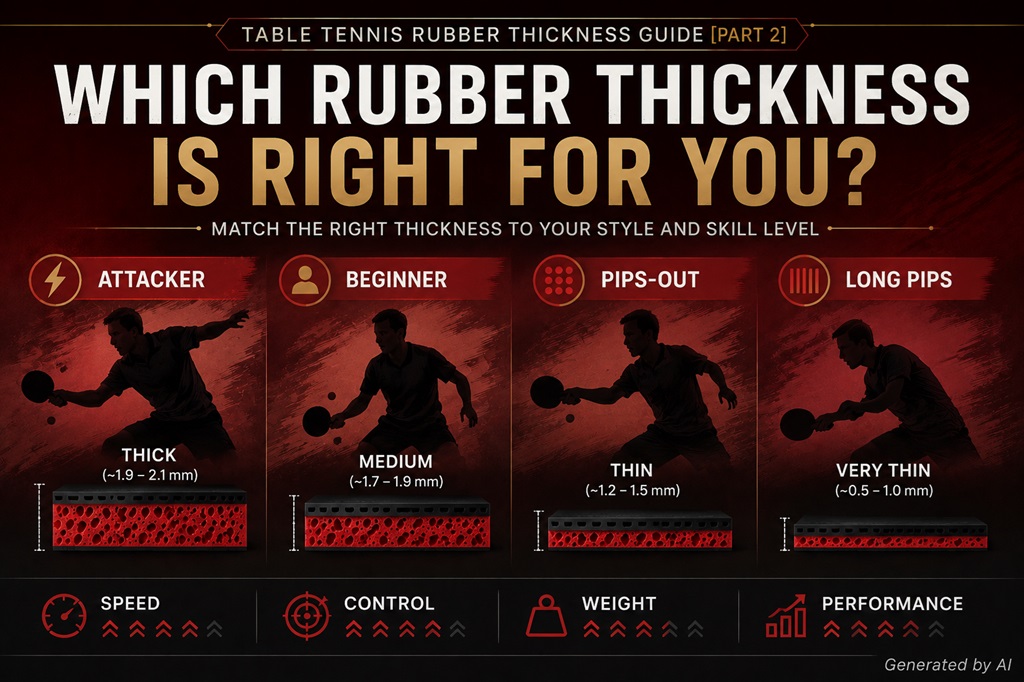
Generally, beginners are often recommended “Thick (Atsu)” or “Medium (Chu)” because these options provide better control and are easier to handle.

By changing the thickness of the rubber, you alter the balance of three key elements that directly affect play: speed (repulsion), rubber weight, and control.

(1)Speed (Repulsion)

The thicker the sponge, the greater the repulsion upon impact, which makes it easier to generate speed. This is because a thicker sponge allows the ball to “sink in” more deeply, enabling the sponge’s restorative force to be converted into energy. Conversely, a thinner sponge results in a stronger sensation of the ball hitting the racket’s wooden blade, which suppresses the overall bounce.

(2)Rubber Weight

The sponge is the component that has the greatest impact on the rubber’s weight. Therefore, the thicker the sponge, the heavier the overall rubber becomes. While a heavier racket allows you to hit more powerful balls, it has the drawback of requiring more physical strength for a full swing and reducing maneuverability, such as when switching between forehand and backhand.

(3)Control Performance and Ease of Use

Generally, “Thick (Atsu)” or “Medium (Chu)” is recommended for beginners. The primary reason for this is that your own power level is more easily transmitted to the ball, making it easier to control.

If the sponge is too thick, the ball may fly too far with even a slight impact, which often leads to overshooting (over-misses) while you are still a beginner. Developing the sensation of manipulating the ball yourself with “Medium” or “Thick” rubber is considered the shortest path to improvement.

5.How to Choose Rubber Based on Thickness

(1)Inverted Rubber

Those suited for “Extra Thick (Tokua)” or “Thick (Atsu)” (Mainly competitive male players and power hitters)

Players with a fast swing and strong impact can effectively deform (sink the ball into) a thick sponge. This allows them to maximize the sponge’s elasticity, achieving a balance of both speed and spin. However, it is important to note that if used without sufficient power, the ball may leave the racket before sinking in properly, often resulting in a weak “dead ball” with little rotation.

Those suited for “Thick (Atsu)” or “Medium (Chu)” (Mainly female players, juniors, and beginners)

Slightly thinner sponges tend to be preferred by female players and those with a relatively moderate impact. This is because a moderately thin sponge allows the force to reach the racket’s wooden blade more easily, even with less power, making it easier to gain a sense of “grabbing” the ball for better control. Additionally, this thickness has the advantage of reducing the overall weight of the racket, which enables smoother transitions between strokes.

(2)Pips-out Rubber

Pips-out rubber is characterized by a high frequency of “smashing” techniques where the ball is hit flat. Therefore, “Thick (Atsu)” and “Medium (Chu)” are often preferred as they allow players to effectively utilize the racket’s repulsion.

Another reason “Thick” or “Medium” options are selected is that they make it easier to produce knuckle-ball shots, which are a defining characteristic of pips-out rubber.

Unlike inverted rubber, which is primarily used for generating spin, pips-out rubber is frequently used for “hitting” through meat-shots (flat hits). Consequently, the choice of rubber thickness should be made to enhance these specific traits.

“Thick” and “Medium” as the Mainstream
To take advantage of the “fast release” that is a core strength of pips-out rubber, many players choose “Thick” or “Medium” options, which provide a moderate feel of the racket’s wooden blade. By ensuring the sponge is not too thick, the impact force is transmitted directly to the ball, making it easier to hit the linear, high-speed shots typical of pips-out play.

Ease of Producing Knuckles (Variation)
Another major weapon of pips-out rubber is the “knuckle-type shot,” which is difficult for opponents to return. By using a slightly thinner sponge (such as “Medium”), the sensation of the ball hitting the racket’s blade becomes stronger. This offers the advantage of being less affected by the opponent’s spin while making it easier to generate knuckle balls.

Weight and Ease of Swing-through
For pips-out players who are required to make quick transitions at the front of the table, reducing weight by choosing a slightly thinner rubber leads to improved swing speed.

(3)Long Pips Rubber

Long pips rubber is an equipment specialized for “defensive techniques,” such as creating variations by utilizing the opponent’s spin or stopping powerful attacks. For this reason, the criteria for selection differ slightly from other types of rubber.

Reasons for Selecting “Thin” or “Extra Thin”
Since long pips rubber is primarily used by defensive players, “Thin” or “Extra Thin” sponges, which suppress bounce for easier defense, are most commonly used. The primary role of long pips is to absorb the power of the opponent’s heavy hits, allowing for short stops or low returns. A thinner sponge makes it easier to feel the racket’s blade, enabling a more delicate ball touch.

Variation Range and Control
A thinner sponge (or no sponge at all, as with “OX” or no-sponge rubber) allows the pips to bend more easily, which generates the variations characteristic of long pips. Additionally, because it is less likely to be pushed back by the opponent’s powerful shots, the stability of blocks is improved.

When Emphasizing Attack
Recently, an increasing number of players are using long pips to initiate their own attacks. In such cases, some players choose a “Medium” sponge to add a bit of bounce and achieve a balance between offense and defense.

6.Why “Thicker is Better” is Not Always True

Since many top players choose the most elastic thicknesses, such as “Extra Thick (Tokua)” or “MAX,” average players often tend to think they should also go with “Extra Thick” for the time being.

However, there is a pitfall here.

Your Playstyle Can Change Dramatically Just by “Stepping Down One Level”

In fact, it is not at all uncommon to find cases where a player tried reducing their rubber thickness by one level and found that it became surprisingly easier to use, significantly improving the quality of their play.

By stepping down the thickness by one level (for example, from Extra Thick to Thick), several benefits can emerge. You gain improved control performance because the reduced bounce makes it more likely that the ball will stay on the table. The resulting weight reduction makes the racket lighter, which leads to better swing-through and smoother repeated attacks or transitions. Additionally, the improved shot feeling allows the sensation of the blade to be transmitted more easily, helping you develop a better touch for the ball.

Reconsider Your “Thickness” if You Are Having Trouble

If you feel like the rubber you are currently using might not suit you, please wait a moment before immediately switching to a completely different type of rubber.

Instead of changing the rubber type, simply changing the thickness of the same rubber often proves to be the shortest route to a solution. Finding the thickness that matches your current skill level and physical strength might seem like a detour, but it is actually the most direct path to improvement.

7.Summary

In this article, we have explained the basic knowledge and key points for choosing rubber thickness.

Even with the same type of rubber, simply changing the thickness can alter the “shot feeling,” “control performance,” and “total racket weight” more than you might expect. It is no exaggeration to say that once the thickness changes, it becomes a “different piece of equipment” altogether.

Exploring the optimal thickness to match your goals—whether you want to generate more speed or achieve greater stability—is one of the essential elements for becoming a stronger table tennis player.

In addition to thickness, “hardness (sponge hardness)” is another extremely important factor in choosing rubber. In the following article, we explain the differences based on hardness in detail, so please be sure to take a look at that as well.

We hope this article serves as a helpful reference for your equipment selection.

コメント

PVランキングも参加しています!

PVアクセスランキング にほんブログ村

Copied title and URL