1. Introduction
Many penhold players have experienced the problem of their fingers slipping when they swing the racket.
Since switching to the Chinese penhold style, I have struggled with my middle, ring, and little fingers slipping while supporting the back of the racket. The problem becomes more noticeable during intense matches, when sweating can make it harder to maintain a stable grip.
For many years, I used a sandpaper treatment similar to the one used by Chinese table tennis legend Wang Hao. I still find this method effective.
However, after adopting a grip technique that keeps the fingers on the back of the racket more extended, I began to experience more slipping. This led me to try athletic finger tape as a new way to improve my grip.
In this article, I compare the sandpaper treatment I have used for many years with finger tape, based on my own experience.
2. My Recommended Anti-Slip Solution
My current favorite solution is simple: wrapping finger tape around the fingers. It is inexpensive and easy to find online.
When playing the reverse penhold backhand, I used to have trouble with my ring and little fingers slipping. Since I started using finger tape, slipping has become rare, allowing me to swing with much more confidence.
(1) How to Wrap the Tape
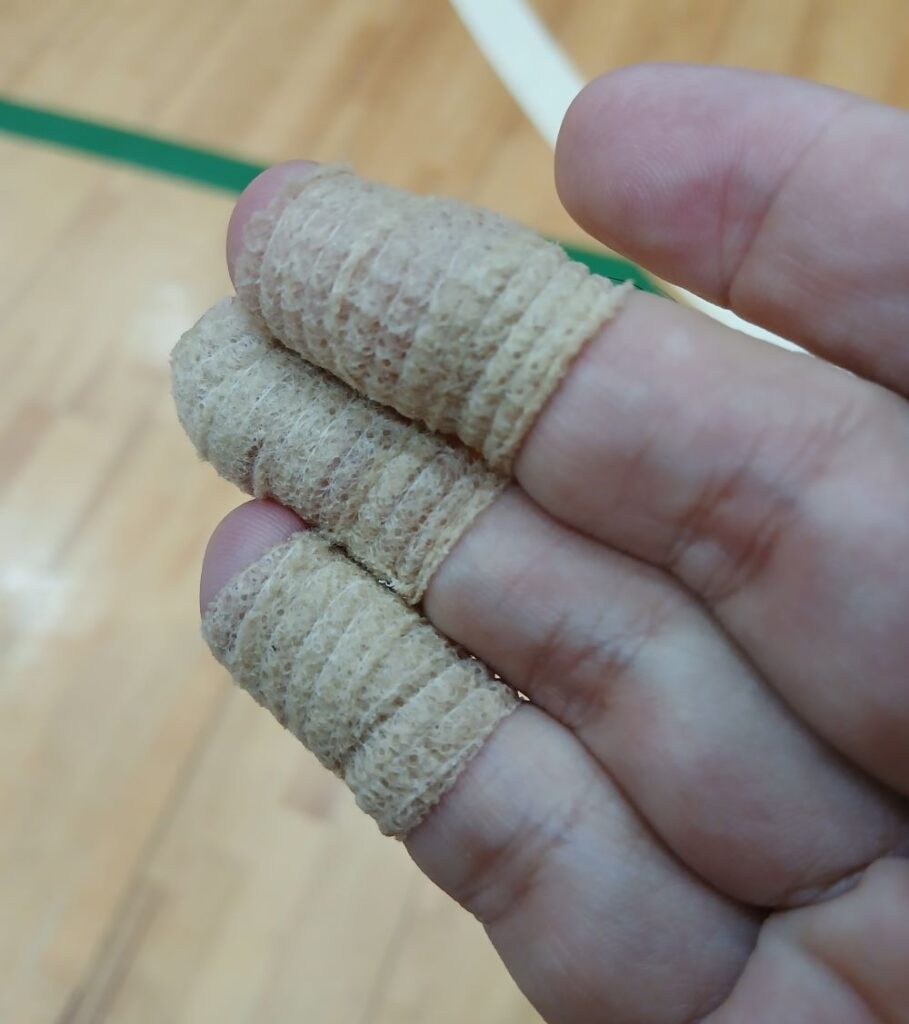
I wrap the tape around the first joints of my middle, ring, and little fingers. The key is to use at least 15 cm (6 inches) of tape per finger. Even wrapping tape around the ring finger alone can provide some grip improvement.
This type of tape sticks to itself, so it stays securely in place without adhesive. It can also be torn by hand, making it easy to use without scissors or other tools.
-1024x736.jpg)
(2) What I Learned from Using the Tape
Of the three fingers, the middle finger provides the most support and acts as a pivot point on the back of the racket, so it tends to slip less.
With the grip technique I currently use, however, I get a better feel when I consciously use my ring finger during the swing. Keeping the ring finger from slipping therefore made my strokes feel more stable.
At first, I used a shorter piece of tape to save tape. However, the tape came off around the third match during actual play.
I then switched to using at least 15 cm (6 inches) of tape per finger and covering the first joint. The larger contact area greatly reduced the chance of the tape coming off during play.
I tested this setup in 7 practice matches (15 sets in total), and the tape never came off. I was able to play comfortably throughout all the matches.
One thing to keep in mind is that sweat can gradually loosen the tape. Before an important match, I recommend wiping the sweat off your fingers and reapplying the tape.
(3) Benefits of Using Finger Tape
- Reduces slipping of the ring and little fingers during the reverse penhold backhand
- Provides a secure grip for the middle finger, which acts as a pivot point, improving racket control
- Works well with the grip technique I currently use
- No need to modify the racket or rubber
- Inexpensive and easy to try
- Self-adherent tape can be secured simply by wrapping it around the finger
- Can be used even if you change to a different racket
Important: Do Not Wrap the Tape Too Tightly
Wrapping the tape too tightly may restrict blood flow and cause discomfort. For a good anti-slip effect, wrap it firmly enough to stay in place, but not so tightly that it feels uncomfortable.
The results may vary depending on your grip technique and hand size. However, this is currently the anti-slip solution I am most satisfied with. In particular, keeping my middle finger, as well as my ring and little fingers, securely in place has made my reverse penhold backhand feel more stable.
3. The Finger Tape I Used
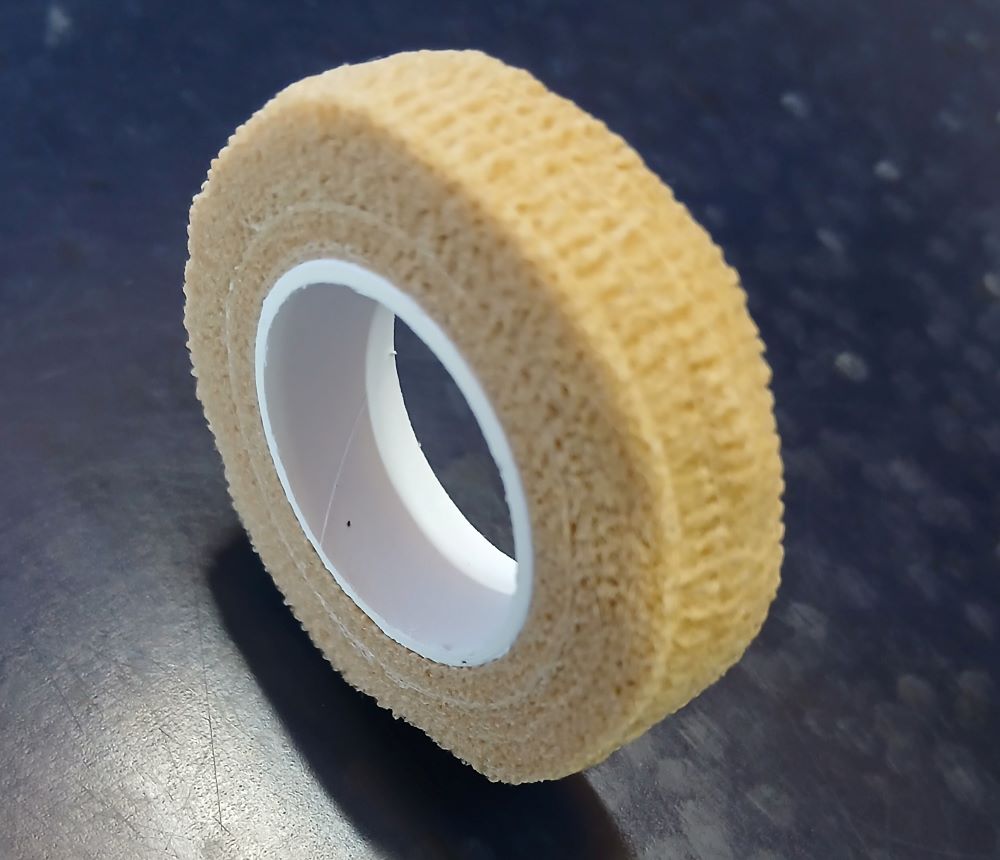
For this test, I used an inexpensive self-adherent finger tape that sticks to itself without adhesive.
Similar products are widely available online and in sports stores, making them an easy and inexpensive option if you want to try an anti-slip solution for the first time.
.jpg)
Because the tape sticks to itself, it can be secured simply by wrapping it around the finger. It does not use adhesive, so it feels less sticky, and no scissors or other tools are needed. You can easily tear it by hand and use exactly the amount you need.
Since there is no adhesive, the tape can also be reused after removal. However, its ability to stick to itself gradually decreases with repeated use. When it no longer stays securely in place, it is best to replace it with a new piece.
Although this is not a table-tennis-specific product, I found it practical for reducing finger slipping during reverse penhold backhand play in both practice and matches.


4. Sandpaper Treatment for Better Grip
Before switching to finger tape, I used sandpaper treatment on the back of the rubber for about 20 years.
I still find this method effective. With a standard Chinese penhold grip, the middle fingernail can hook onto the rubber to help support the racket, making this treatment particularly effective.
When I first switched to the Chinese penhold style, I struggled with my middle, ring, and little fingers slipping on the back of the racket. After trying different solutions, I began using sandpaper to improve the grip.
● Sanding the Rubber
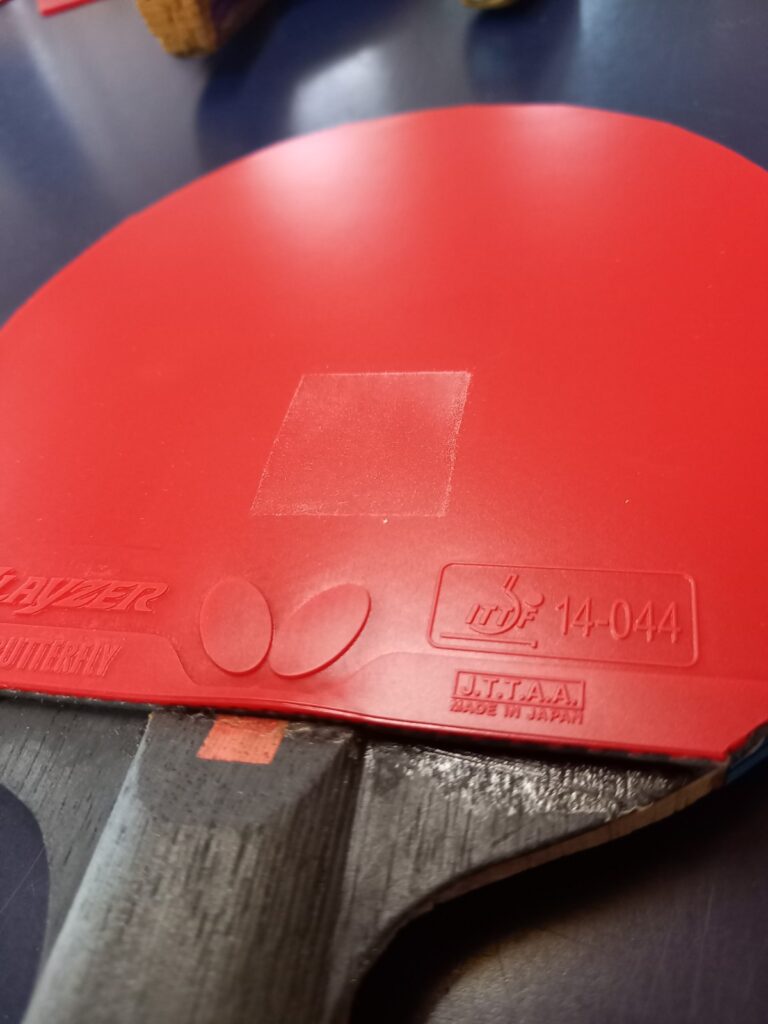
As shown in the image, lightly sanding only the area where your fingers contact the rubber can improve grip. I have used this method for many years.
※I intentionally left the sanding dust on the surface so that the treated area is easier to see.
Important Notes
・Limit the sanding to the area where your fingers make contact with the rubber.
・Lightly sanding in both vertical and horizontal directions can improve grip further.
・There is no need to sand deeply. Creating only fine scratches on the surface is sufficient.
※Modify the rubber at your own risk.
Similar marks can also be seen on a racket used by Wang Hao, one of the great Chinese penhold players. Based on my experience, I consider sanding limited to the finger-contact area to be acceptable under the rules.
For a standard Chinese penhold grip, I still consider sandpaper treatment an effective way to improve grip.
5. Anti-Slip Options for Single-Sided Penhold Rackets
The methods discussed above are mainly intended for Chinese penhold rackets with rubbers on both sides.
With single-sided penhold rackets, such as traditional Japanese penhold rackets, the back of the racket is often covered with cork. For this reason, I do not think additional anti-slip treatment is usually necessary.
However, some players add material to the back of the racket to improve cushioning or create a guide for finger placement.
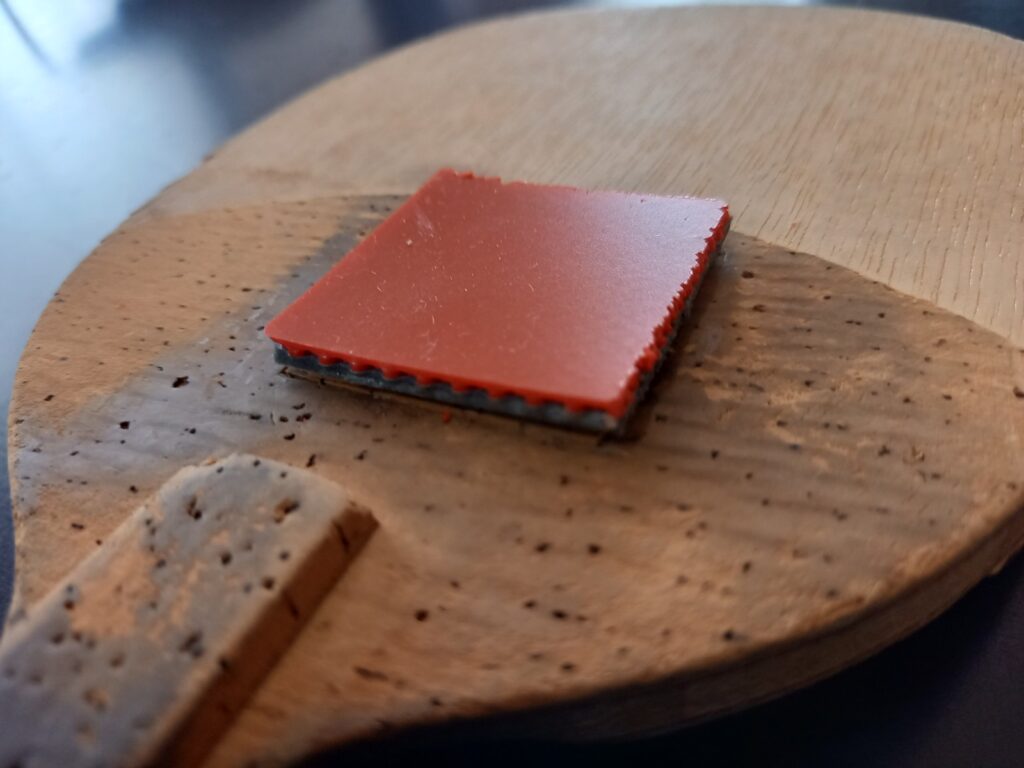
When I used a traditional Japanese penhold racket, I often attached leftover pieces of rubber to the back. It was a simple way to reuse spare rubber while also adding some cushioning.
Tip
For single-sided penhold rackets, you can use various materials, including rubber topsheets, sponge, or cork sheets. The best choice depends largely on your preferred grip and feel.
If you add any anti-slip material, make sure it does not extend into an area that could contact the ball. Keep the material limited to the finger-contact area.
6. Conclusion
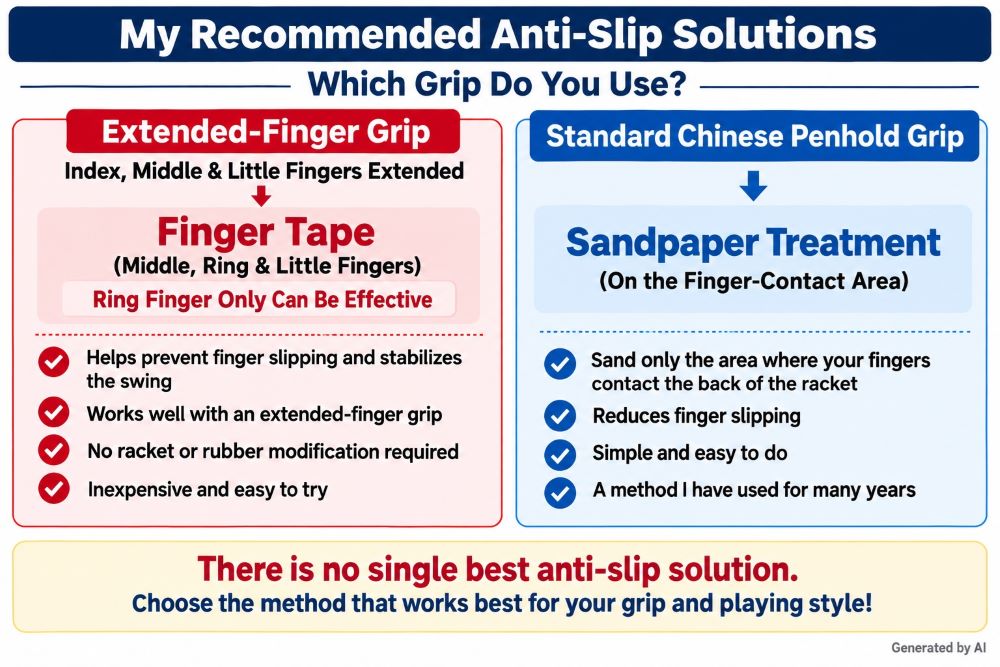
I have used sandpaper treatment on my Chinese penhold racket for about 20 years, and I still find it effective with a standard grip.
More recently, I started using finger tape to improve grip. It has become my preferred solution, especially for keeping my fingers from slipping during the reverse penhold backhand.
There is no single best anti-slip solution. The most effective method depends on your grip technique, hand size, and playing style.
I hope the methods introduced in this article give penhold players some ideas for making their racket control more stable and comfortable.
Related Articles
Where to Place Rubber on a Chinese Penhold Racket
Heavy Chinese Penhold Blades: Ranking

Lightest Chinese Penhold Blades: Ranking



コメント