1. Introduction
This article introduces Rozena from Butterfly as a rubber for reverse penhold backhand (RPB) play.
Some table tennis enthusiasts may wonder, “Why Rozena now?”
However, after trying many different rubbers for RPB play, I have come to appreciate Rozena again. As an RPB player, I would like to share what I like about this rubber.
Rozena is one of Butterfly’s popular rubbers and is recommended for players across a wide range of skill levels, from beginners onward.
Butterfly uses the term “Tolerance” to describe its ability to compensate for slight errors in racket angle and swing direction.
This test was originally conducted in 2023. Three years have now passed, and my knowledge and skills in RPB play have improved since then. Therefore, I have revised and expanded this article based on my original impressions, adding my perspective from the present day.
In this article, I focus on my experience using Rozena as a rubber for reverse penhold backhand (RPB) play on a Chinese penhold blade, including its characteristics and points to keep in mind.
So, how did Rozena actually perform when I put it on the back of my Chinese penhold blade and played with it?
2. Rubber Weight
When using a penhold blade with rubbers on both sides, I believe the overall racket weight is very important.
Therefore, I compared the weights of four representative Butterfly rubbers that I have personally used and that are still widely used by table tennis players.
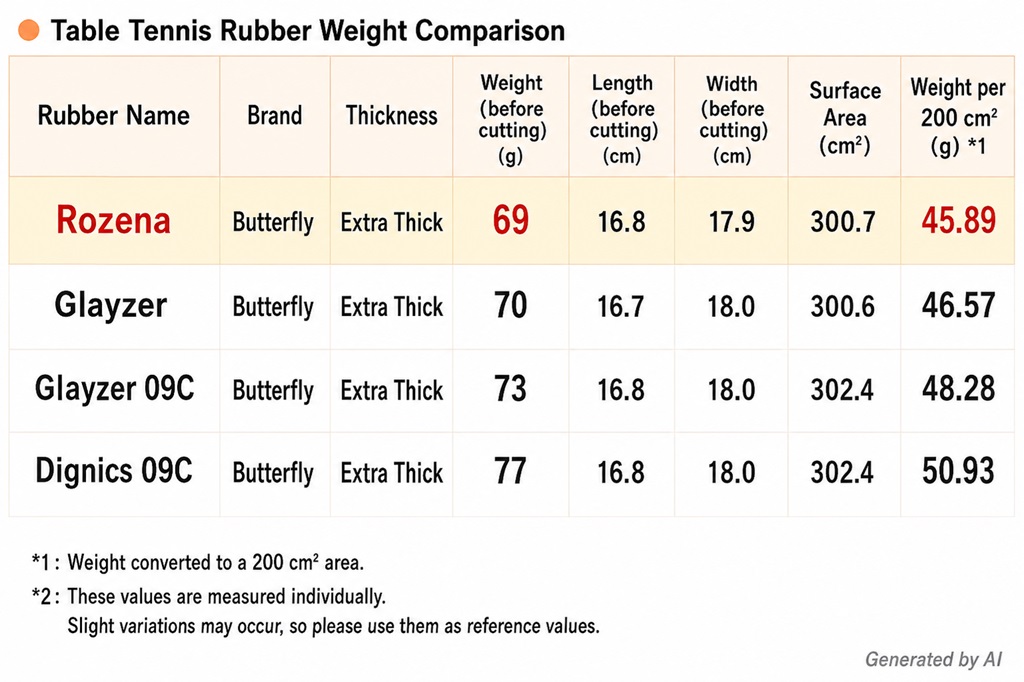
Among the four rubbers compared, Rozena was the lightest.
Rozena is lighter than Glayzer, which is positioned as a step-up rubber. It is even lighter than Glayzer 09C and Dignics 09C.
For this test, I also focused on keeping the racket and rubber combination as light as possible.
Next, I will introduce the racket and rubbers I used for the test.
3. Equipment Setup (Lightweight Blade)
For this test, I built the setup around the concept of a “lightweight blade.”
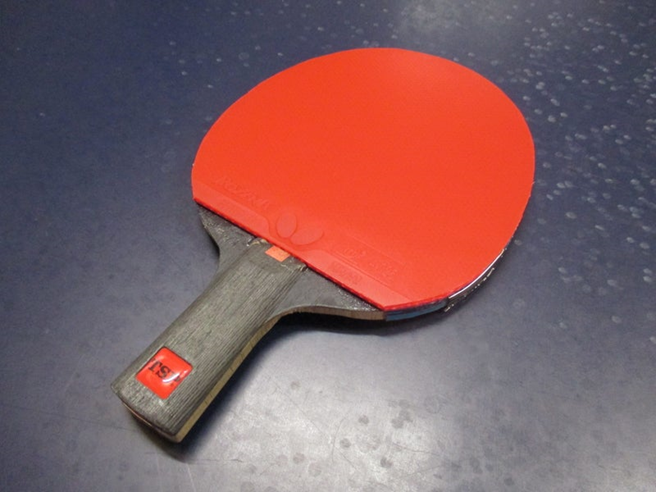
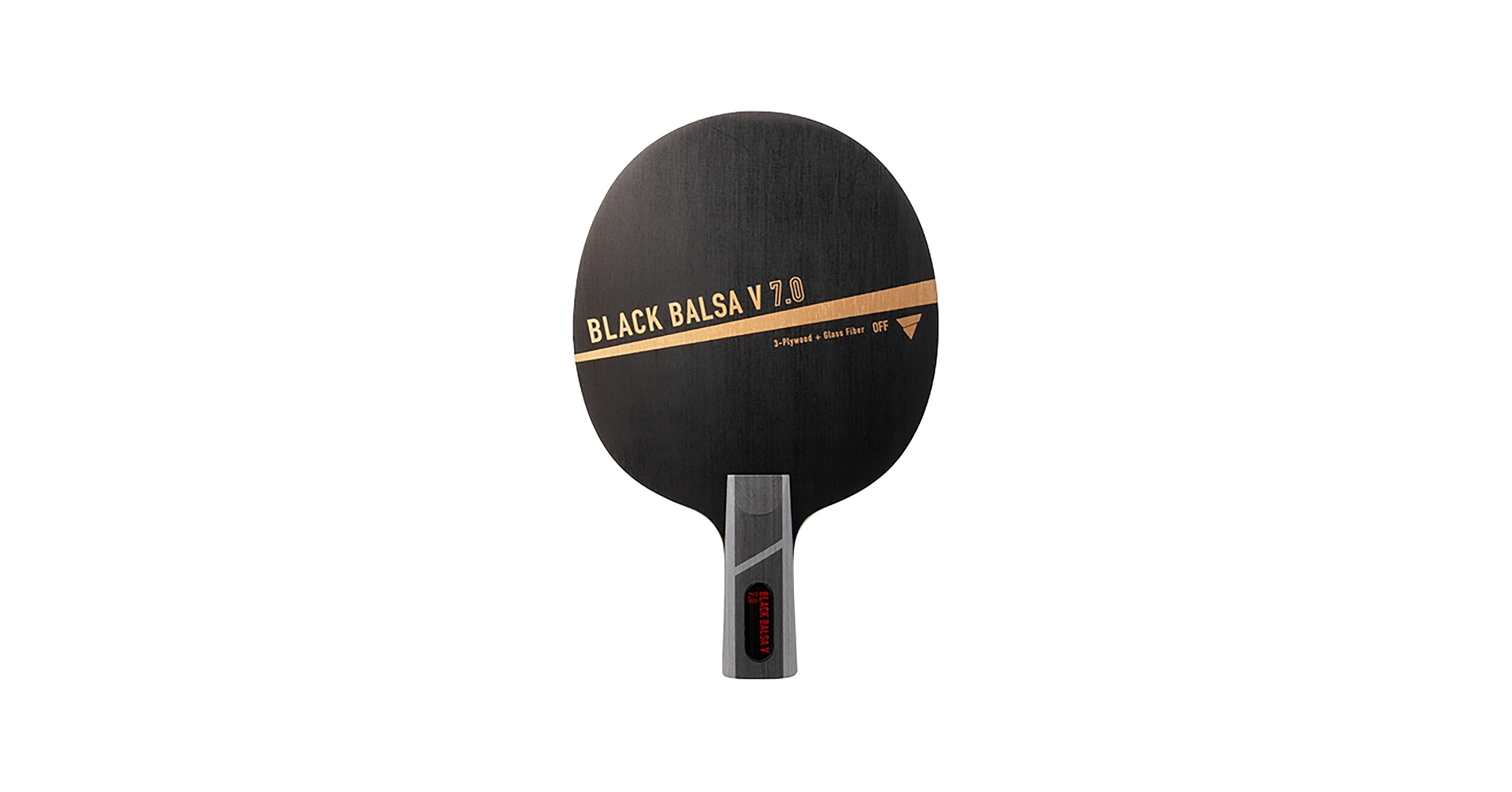
I used the TSP Black Balsa 7.0 for the blade. Although this model has been discontinued, VICTAS currently offers a blade with the same specifications. It is an extremely lightweight blade.

For the forehand, I used the hard and heavy Chinese-made tacky rubber “Apollo 5” (Yinhe). Even with an Extra Thick rubber on both sides, the lightweight blade and Rozena allowed me to achieve a total racket weight of just 154 g.
4. My Experience Using Rozena for Reverse Penhold Backhand Play
Here are my impressions of using Rozena for reverse penhold backhand (RPB) play, broken down by technique.
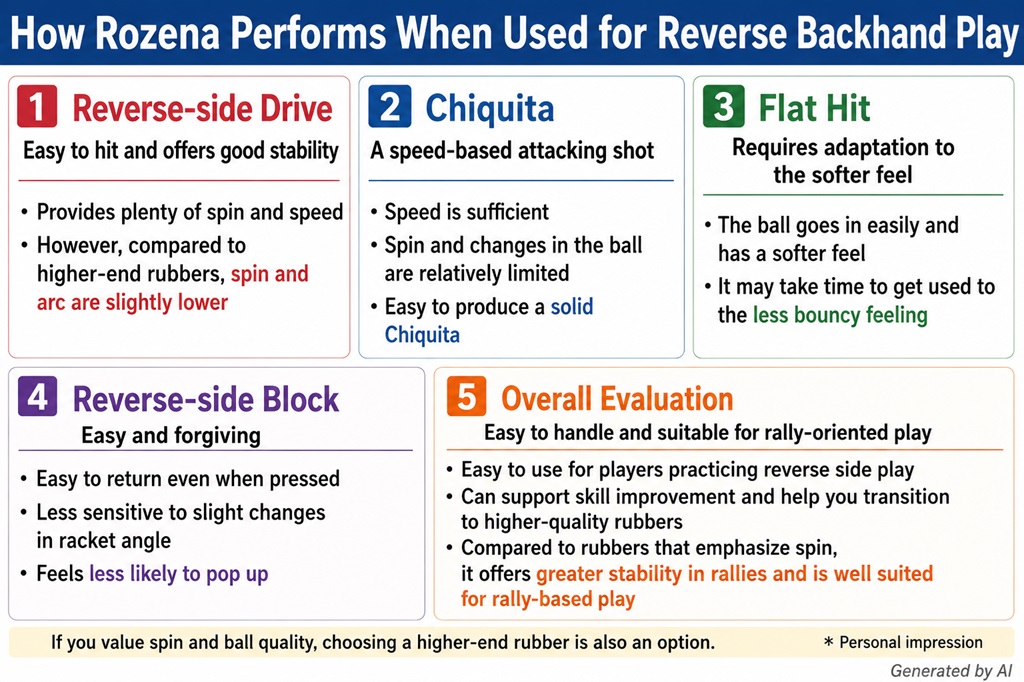
(1) Stable Reverse Penhold Backhand Drives
The first thing I noticed when using Rozena on the backhand side was how easy it was to play RPB drives against backspin. The rubber generated plenty of spin, and the ball traveled in a clean arc. I particularly liked how easy it was to maintain consistent rallies.
However, based on my current experience, the spin and arc are somewhat less impressive compared with Glayzer and Glayzer 09C. Even so, Rozena provides enough spin and speed while remaining relatively easy to control, making it a good option for players developing their RPB technique.
(2) Easy to Play Fast Chiquita Receives
If you are going to incorporate RPB into your game, the Chiquita is one of the techniques worth learning. Since Rozena is a bouncy rubber, I found it easy to play fast Chiquita receives.
On the other hand, the amount of spin is somewhat lacking compared with Glayzer and other similar rubbers. The ball also produces relatively little variation on the opponent’s side of the table. Rather than using spin to disrupt the opponent, my impression was that Rozena’s Chiquita is more about using speed to pressure the opponent.
(3) The Flat Hit Takes Some Getting Used To
When using RPB for a wide range of backhand techniques, the flat hit is an important skill.
When I used Rozena for flat hits, I felt that the ball sank deeply into the rubber at impact, which made it difficult for me to get a crisp hitting sensation. Since I was accustomed to a firmer feel, it took me some time to get used to it.
(4) Very Easy to Use for RPB Blocks
Of all the techniques I tried with Rozena, RPB blocking was one of the easiest.
In fact, it felt like I could return the ball simply by putting the racket in its path. Personally, I felt that because the ball sinks into the rubber, the shot remains relatively stable even when the racket angle is slightly off.
(5) Easy for Beginners and Suitable for Stepping Up
Although Rozena is a bouncy tension rubber, I found it relatively easy to control and well suited to players developing their RPB technique.
It also provides enough speed to allow players to move up to rubbers such as Glayzer, Tenergy, and Dignics as their skills improve. At the same time, I can understand why experienced players appreciate Rozena for its ease of use. Personally, I feel it works particularly well for building consistent rallies rather than relying on spin to overpower the opponent.
5. Points to Keep in Mind
Although Rozena is relatively easy to use, its strong bounce may be difficult to handle for players who are just starting to learn RPB.
In particular, if you have not yet developed the ability to properly brush and grip the ball against backspin, it may be difficult to take full advantage of Rozena’s performance.
If you want to develop the basic feel and technique needed for RPB, I recommend checking out the following article first.

Column: What Does “Tolerance” Mean?

Butterfly uses the term “Tolerance” to describe one of the key characteristics of Rozena.
According to Butterfly’s official website, this feature helps compensate for slight errors in racket angle and swing direction, resulting in greater stability during play.
Personally, however, I find the idea that the rubber “compensates for errors in racket angle and swing direction” somewhat difficult to visualize.
If the racket angle is significantly wrong, you will naturally make a mistake. The rubber does not automatically correct the racket angle for you.
I personally interpret Rozena’s “Tolerance” as a characteristic that makes it easier to grip the ball and generate spin, even when the point of impact is slightly off, because the ball sinks easily into the rubber, ultimately making mistakes less likely.
In other words, rather than the rubber actually “correcting” technical mistakes, I understand “Tolerance” as the ability to make solid contact and produce the intended shot even when there are slight inconsistencies in the stroke or contact point.
This is simply my personal interpretation, but it also matches the sense of confidence I experienced when hitting the ball with Rozena during RPB play.
6. Conclusion
I found Rozena to be a well-balanced rubber that combines ease of use with sufficient speed.
For RPB play in particular, it is easy to perform techniques such as drives, Chiquitas, and blocks with good consistency. I would also recommend it to players who are looking to develop their RPB skills.
However, as your skills improve and you begin to place greater importance on spin and ball quality, you may find Rozena somewhat lacking in certain situations.
In that sense, Rozena is a versatile option for a wide range of players, from those learning RPB to those looking to move up to a more advanced rubber.
If you are interested in the current retail price of Rozena, you can check it below.

Related Articles
What Is the Best Blade for Reverse Penhold Backhand (RPB) Play?

Lightest Chinese Penhold Blades Ranking

What Is the Ideal Weight for a Chinese Penhold Blade?

コメント