
1.Introduction
Quality isn’t everything:
- Choosing the most expensive or high-performance gear does not guarantee success.
The importance of synergy:
- Even if individual components are excellent, they must work together.
- If the interaction between the blade and rubber does not match your playing style, you cannot reach your full potential.
Goal of this article:
- Provide fundamental concepts of blade and rubber compatibility.
- Help you avoid common mistakes when selecting your equipment.
2.Understanding the Hardness of Blades and Rubbers
(1)Blade Hardness (Stiffness)
Influence of Ply Count:
- The stiffness of a blade primarily changes based on the number of wood layers (plies).
- Generally, more plies lead to higher stiffness and a harder feel.
- Typical Progression: Single-ply < 3-ply < 5-ply < 7-ply.
Modern Variations:
- Stiffness is also significantly affected by:
- Special materials: Presence of Carbon, Arylate, etc.
- Positioning: Inner-layer vs. Outer-layer.
- Top sheet: The type of wood used for the surface.
【Point: Identification by Impact Sound】
You can judge the hardness by tapping the blade face with your knuckle while holding the grip lightly.
- Hard Blades: Produce a high-pitched ring (“kan-kan” sound).
- Soft Blades: Produce a lower, duller thud (“kon-kon” sound).
Note on Humidity:
As wood products, blades absorb moisture over time.
Increased humidity reduces stiffness, causing the sound to become lower and duller than when new.
【Example】
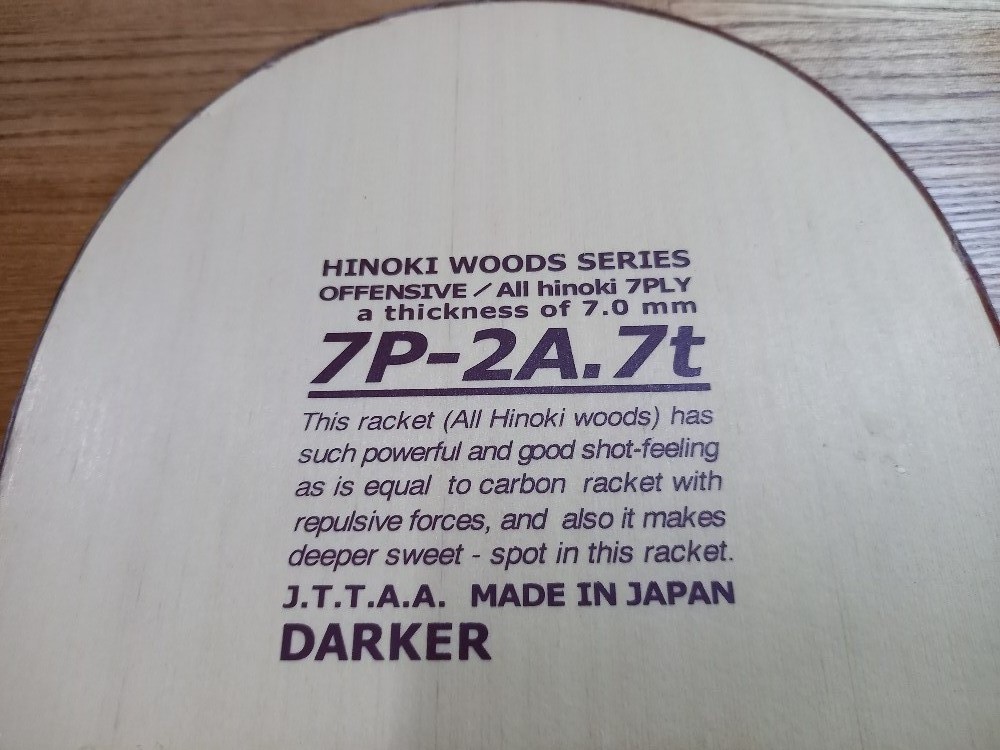
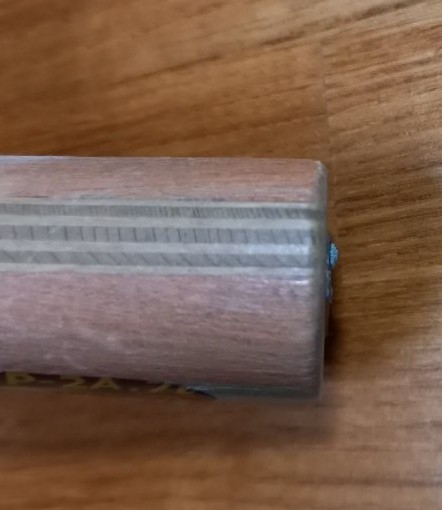
- The image shows a 7-ply wood blade: 7P-2A.7t (Darker).
- Among my personal collection, this blade produces the highest pitch.
(2)Rubber Hardness
- Defined by Sponge Hardness:
- Rubber hardness is primarily determined by the density and stiffness of the sponge.
- Key Characteristics:
- Hard Sponges: Deliver maximum power and speed during high-impact strokes.
- Soft Sponges: Provide better “dwell time” (ball-to-rubber contact), offering superior control and ease of use.
- Checking Specifications:
- You can verify the specific hardness ratings on each manufacturer’s official website.
【Official Digital Catalogs】
- Butterfly:
- Nittaku:
- Catalog | Nittaku (Nippon Takkyu Co., Ltd.)
Note on Accessibility: * English versions of these catalogs are also available on their websites.
- Catalog | Nittaku (Nippon Takkyu Co., Ltd.)
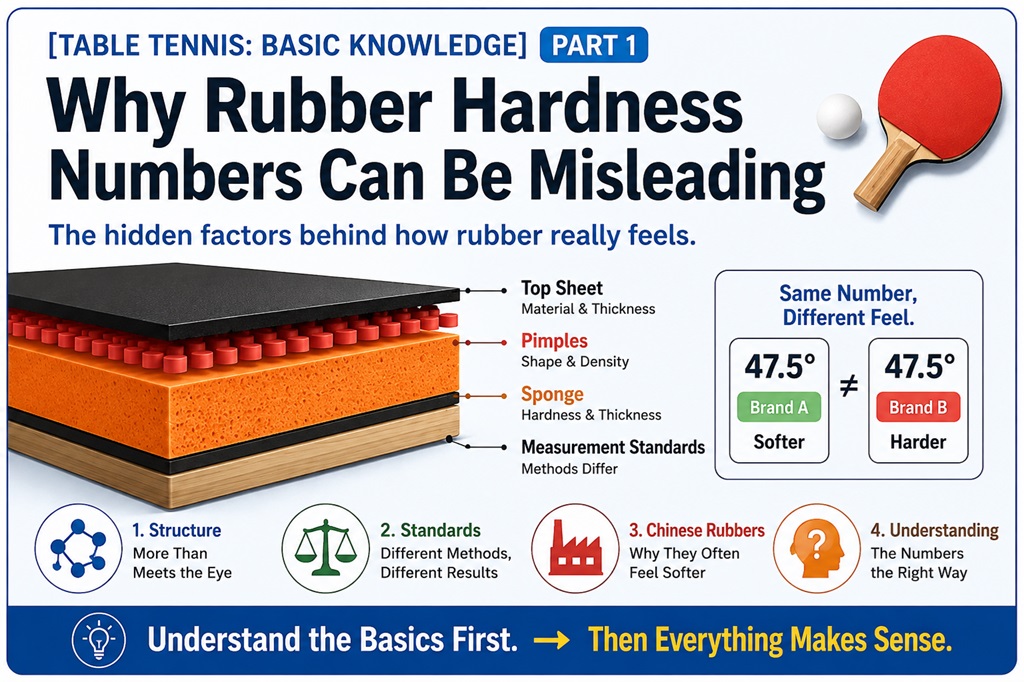
【Important Note: Comparing Hardness Across Manufacturers】
Unique Standards:
- Rubber hardness is measured and labeled based on each manufacturer’s internal standards.
Different Measuring Methods:
- Methods and durometer scales vary by brand (e.g., German standards vs. Japanese standards).
- Therefore, you cannot simply compare numerical values between different manufacturers.
Relative Comparison Only:
- Hardness ratings should be used only as a relative reference within the same brand.
3.Analyzing Blade and Rubber Combinations

General Characteristics:
- Harder Equipment: Offers higher energy transfer efficiency, prioritizing Speed.
- Softer Equipment: Increases ball contact time (dwell time), prioritizing Control.
Basic Roles of Equipment
- Primary Role of the Rubber: * To “grip” the ball and generate Spin.
- Primary Role of the Blade: * To repel the ball and provide Speed.
The 4 Core Patterns:
- By combining the “hardness” of these two components, equipment characteristics can be categorized into four distinct patterns.
Relative Performance Ratings:
- Below is a comparison of Speed and Spin for each combination.
- These ratings (up to 5 stars ★) are based on my personal experience and observation.
- Speed Rating:More stars indicate faster ball release and higher initial velocity.
- Spin Rating:More stars indicate a better “grip” on the ball, making it easier to generate spin.
(1)Hard Blade × Hard Rubber
Performance Characteristics:
- Maximum Speed: This is the fastest possible combination, offering extremely quick ball release.
- Difficulty in Generating Spin: Because the ball leaves the racket so quickly, it is very difficult to “grab” the ball to generate your own spin.
Ratings:
- Speed: ★★★★★ (5)
- Spin: ★ (1)
Strategy & Player Profile:
- High Risk, High Reward: This is the most difficult setup to control and requires precise touch.
- Iconic Example: Werner Schlager (Austria), the 2003 World Champion.
- The Schlager Style: This ultra-offensive setup was essential for his style—staying close to the table and executing devastating counters.
(2)Hard Blade × Soft Rubber
Performance Characteristics:
- The “Bite and Repel” Effect: The soft rubber temporarily “bites” the ball, which is then powerfully repelled by the hard blade.
- Complementary Design: The rubber ensures ease of handling, while the blade provides the necessary speed.
Ratings:
- Speed: ★★★★ (4)
- Spin: ★★☆ (2.5)
Strategy & Player Profile:
- Well-Balanced: A versatile setup where the hard blade generates speed, though the soft rubber makes it slightly harder to maximize heavy spin.
- Mitigating Hardness: The soft rubber helps to soften the overall impact feel, making the high speed of a hard blade more manageable.
(3)Soft Blade × Hard Rubber
Performance Characteristics:
- Counterbalancing Effect: The “sharp ball release” of the hard rubber is absorbed and balanced by the “flex” and “softness” of the blade.
- Modern Standard: This is considered a highly rational combination and is currently favored by many top-tier players worldwide.
Ratings:
- Speed: ★★★☆ (3.5)
- Spin: ★★★☆ (3.5)
Strategy & Player Profile:
- Superior Balance: While hard rubbers are typically difficult to control, pairing them with a soft blade ensures enough “dwell time” to generate heavy spin.
- The “Golden Standard” for Pros: * This theory is perfectly embodied by the combination of Sticky High-Tension Rubbers with Inner-Carbon or 5-ply wood blades.
- It is one of the optimal solutions for achieving both devastating power and high stability.
(4)Soft Blade × Soft Rubber
Performance Characteristics:
- Maximum Dwell Time: This combination synchronizes the “bite” of the soft rubber with the “flex” of the soft blade.
- Slowest Release: While ball speed is minimized, the time available to generate spin is maximized.
Ratings:
- Speed: ★ (1)
- Spin: ★★★★★ (5)
Strategy & Player Profile:
- Stability & Feel: It is incredibly easy to get a feel for “grabbing” the ball, offering outstanding stability. However, it can lack finishing power since generating raw speed requires significant physical effort.
- Ideal Users:
- Defensive Players: Suitable for choppers (cutmen) who prioritize heavy backspin.
- Loopers: Players who prefer winning with consistent, heavy topspin loops rather than pure speed.
- Beginners: An excellent choice for entry-level players to develop their ball-handling skills and “feeling” for the ball.
4.Recommended Playing Styles for Each Combination
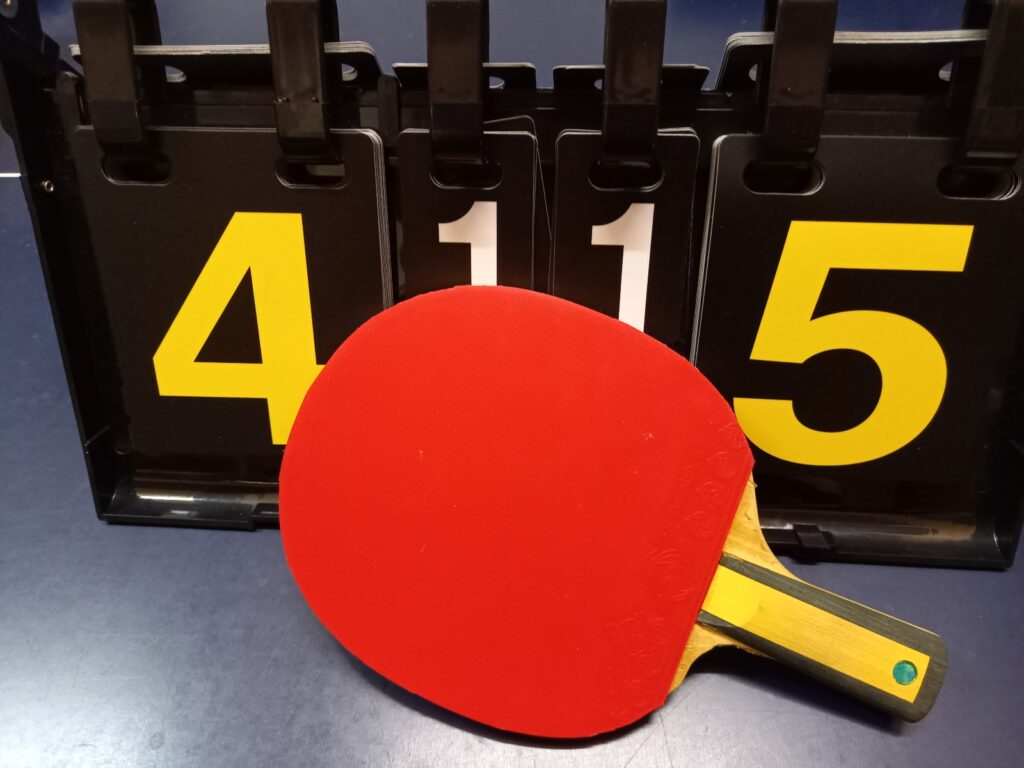
Based on my analysis, here are the tactical applications for each of the four patterns. Use these as a guide to find the equipment that best aligns with your strategy.
(1) Hard Blade × Hard Rubber
- Style: Ultra-Offensive / Close-to-Table Fast Attack
- Best for: Players who want to end points early and avoid long rallies. It is ideal for sharp counters and smashes while staying close to the table.
- Note: Not recommended for beginners due to the extreme difficulty in handling and precise timing required.
(2) Hard Blade × Soft Rubber
- Style: Close-to-Table / Quick-Pitch Attack
- Best for: Players who stay near the table and rely on rapid-fire blocks and compact counter-attacks.
- Drawback: It lacks the distance and power needed for mid-distance play and isn’t ideal for persistent, heavy topspin looping.
(3) Soft Blade × Hard Rubber
- Style: All-Round / Modern Offensive
- Best for: The modern “standard” for versatile players. It balances offense and defense, allowing for powerful mid-distance counter-looping while maintaining consistency.
- Advantage: Since it has no extreme weaknesses, it allows you to adapt flexibly to any opponent’s style.
(4) Soft Blade × Soft Rubber
- Style: High-Stability / Defensive-Minded
- Best for: Players who prioritize consistency and forcing opponent errors over raw power. It is perfectly suited for Choppers or players using Long Pips to control the game.
- Tactics: Ideal for neutralizing the opponent’s strongest shots and waiting for the right moment to strike with placement rather than speed.
5.Recommended Equipment for Beginners
- Avoid Hard Equipment:
- For those just starting out or focusing on the basics, “hard” combinations are not recommended.
- Harder gear requires extremely delicate control, which can hinder the development of proper form and a natural “feel” for the ball.
- The Ideal Starting Setup:
- Blade: Choose a “lightweight wood blade” that is easy to handle and doesn’t bounce too much.
- Rubber: Select a “softer rubber” that allows the ball to bite in easily, making it simpler to generate spin.
- The Path to Improvement:
- Start with a setup close to “Pattern 4” to master the basics of ball control.
- As your skills and playing style evolve, gradually transition toward harder equipment.
【Learn More】 For more specific product recommendations and a step-by-step guide to upgrading your gear, please check out the following article:

6.Summary
The table below summarizes the characteristics and recommended playing styles for each blade and rubber combination discussed in this article. Use this as a quick reference to evaluate your current setup or plan your next upgrade.

A Crucial Step for Success:
- Checking the hardness of both your blade and rubber is essential for finding the right gear.
- Understanding the concept of these “Four Core Patterns” alone will help you avoid critical mistakes in equipment selection.
The Path of Strong Players:
- Elite players deeply analyze their own playing style and logically select gear that complements it.
- Finding your own “optimal solution” as you improve will deepen your appreciation and enjoyment of table tennis.
Final Thoughts:
- I hope this article serves as a helpful guide in enriching your table tennis life.


-320x180.jpg)

コメント