1. Introduction
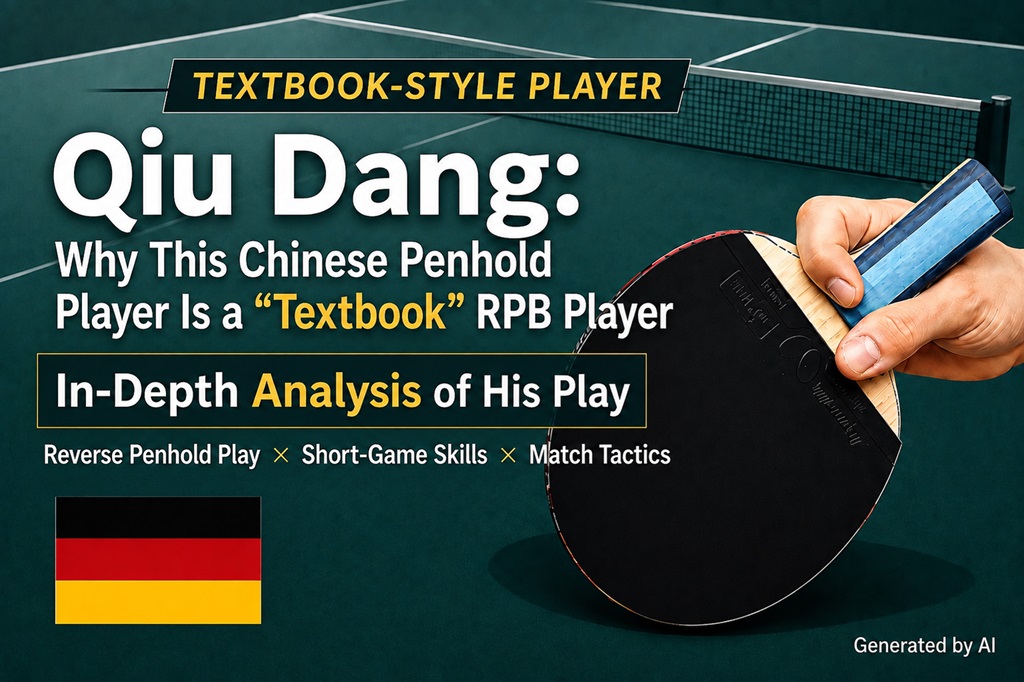
Have you heard of Qiu Dang, a German national team player who uses the Chinese penhold style?
There are few penhold players ranked among the world’s best. Qiu Dang is one of the few Chinese penhold players to have reached a career-high world ranking of No. 8.
He is an RPB player, but unlike explosive attackers such as Felix Lebrun, he wins through consistent short-game skills and excellent match management. His style is truly subtle and highly effective.
In this article, I will analyze Qiu Dang’s playing style, focusing mainly on his match against Kanak Jha.
2. About Qiu Dang (as of August 3, 2026)
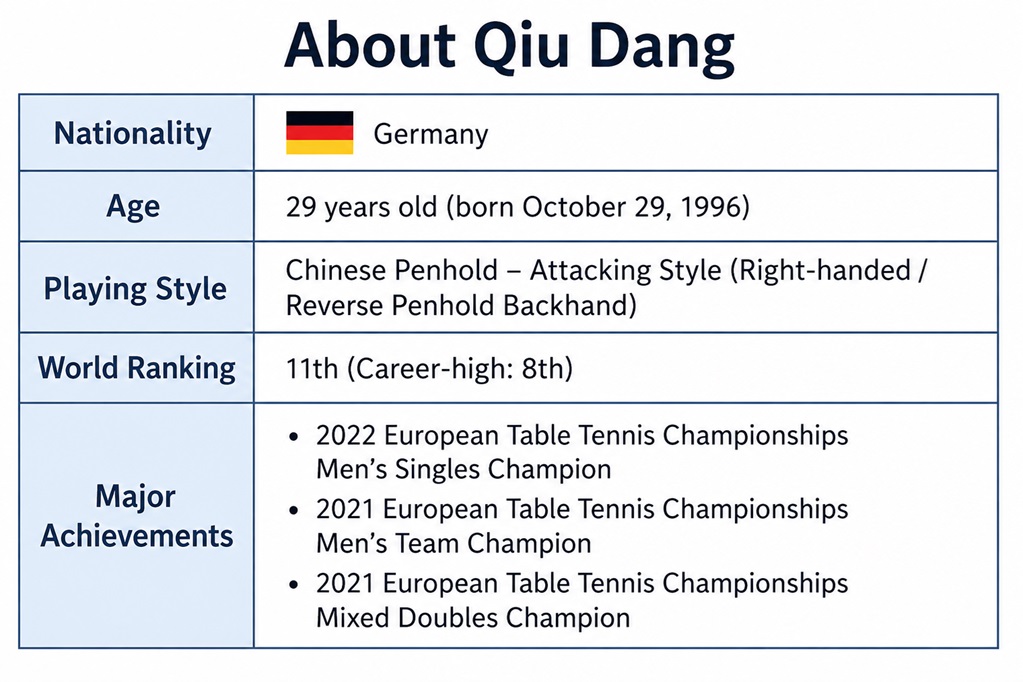
Born in Germany to a Chinese family, Qiu Dang is a rare top-level Chinese penhold player in Europe. He has reached a career-high world ranking of No. 8 and is currently ranked No. 11 (as of August 3, 2026), with a highly consistent RPB-based playing style.
Rather than relying on powerful attacks, he gradually puts pressure on opponents with his short-game skills and excellent match management. His style offers valuable lessons for penhold players.
3. Equipment
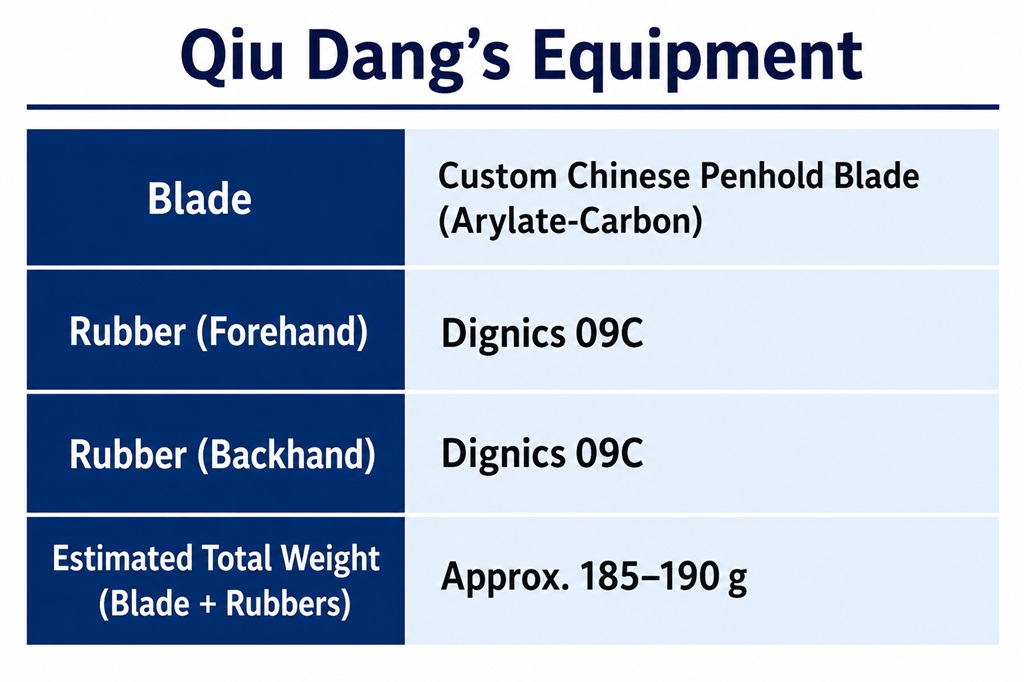
Qiu Dang is sponsored by Butterfly. As of February 11, 2025, he uses a custom Chinese penhold blade made with Arylate-Carbon and Dignics 09C on both sides. Dignics 09C is a tacky high-tension rubber known for its short-game and counter-play performance, making it a good fit for Qiu Dang’s consistent playing style.
1. Blade
He uses a custom Butterfly blade made with Arylate-Carbon. Although it is not a retail model, its good ball feel and rebound support his stable forehand and RPB play close to the table.
2. Rubber
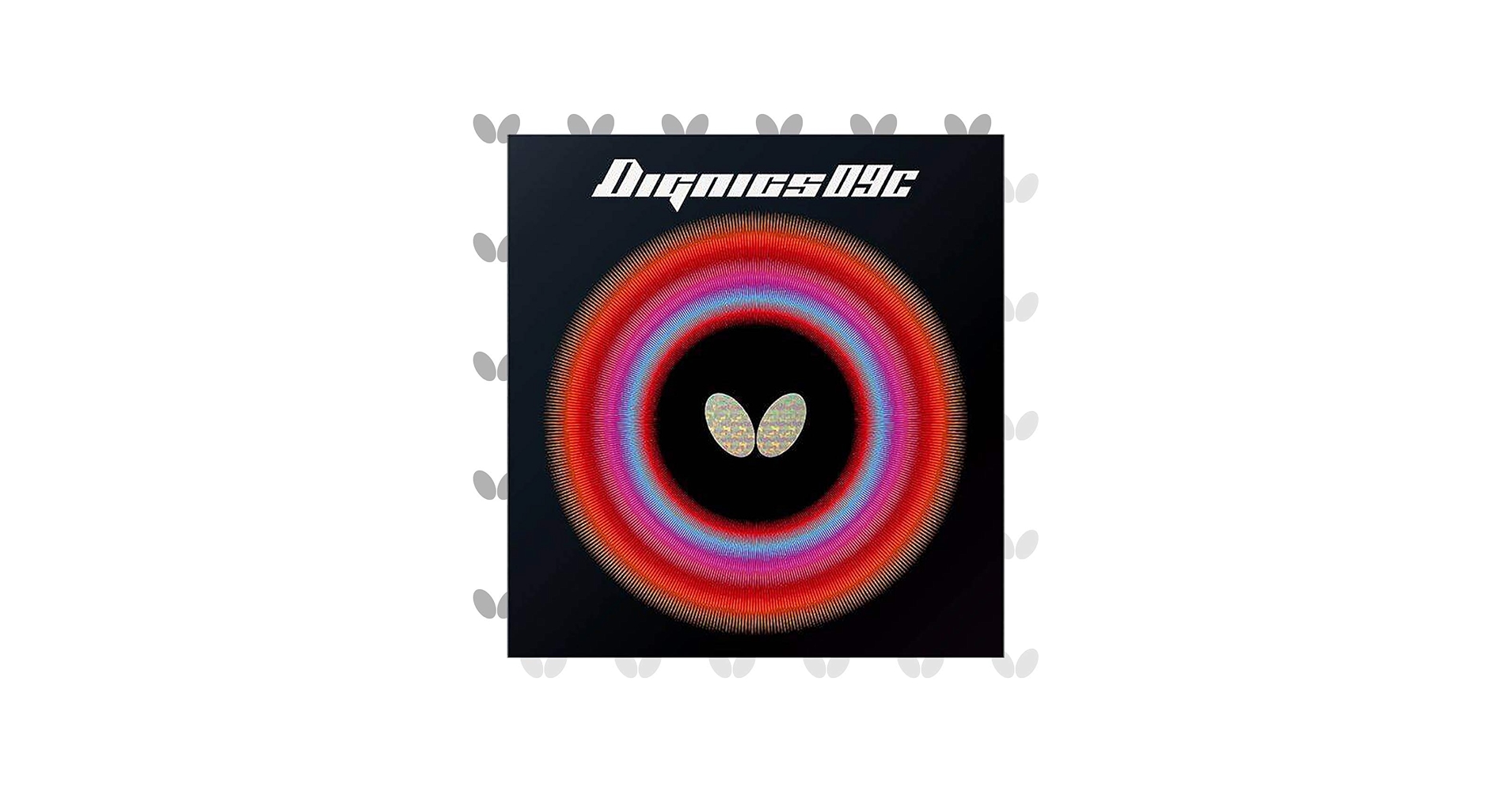
Qiu Dang uses Dignics 09C on both the forehand and RPB sides. It combines the high spin of a tacky rubber with the speed of a high-tension rubber, while also offering excellent short-game and counter-play performance.

Released in April 2020, Dignics 09C is a high-end Butterfly rubber. Many top players worldwide use it for its high spin and stable counter-play performance.
Its characteristics also suit Qiu Dang’s controlled rallying style and help support his consistent RPB play.
Want to try the same rubber as Qiu Dang? Check the latest price below.

3. Estimated Racket Weight
Qiu Dang’s custom blade is not commercially available, and its weight has not been published. However, we can estimate its weight based on the Dignics 09C (MAX) used on both sides.
One sheet of Dignics 09C (MAX) weighs about 50 g when covering the full surface of a Chinese penhold blade. Two sheets therefore add about 100 g. Including the Arylate-Carbon blade, the total weight is estimated at around 185–190 g.
This is relatively heavy for a Chinese penhold. However, Qiu Dang handles the racket smoothly and switches effortlessly between forehand and RPB. His racket control is particularly impressive in close-to-the-table counter-play and short-game situations.
4. Grip
1. Front Side (Thumb and Index Finger)
-1024x810.jpg)
The most distinctive feature of Qiu Dang’s grip is that he inserts his thumb deep into the handle. He also places his index finger along the handle rather than on the racket surface.
This grip makes the Reverse Penhold Backhand (RPB) much easier to play. It stabilizes the racket face and can improve the power and consistency of RPB drives and counters.
However, it makes the traditional penhold backhand technique, known as the “short”, difficult to execute because it is harder to adjust the racket angle.
Qiu Dang rarely uses the short during matches and relies on RPB for his backhand. Therefore, this grip maximizes the advantages of RPB while minimizing its drawbacks.
2. Back Side (Middle, Ring, and Little Fingers)
-1024x882.jpg)
On the back side, Qiu Dang uses a standard grip with the middle, ring, and little fingers supporting the blade. The middle finger acts as the main support point.
While his front-side grip is distinctive, his back-side grip is relatively standard. This allows smooth transitions between forehand and RPB and supports his stable two-winged play.
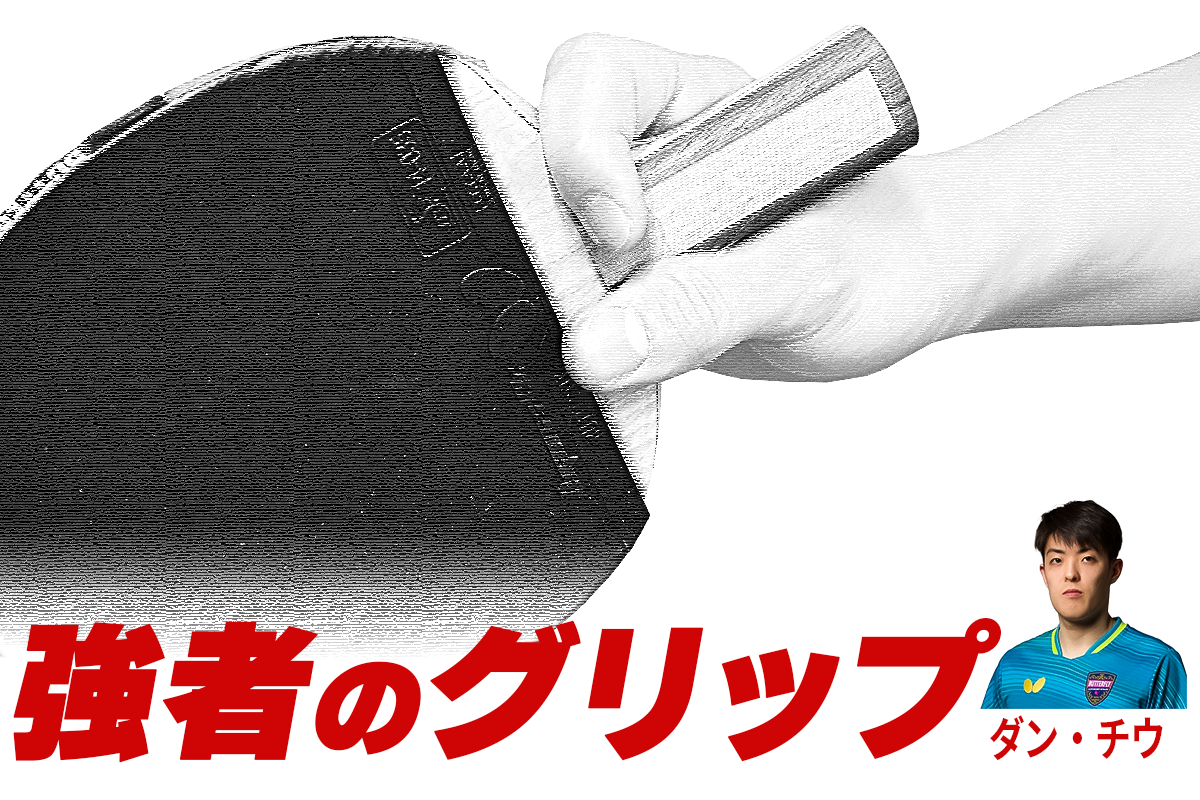
Butterfly also features his grip in its official digital content, “The Grip of Champions: Dang Qiu.” This article also includes the author’s own analysis based on match footage.
5. Serve Characteristics
For this analysis, I examined Qiu Dang vs. Kanak Jha in the men’s singles Round of 16 at WTT Champions Yokohama 2026, held in August 2026.
I counted the serve types and lengths, but some serves were difficult to classify as backspin or knuckle from the TV footage alone. Some classifications are therefore based on my judgment and may not be completely accurate.
Qiu Dang uses a very conventional service motion, but his swing speed just before contact is extremely fast, making it difficult to identify the spin type from his motion alone. With this limitation in mind, let’s examine his serving patterns.
1. Serve Types
Let’s first look at Qiu Dang’s serve types.
In this match, all of his serves were forehand serves, and he always served from the backhand side. He did not use backhand serves or serve from the forehand side.
In other matches, he sometimes serves from near the center of the table, suggesting that he adjusts his service position depending on the situation and opponent.
Serve selection and frequency can vary depending on the opponent’s style, tactics, and the effectiveness of each serve. Therefore, these results should be considered an example from the match against Kanak Jha.
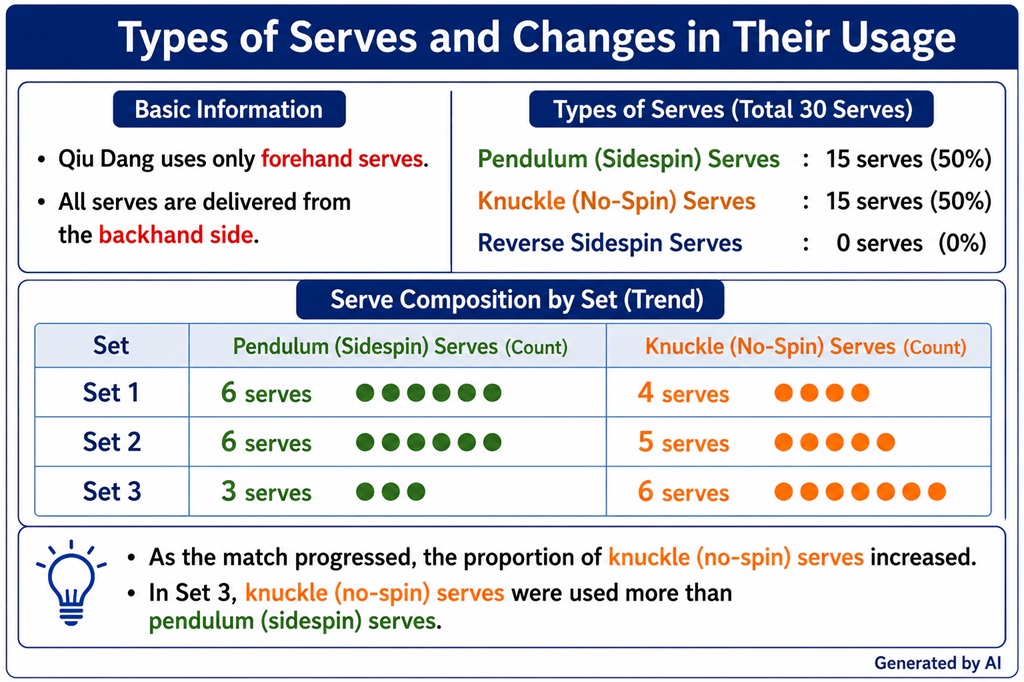
As shown in the infographic, Qiu Dang used 15 backspin serves and 15 knuckle serves in total. However, the balance changed by set: backspin serves were more common in Sets 1 and 2, while knuckle serves became more frequent in Set 3.
This suggests that Qiu Dang may have recognized the effectiveness of his knuckle serves and adjusted his serve selection during the match. His serves are not flashy, but his calm adjustments based on the situation are a key part of his playing style.
2. Serve Placement and Length
Next, let’s look at the length and placement of his serves.
Qiu Dang mainly uses short serves, while varying their length and placement from set to set.
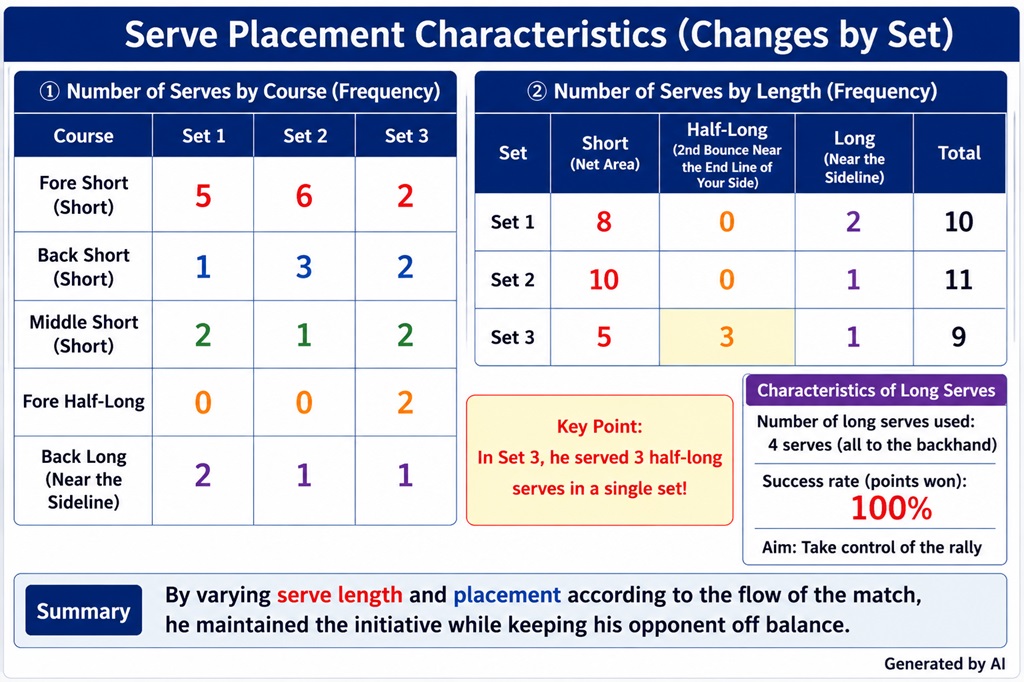
In Sets 1 and 2, most serves were short, especially short serves to the forehand. In Set 3, he used fewer short serves and added three half-long serves to the forehand. These serves were close to the borderline between a second bounce staying on the table and going off the end, giving his opponent a different look.
He used only four long serves, all knuckle serves to the opponent’s backhand. All four led to points, but rather than aiming for an ace or a direct third-ball attack, he appeared to use them to force a weaker return and gain an advantage in the rally.
6. Receive Characteristics
Next, let’s look at Qiu Dang’s receiving patterns.
As with the serve analysis, I examined Qiu Dang vs. Kanak Jha in the men’s singles Round of 16 at WTT Champions Yokohama 2026, held in August 2026, and counted the types and placement of his returns.
Return selection can vary greatly depending on the opponent’s serve spin, placement, and the match situation. Therefore, these results should be considered an example from the match against Kanak Jha.
1. Breakdown of Returns
First, I counted the types of returns Qiu Dang used.
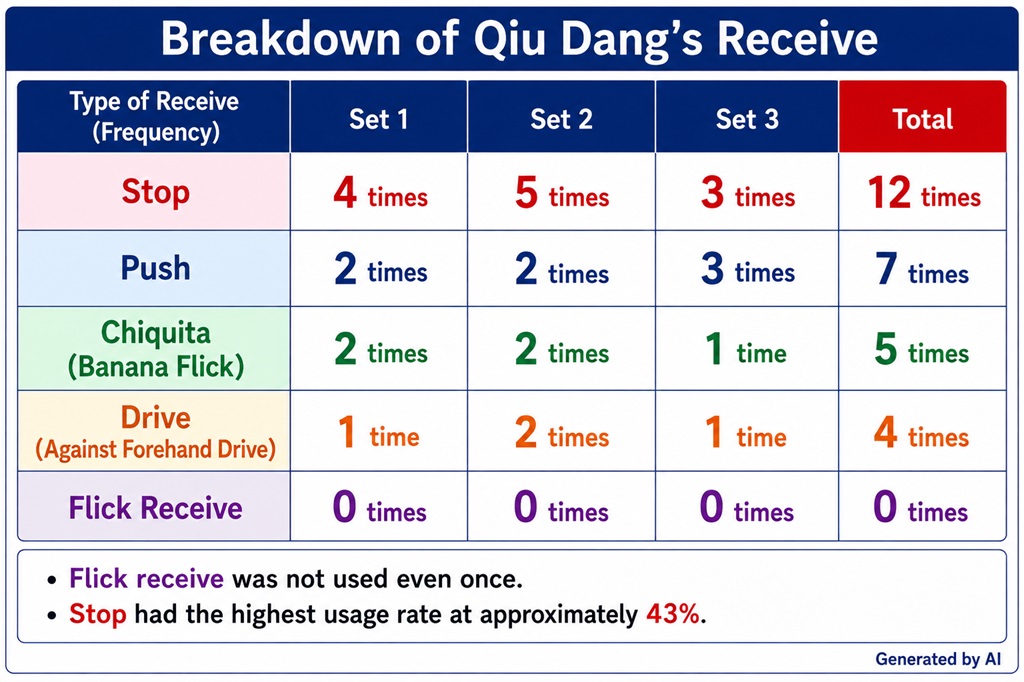
As shown in the chart, the stop return was his most frequently used option across all three sets. He also mixed in pushes and Chiquitas, choosing different techniques according to the situation.
Qiu Dang is also an excellent flick receiver, but he did not use a flick return even once in this match. Kanak Jha’s short serves were kept low, so Qiu Dang rarely had a chance to attack them aggressively.
Rather than forcing an attack, he first focused on taking control of the short game with a solid, “crafty” style. This was another clear example of his efficient playing style.
2. Choosing Between Stops and Pushes
The most impressive part of Qiu Dang’s short game is that he keeps his return choice hidden until the last moment.
He mainly uses stop returns, but can play a stop, push, or flick from the same motion. This makes it difficult for the opponent to predict the return until the last moment.
If the opponent moves too close to the table to prepare for a stop, Qiu Dang can respond with a flick or a deep push aimed near the end line. This constantly forces the opponent to adjust their position.
Rather than winning with flashy shots, Qiu Dang uses the opponent’s position and psychology to take control of the short game. By mixing stops and pushes, he moves the opponent and gains an advantage in the rally.
3. Surprisingly Few Chiquita Returns
Despite being an RPB specialist, Qiu Dang does not rely heavily on Chiquita returns. As shown in the chart, they account for only a small portion of his returns. He mainly builds his short game with stops and pushes.
In this match, he also never moved around to the forehand side to play a Chiquita, a tactic often seen among today’s top players.
He mainly used the Chiquita against half-long sidespin-backspin serves to his backhand side, suggesting that he chooses it only when the situation clearly favors the shot.
Rather than forcing an attack from an awkward position, he focuses on choosing the best return for each situation.
His confidence in the short game allows him to avoid relying too much on the Chiquita and take control of rallies with solid returns.
7. Why Is Qiu Dang a Textbook-Style Player?
Based on our analysis of Qiu Dang’s grip, equipment, serves, and returns, four key factors explain why he is a “textbook-style player” who excels with the RPB.
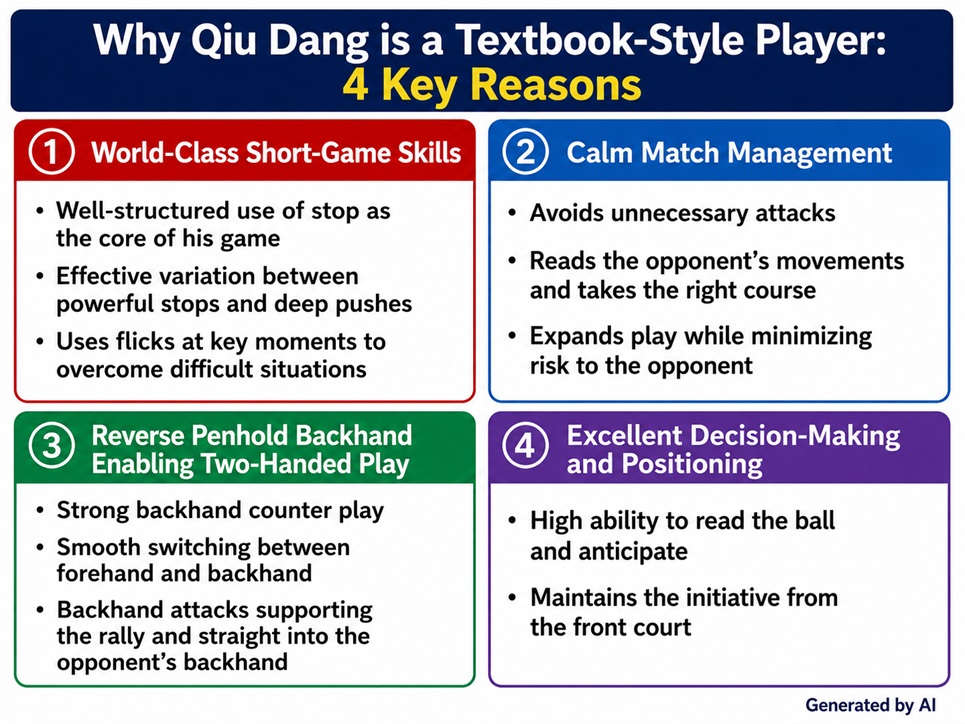
Qiu Dang does not rely on flashy winning shots. He controls rallies through world-class short-game skills, calm match management, RPB-based two-winged play, and excellent decision-making and positioning.
Against Kanak Jha, he varied his serves and used stops and pushes effectively to control the match. Rather than forcing attacks, he builds points patiently, offering valuable lessons for penhold players.
Column: What Is the Black Band on His Upper Arm?
In some photos of Qiu Dang, he wears a black band around his upper left arm. Kanak Jha also wore a similar black band on his arm in the match analyzed here.
It looks like a support band or athletic tape, but I could not confirm what it actually is.
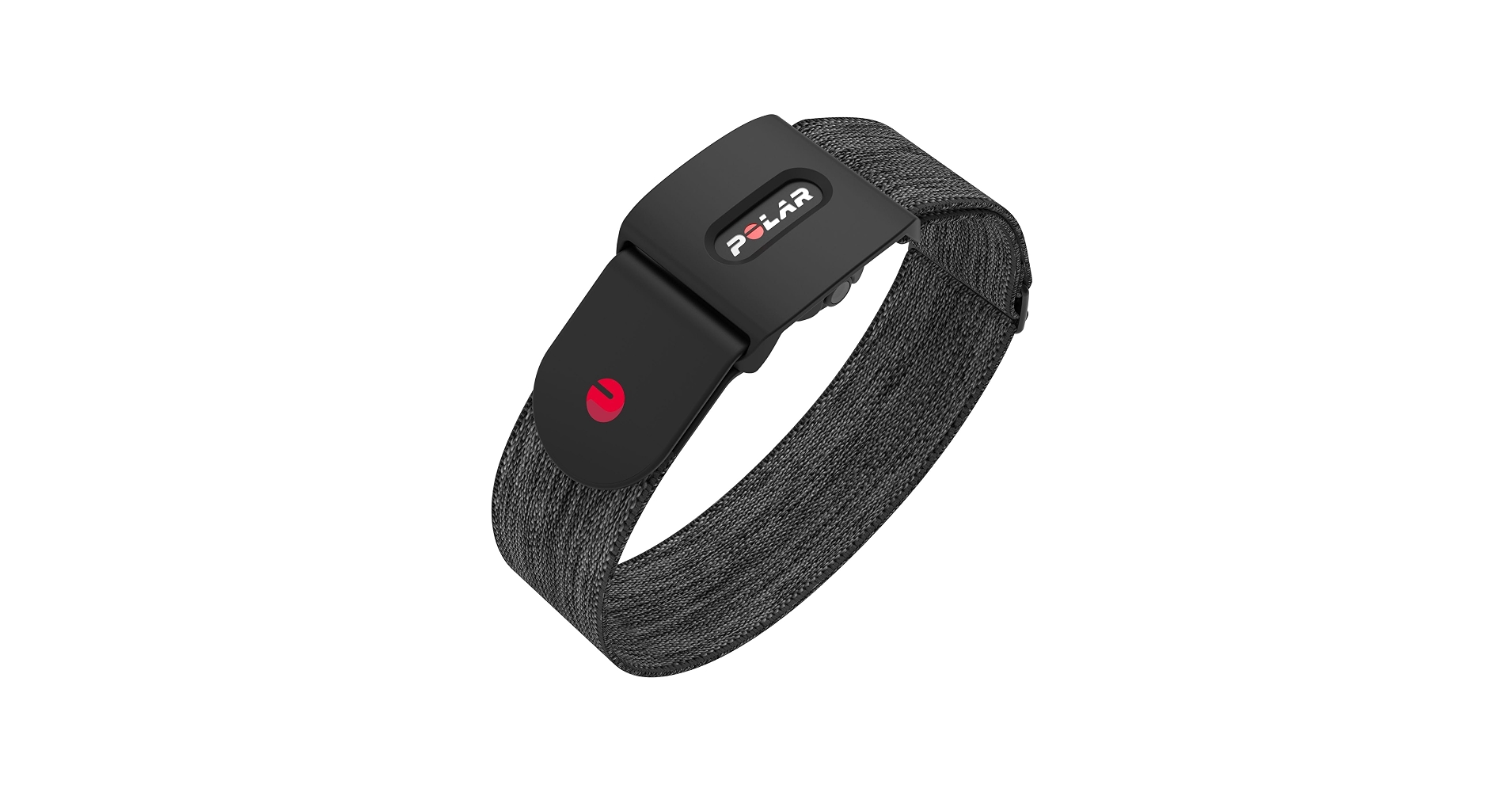
While researching this, I found that athletes can use optical heart rate sensors worn on the upper arm or forearm to measure heart rate.
For example, the Polar Verity Sense is a compact sensor worn on the arm to measure heart rate.
Of course, this does not mean that Qiu Dang or Kanak Jha uses this device. It is simply an example of a product that looks similar.
If you are interested in equipment used by top athletes or want to track your heart rate during training, it may be worth checking out.

8. Conclusion
Qiu Dang is not the type of player who wins over the crowd with flashy super plays.
His greatest strength is his “textbook” style of play: executing world-class fundamentals such as short-game skills, returns, and RPB counters with remarkable consistency, gradually putting pressure on his opponent.
Watching Qiu Dang has also reminded me that there is no need to force an attack. By focusing on the short game first, I can play more calmly and reduce unnecessary attacks.
His matches may not feature many flashy plays, but they are full of useful techniques and ideas. His style is worth studying for anyone learning the Chinese penhold or RPB, as well as players looking to improve their short game and match management.
Try watching his matches twice: first for the overall game, then focusing only on his short game and serve placement. You may discover something new each time.
Here is the match video. Compare it with the analysis above and see what you notice.
Related Articles
Felix Lebrun: Another Top Player Using the RPB

Top Table Tennis Players Using the RPB

Lightest Chinese Penhold Blades: Ranking




コメント