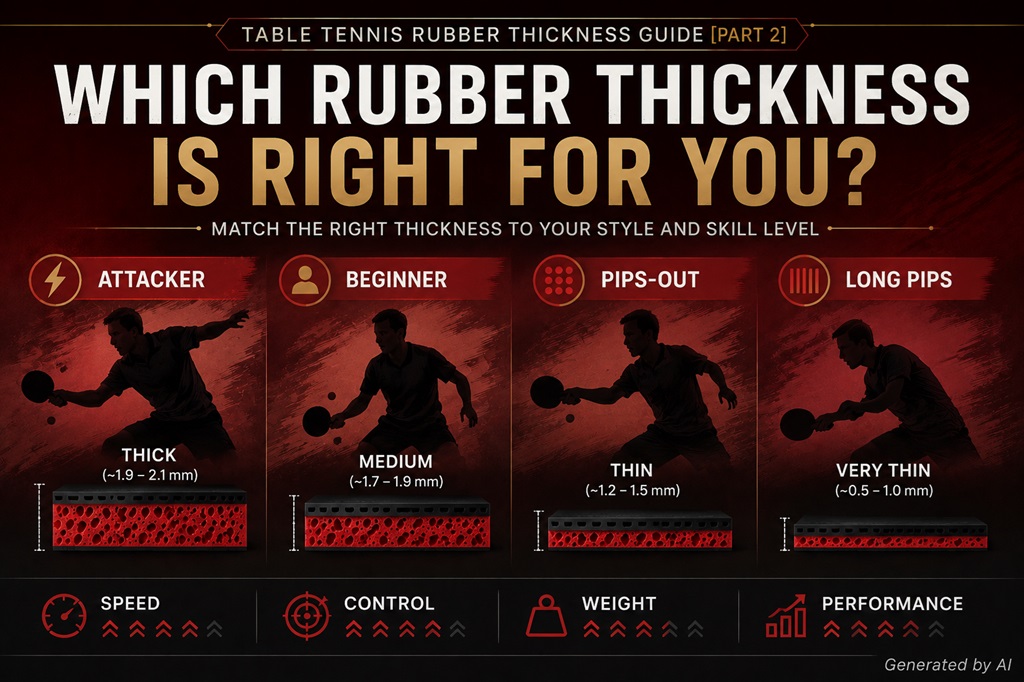
In Part 1, we explained the basics of rubber thickness, official regulations, and how thickness affects performance.
In Part 2, we will focus on how to choose the right thickness for different rubber types and playing styles.

5.How to Choose Rubber Based on Thickness
(1)Inverted Rubber
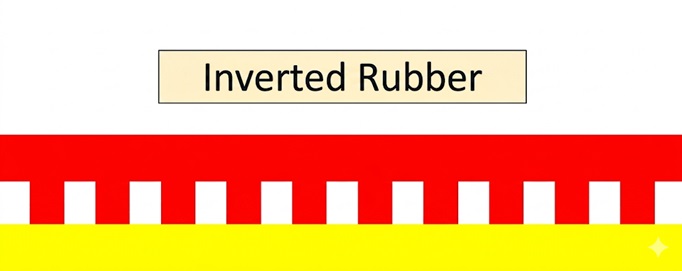
Players suited for “Extra Thick” or “Thick”
(Mainly advanced players and power hitters)
Players with fast swings and strong impact can fully compress a thick sponge.
This allows them to:
- Generate more speed
- Create heavier spin
- Maximize the sponge’s elasticity
Thicker sponge rubbers perform best when the player can generate enough impact power.
However, if the player lacks power, the ball may leave the racket before fully sinking into the sponge.
As a result:
- The shot may feel weak
- Spin may decrease
- The ball can become a “dead ball”
Players suited for “Medium” or “Thick”
(Mainly female players, juniors, and beginners)
Slightly thinner sponges are often easier for players with moderate impact power to use.
Benefits include:
- Better control
- Better ball feel
- Improved racket maneuverability
- Reduced racket weight
Because the blade feeling becomes clearer, many players find it easier to “grab” the ball and control their shots.
The lighter racket weight also helps with quick transitions between forehand and backhand strokes.
As one of the rubbers I personally use, Butterfly’s Dignics 09C remains popular among many advanced and professional players for its powerful sponge performance.



(2)Pips-out Rubber
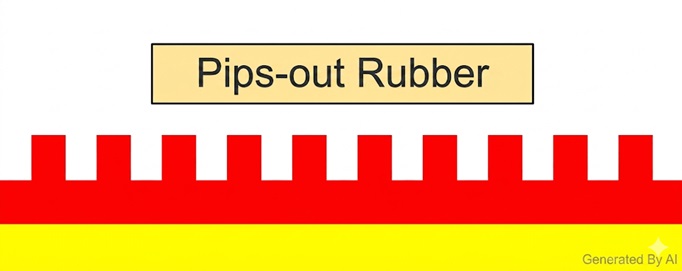
Pips-out rubber is often used for:
- Flat hits
- Smashes
- Fast attacking shots
Because pips-out rubber is designed for direct hitting, many players prefer “Medium” or “Thick” sponge thicknesses.
These thicknesses help players:
- Use the racket’s rebound effectively
- Produce fast direct shots
- Maintain quick ball release
Unlike inverted rubber, pips-out rubber is not mainly focused on generating heavy spin.
Instead, it is often used for direct attacking shots such as flat hits and punch shots.
Why “Medium” and “Thick” Are Popular
Many pips-out players choose “Medium” or “Thick” sponge because these options provide a balanced blade feeling.
Benefits include:
- Faster ball release
- Easier direct hitting
- Better speed in flat rallies
If the sponge becomes too thick, the direct hitting feel of pips-out rubber may decrease.
Producing Knuckle Balls
Another major advantage of pips-out rubber is the ability to produce knuckle balls.
Using a slightly thinner sponge can:
- Increase blade feeling
- Reduce sensitivity to incoming spin
- Make knuckle balls easier to create
Slightly thinner sponges often make knuckle balls easier to produce.
Weight and Swing Speed
Pips-out players often play close to the table and require quick racket movement.
Because of this, slightly thinner rubbers can improve:
- Swing speed
- Maneuverability
- Transition speed between shots
(3)Long Pips Rubber
Long pips rubber is mainly designed for defensive play.
It is commonly used for:
- Disrupting the opponent’s spin
- Blocking powerful attacks
- Creating unpredictable returns
Because long pips rubber focuses on defense and variation, its thickness selection differs from other rubber types.
Why “Thin” or “Extra Thin” Is Common
Most defensive players choose “Thin” or “Extra Thin” sponge thicknesses.
Benefits include:
- Reduced bounce
- Easier short control
- More stable blocking
- Better touch
A thinner sponge makes the blade feeling stronger, which improves delicate control.
Variation and Control
With thinner sponge — or OX (no sponge) — the pips bend more easily.
This helps generate:
- More variation
- More spin reversal
- More unpredictable returns
OX and thinner sponge setups often increase the disruptive effect of long pips rubber.
Because thinner setups absorb impact more effectively, blocking stability also improves against powerful attacks.
When Prioritizing Attack
Recently, more players have started using long pips for attacking play as well.
In these cases, some players choose “Medium” sponge thickness to add:
- More rebound
- Better attacking speed
- Improved offensive potential
This creates a balance between offense and defense.
6.Why “Thicker is Better” is Not Always True
Many top players use “Extra Thick” or “MAX” sponge thickness.
Because of this, many players assume that thicker sponge is always better.
However, this can sometimes become a mistake.
Your Play Can Change Dramatically by Reducing Thickness One Step
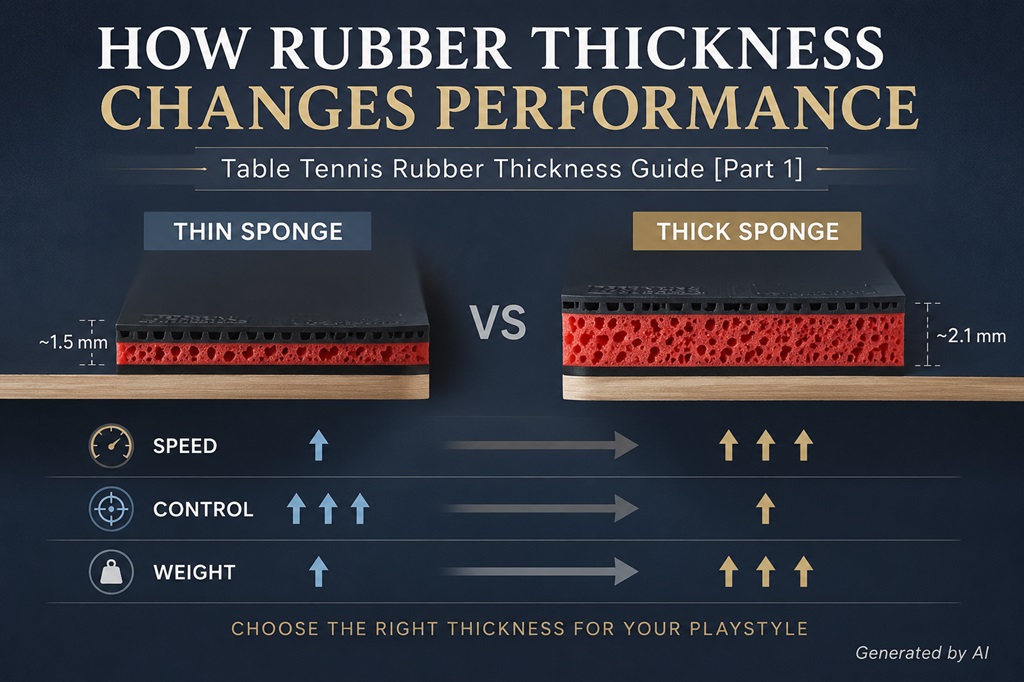
Many players are surprised to find that reducing sponge thickness by just one level greatly improves control and overall play quality.
For example:
- Extra Thick → Thick
- Thick → Medium
Even a small thickness change can produce noticeable differences.
Benefits of reducing sponge thickness include:
- Better control
- More stable shots
- Lighter racket weight
- Faster swing speed
- Improved blade feeling
Because the ball becomes easier to keep on the table, many players experience fewer over-misses.
The lighter racket also improves repeated attacks and transitions between strokes.
Reconsider Thickness Before Changing Rubber Type
If your current rubber feels difficult to use, do not rush to change to a completely different rubber.
In many cases, simply changing the sponge thickness of the same rubber can solve the problem.
If your current rubber feels difficult to control, trying a different sponge thickness of the same rubber may be worth considering.
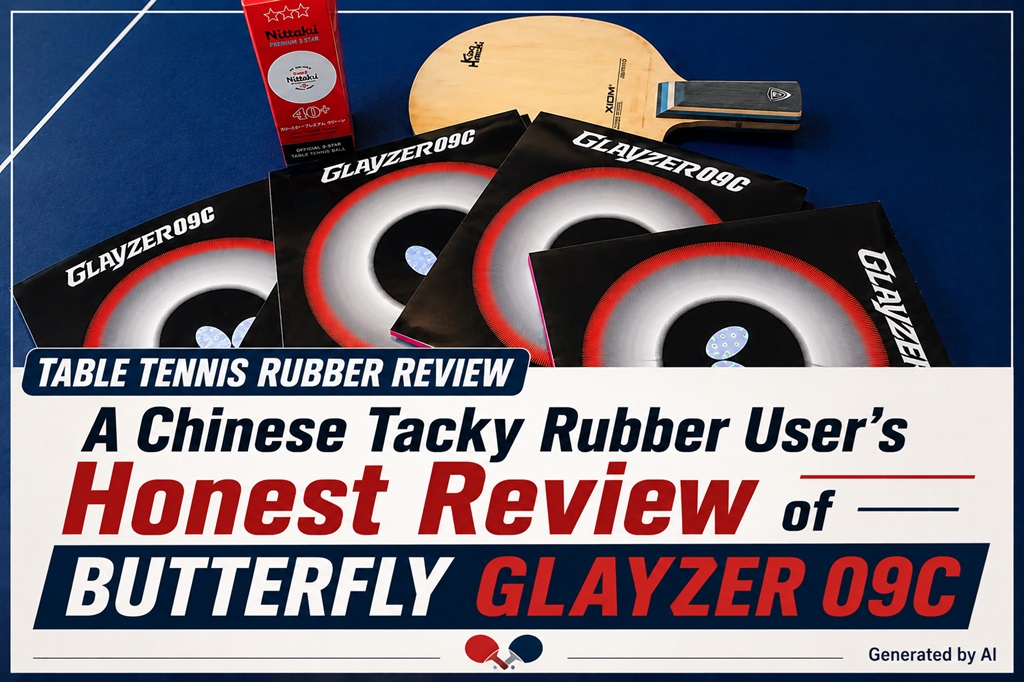
For players looking for even higher levels of spin and attacking performance, Butterfly’s Dignics 05 is often considered a higher-end option compared to Glayzer.
-320x180.jpg)


Finding a thickness that matches your:
- Skill level
- Swing power
- Physical strength
- Playstyle
is often the shortest path to improvement.
7.Summary

In this article, we explained the basics of table tennis rubber thickness and how to choose the right thickness for your playing style.
Even when using the same rubber, changing the sponge thickness can dramatically affect shot feeling, control, and racket weight.
In many cases, changing thickness can make the rubber feel like a completely different piece of equipment.
When choosing sponge thickness, it is important to consider:
- Your skill level
- Physical strength
- Swing speed
- Preferred playstyle
Finding the right balance between:
- Speed
- Control
- Stability
- Weight
can greatly improve overall performance.
In addition to thickness, sponge hardness is another extremely important factor in rubber selection.
Rubber hardness can dramatically change the feeling and performance of your racket.
Be sure to check the following articles as well:
- Rubber Hardness Guide
- Blade and Rubber Compatibility Guide
- MAX vs Thick Rubber Comparison
We hope this guide helps you find the ideal rubber thickness for your playing style.


コメント