【新プロジェクト始動!】 50代からの再挑戦を綴る雑記ブログを開設 | Kindle本「裏面打法による逆襲」好評発売中!

[Table Tennis Basics] Understanding Rubber Hardness: The Truth Behind “Feel” Beyond the Numbers

※This site contains affiliate links. Please note that some visuals are created with the help of AI.

【Basics & Beginner Guides】
About the Author

・Table Tennis Experience: 40+ years (Insights from a veteran's perspective)
・Playstyle: Chinese Penhold / Attacker (Exploring Reverse Penhold Backhand)
・Owner: Administrator of "Table Tennis Lab," with a Master’s degree in Physical Chemistry.
・Mission: Articulating the unique characteristics of equipment and technical tips through an original lens, sharing information to deepen the enjoyment of the sport.

1.Introduction

The Limitation of Manufacturer Specs

  • Have you ever felt that official hardness ratings aren’t actually that helpful when choosing new rubber?
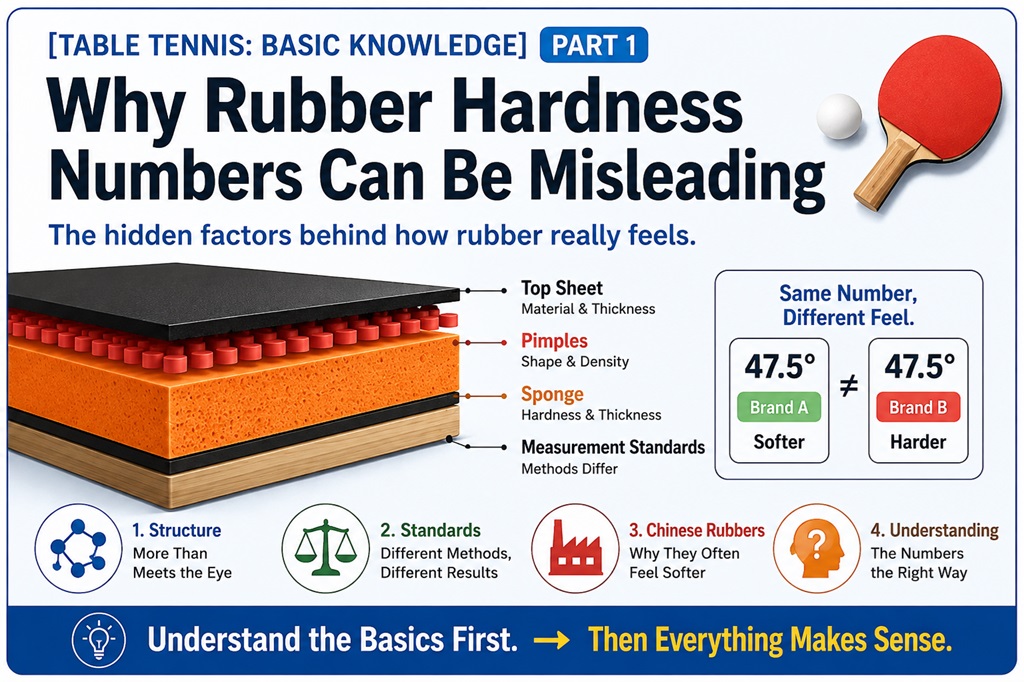
  • Even if two rubbers are both labeled “47.5 degrees,” the actual “feel” can differ drastically between brands.
  • There is no official conversion table between manufacturers—only unofficial estimates from the community.

The Complexity of Choice

  • The fact that “hardness” fails as an objective cross-brand metric is exactly what makes choosing rubber so difficult.
  • Consequently, players often fall back on “safe” selection criteria:
    • Sticking to a familiar manufacturer.
    • Relying solely on online reviews or word-of-mouth from teammates.

Beyond the Sponge: The Logical Approach

  • While these methods work, finding the perfect rubber requires understanding the logic behind the numbers.
  • It is true that rubber hardness is the most direct indicator of “impact feel.”
  • However, these values typically only represent the hardness of the sponge alone.

The “True Identity” of Impact Feel

  • In reality, the final feel is a complex output of physical factors, such as top sheet structure and pimple density.
  • Have you ever tried a rubber based on its specs, only to find it doesn’t feel right?
  • This article focuses on the “internal structure” that sponge hardness doesn’t show.
  • Let’s gain the knowledge to choose equipment logically, rather than being misled by catalog numbers.

2.The Reality of Rubber Hardness: How Pimple Structure Defines “Feel”
The Limitation of Official Specs

  • In reality, most values published by manufacturers refer strictly to the hardness of the sponge alone.
  • However, the “impact feel” we perceive when hitting the ball is not determined by the sponge in isolation.

The Role of the Top Sheet

  • The overall sensation changes significantly depending on the design of the “top sheet” (the rubber surface) paired with the sponge.
  • The key factor here is the design of the “pimples” (pips) that make up the sheet.

Pimples as “Support Pillars”

  • Whether they are on the inside (for inverted rubber) or on the surface (for short/long pips), these pimples act as pillars.
  • They serve as the bridge that transmits the force of the impact directly into the sponge.

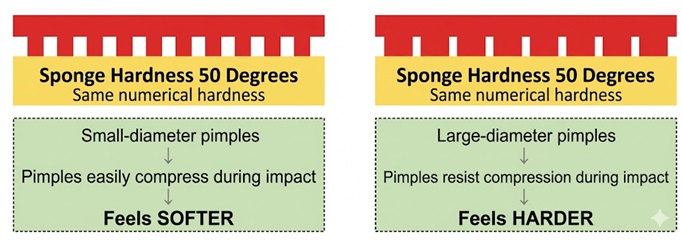
(1)Difference in “Springiness” Based on Pimple “Thickness”

Pimple Diameter and Rigidity

  • As shown in the diagrams, the thicker the diameter of the pimples, the more resistant they become to bending upon impact.
  • This increases the structural rigidity of the pimples as “support pillars”.

Impact on Feel

  • Because the pimples resist bending, the ball does not “sink” into the rubber as easily.
  • As a result, the overall impact feel of the rubber is perceived as “Harder,” even if the sponge hardness remains the same.
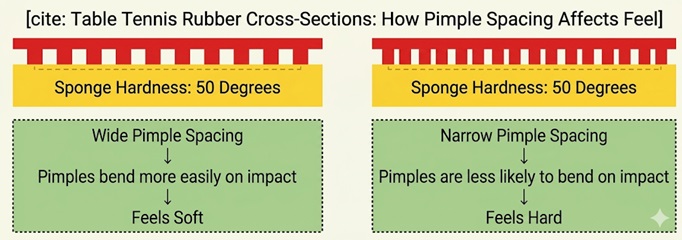
(2)The Impact of Pimple “Density (Spacing)”

Pressure Distribution and Density

  • Even if the diameter remains the same, narrower spacing between the pimples (higher density) means the ball’s pressure is distributed across and supported by a larger number of pimples.
  • When pimples are densely packed, they become more resistant to bending or “toppling” during impact.

Resulting Impact Feel

  • Because the structure provides more resistance, the overall impact feel is perceived as “Harder”.

(3)How Structure Dictates “Perceived Hardness”

  • Factors Creating a “Firm” Feel
    • As discussed, a top sheet with “thick” and “densely packed” pimples creates a firmer impact feel than the sponge’s numerical value suggests.
    • This structure increases resistance, leading to a more solid striking sensation.
  • Factors Creating a “Soft” Feel
    • Conversely, a sheet with thin pimples and wide spacing allows the pimples to bend easily.
    • This allows the ball to “bite” deeper into the sponge, making the rubber feel “softer” than its actual hardness rating.
  • Conclusion: The Structural Difference
    • In short, even if the sponge hardness is identical, a different pimple structure (thickness and density) results in a completely different rubber.
    • Furthermore, variations in the actual shape of the pimples will also alter the overall sensation during play.

3.The Current State of Differing Measurement Standards by Manufacturer

The Root of the “Mismatch”

  • One reason why choosing rubber based on catalog specs often fails to “feel right” is that each manufacturer uses a different durometer (measurement tool).
  • There are several global standards for instruments used to measure rubber hardness.

Varying Numerical Outputs

  • The final numerical value produced depends entirely on which specific instrument is adopted for testing.
  • Because these standards are not unified, comparing degrees directly across different brands is often misleading.

(1)Why Values Cannot Be Compared Directly

  • The Inconsistency of “50 Degrees”
    • For example, just because “Brand A” and “Brand B” both label a rubber as “50 degrees,” it does not mean the actual hardness is the same.
  • Differing Regional and Brand Standards
    • German-made Rubbers (e.g., ESN): These typically use what is known as “German Hardness,” which tends to result in higher numerical values.
    • Butterfly (Tamasu): This brand uses its own proprietary “Butterfly Standard,” which operates on a different numerical range compared to German hardness.
  • The Reality of Multiple “Rulers”
    • In short, the “ruler” used for measurement is unique to each manufacturer.
    • This lack of a universal scale is the primary reason why cross-brand comparisons are so difficult.

(2)Utilizing Online Verification Data and Important Cautions

Using Community Data as a Guide

  • Currently, the internet is full of independent comparisons by enthusiasts and playtest reports from equipment shops.
  • These can be utilized as “clues to understand trends” when considering products from different manufacturers.

The Subjectivity of Unofficial Data

  • However, it is important to remember that these are strictly based on unofficial testing and individual subjectivity.
  • No official unified standard or strict conversion formula exists across different manufacturers.

Final Judgment

  • One must be cautious: online information should only be used as supplementary material and cannot serve as the definitive criteria for final judgment.

(3)The Particular Difficulty of “Chinese Rubbers”

The Unique Scale of Chinese Brands

  • Personally, I find the numerical values of Chinese rubbers (such as DHS) to be especially difficult to interpret.
  • The ratings of “39 degrees” or “40 degrees” used for Chinese rubbers carry a completely different meaning compared to the standards of other manufacturers.
  • This makes direct, simple comparisons even more extremely challenging.

【Key Takeaways】

Sponge Hardness is a Proprietary Standard: Understand that each manufacturer operates on its own unique baseline.

Smart Use of Data: It is vital to use online verification data wisely as a rough guide.

Avoid Direct Comparison: Recognize that it is difficult to make a side-by-side judgment based solely on the numerical values found in catalogs.

4.Behind the Scenes of the “Thin Top Sheet × Thick Sponge” Trend and the Regulatory Barriers

The Shift Toward Thinner Top Sheets

When considering rubber hardness today, the “thinning of the top sheet” has become an unavoidable factor. While manufacturers once maintained relatively uniform sheet thicknesses, the current landscape—driven by elite players—has shifted toward a definitive trend: engineering top sheets to their physical limits to accommodate the thickest possible sponge.

(1)The “4.0mm” Regulatory Barrier

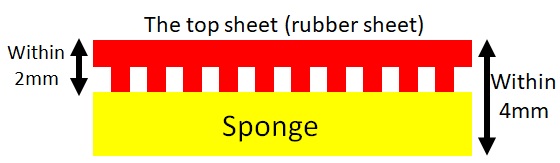
Under official table tennis regulations, the total thickness of the top sheet, the sponge, and the adhesive layer must not exceed a strict limit of 4.0mm.

Modern high-end rubbers are engineered with a design philosophy of physically thinning the top sheet to maximize sponge thickness within this confined space. A thicker sponge enhances energy efficiency upon impact, making it possible to generate overwhelming distance and speed even with plastic balls.

(2)The Risk of “Disqualification” for Manufacturers

One question naturally arises: “Why don’t all manufacturers push the limit to exactly 4.0mm?”

The reason is that designing a rubber to the absolute 4.0mm limit would create a high risk of rule violations, as the added thickness of the player’s adhesive could easily push the total over the limit.

To prevent players from facing disqualification at official tournaments, manufacturers deliberately calculate a margin for error, factoring in the thickness of the adhesive. Modern thin-sheet rubbers are the result of this sophisticated balance between precise engineering and pushing the boundaries of the regulations.

(3)Representative Product Examples

This innovative design is utilized in high-end models that represent the pinnacle of each manufacturer’s technology. While these rubbers offer exceptional performance, they also involve high manufacturing costs, which is reflected in their premium price range.

  • Butterfly: Xiah 03 A new flagship model from Butterfly that brings together their latest technologies. It is designed to directly transmit the energy of the thick sponge through a thin top sheet.
  • STIGA: DNA Platinum A product where the sheet has been thinned to the limit to increase the sponge thickness to “MAX (2.3mm).” It achieves both an overwhelming “bite” and powerful resilience.
  • andro: Rasanter Series A pioneer of the current trend, they were among the first to realize thinner sheets and thicker sponges under their “ULTRAMAX” standard.

(4)Impact on Choosing Hardness: Why They Feel “Softer” Than the Numbers Suggest

The most critical factor here is the shift in “perceived hardness.” Because rubbers with thinner top sheets allow the ball to sink into the sponge almost instantaneously upon impact, they often feel “softer” and offer a better “bite” than traditional rubbers, even when the sponge hardness ratings are identical.

“Even though the numbers suggest it should be a perfect fit, it just doesn’t feel right…”

The true source of that mismatch may lie in how the “thickness ratio” between the top sheet and the sponge alters the impact feel. Understanding the “sensory shift” brought about by this modern structure—beyond what is listed in the catalog specs—is the essential first step toward choosing equipment you can truly trust.

(5)Reference: Butterfly’s Latest Gear “Xiah 03”

Compared to the pioneering Rasanter series, Butterfly’s “Xiah 03” was released much later in terms of this “thin top sheet x thick sponge” design concept.

However, Butterfly is a manufacturer with a global reputation for exhaustive product development and quality control. It is easy to imagine that the reason they chose this timing for the release was that they repeatedly conducted an extraordinary number of trials and verifications, finally reaching a level of perfection where they felt confident enough to say, “With this, we can win.”

Gathering the best of the latest technology, “Xiah 03” carries a high-end price tag commensurate with its performance. While a price range that could nearly buy a whole racket requires some courage for the average player, the shot feeling of this latest structure, which Butterfly has taken the time to refine, is extremely intriguing.

If you are interested, please check the current price via the banner below.

If you are interested, please check the current price via the banner below (please note that the link directs to a Japanese page).

[Column] The “Magic Racket” of the Past and the Birth of Modern Regulations

It may seem unbelievable today, but during the 1950s, there was an era when rackets covered solely in sponge—without the rubber top sheets we see on modern inverted rubbers—dominated the world of table tennis.

1.The “Explosive Power” That Astonished the World

It all began at the 1952 World Championships in Bombay. Hiroji Sato, representing Japan, captured the world title in his debut appearance, wielding a sponge rubber nearly 10mm thick.

This equipment possessed speed that was incomparable to the “hard rubber” (thin rubber sheets without sponge) dominant at the time, along with the unique characteristic of being silent upon impact. Opponents found it impossible to judge the spin or speed of the ball, sending shockwaves through the global community as a true “Magic Racket.”

2.Ichiro Ogimura and the “Golden Age”

A figure indispensable to the history of sponge rubber is Ichiro Ogimura, who would later be known as “Mr. Table Tennis.” He did not treat this new material as a mere gimmick; instead, he developed sophisticated tactics that leveraged its physical properties. By winning the Men’s Singles titles at the 1952 and 1956 World Championships, he solidified Japan’s Golden Age in the sport.

However, because the sponge rubber—characterized by its silent impact and unpredictable power—was so dominant, it eventually began to fundamentally change the very nature of the competition.

3.Why Was “Sponge Only” Prohibited?

In 1959, international regulations were finally amended, leading to the disappearance of sponge-only rubbers from the sport. The primary reasons for this change were as follows:

  • Excessive Increase in Power: With thicknesses reaching 10mm, it became impossible to sustain rallies.
  • Transformation of the Sport’s Nature The inability to judge a shot by its sound was deemed a detriment to the fairness of the competition.
  • Impact on Media: As television broadcasting began to spread, there were concerns that the short duration of rallies would lack appeal for viewers.

4.Prohibition of “Sponge Only” Usage

The 1959 regulatory amendment established the following two primary points:

Prohibition of Standalone Sponge Use: It was established that if a sponge is used, it must be covered with a rubber top sheet (either inverted or pips-out).

The “4.0mm” Limit:For “sandwich” rubbers (consisting of a sponge and a top sheet layered together), a strict regulation was introduced limiting the total combined thickness to 4.0mm or less.

※Note that for “hard rubber” (single rubber sheets without sponge), a separate regulation has remained in effect from that time until today, allowing a maximum thickness of up to 2.0mm.

In essence, the rules were reshaped to mandate that if you wish to use a bouncy sponge, it must be covered with a top sheet, and the total combined thickness must be kept within 4.0mm.

My Favorite Book: “Ping Pong San” – Discovering the Roots of Passion

While I have discussed the evolution and history of rubber, I would like to conclude by introducing a deeply meaningful book that I return to time and again.

It is Ping Pong San by Mitsuru Jojima (Kadokawa Bunko).

This book portrays the staggering passion and philosophy of the legendary Ichiro Ogimura, whom I previously introduced as “Mr. Table Tennis.” Through its pages, I learned that Mr. Ogimura was far more than just a world champion; he was a “true hero” who loved the sport and sought to foster world peace through table tennis, earning respect that transcended national borders.

Behind the physical evolution of equipment, there is always the burning desire of our predecessors to reach higher peaks. This book teaches us the spiritual roots of why we continue to meticulously refine our gear within the strict 4.0mm limit.

For anyone who loves table tennis, this is a book I wholeheartedly recommend—it is a work that represents the very origin of my own passion for the game.

Book Information: “Ping Pong San”

  • Title: Ping Pong San (Mr. Ping Pong)
  • Summary: A biographical non-fiction capturing the life of Ichiro Ogimura, the legendary “Mr. Table Tennis” who bridged nations through the sport.
  • Availability: Currently available only in Japanese, but it is a must-read for understanding the philosophical roots of modern table tennis.

Note to International Readers:
The link below directs to Amazon Japan. While the book is currently available only in Japanese, it is a valuable addition to any table tennis enthusiast’s collection for its historical and philosophical significance.

5.Finding the “Ideal Hardness” That Suits You

To produce high-quality shots, it is essential to allow the ball to sink moderately into the rubber upon impact, ensuring a well-managed balance of the three key elements: “speed,” “spin,” and “control.”

The Relationship Between Swing Speed and Sink-in

Top players are able to master extremely hard rubbers because their extraordinary swing speed allows them to force the ball to sink into the stiff sponge. However, since power and swing speed vary immensely from player to player, there is no single “correct rubber” that applies to everyone.

The most important perspective to maintain is whether you can consistently make the ball sink into the rubber using your own unique swing.

When in Doubt, Step Up from a “Slightly Softer” Rubber

Rather than overreaching by jumping straight into a hard rubber, I recommend starting with a “slightly softer” rubber that allows you to reliably feel the ball sinking in. Gradually increasing the hardness as your level improves and your swing speed increases is the shortest path to steady progress.

My Personal Example: Choosing the Apollo 5 (Yinhe)

I personally own a Chinese penhold racket equipped with “Apollo 5,” a Chinese rubber, on the forehand side. This particular rubber is available in a lineup of various hardnesses, including 36, 38, and 40 degrees.

  • 40 Degrees At this hardness, the sponge is too stiff for my swing; the ball doesn’t sink in, making it difficult to generate spin.
  • 38 Degrees This provides just the right amount of feedback upon impact, making it the easiest to control.

Note Since I was fully satisfied with the 38-degree version, I have not tried the 36-degree one.

The hardness level of “38 degrees” chosen by the author when using the Chinese rubber “Apollo 5”

6.Summary

In this article, we have explored the “true nature of rubber hardness,” a topic that is surprisingly little-known. The key points are summarized below:

  • Most catalog values represent the hardness of the “sponge alone.”
  • Even with the same hardness, the feeling of the impact changes significantly depending on the “pip density and thickness” of the top sheet.
  • Numerical comparisons cannot be made across different brands because measurement standards vary by manufacturer.
  • The trendy “thin-sheet” models tend to feel softer than their numerical values suggest.
  • Choosing a hardness that allows you to “reliably make the ball sink in” with your own swing is the shortest path to improvement.

The process of searching for the perfect rubber can be challenging, but it is also one of the greatest joys of table tennis.

In recent years, the options have expanded even further with the emergence of innovative models—such as Butterfly’s “Xiah 03″—that push the sponge thickness to the very limits of the regulations. By viewing manufacturer specifications not as “absolute standards” but as “general guidelines,” and by wisely utilizing review information alongside an understanding of construction and trends, you will surely be able to find the “correct” choice for yourself.

Ultimately, nothing beats actually hitting with the rubber; however, simply knowing the “structural differences” and “varying standards” we discussed this time will significantly reduce the risk of choosing a rubber that is completely ill-suited to you.

Furthermore, “thickness” is just as crucial a factor as “hardness” when it came to selecting rubber. I have explained how to choose the right thickness in detail in the following article, so please refer to it as well.

I hope that your equipment selection becomes a more satisfying and enjoyable experience.

コメント

PVランキングも参加しています!

PVアクセスランキング にほんブログ村

Copied title and URL