1.Introduction
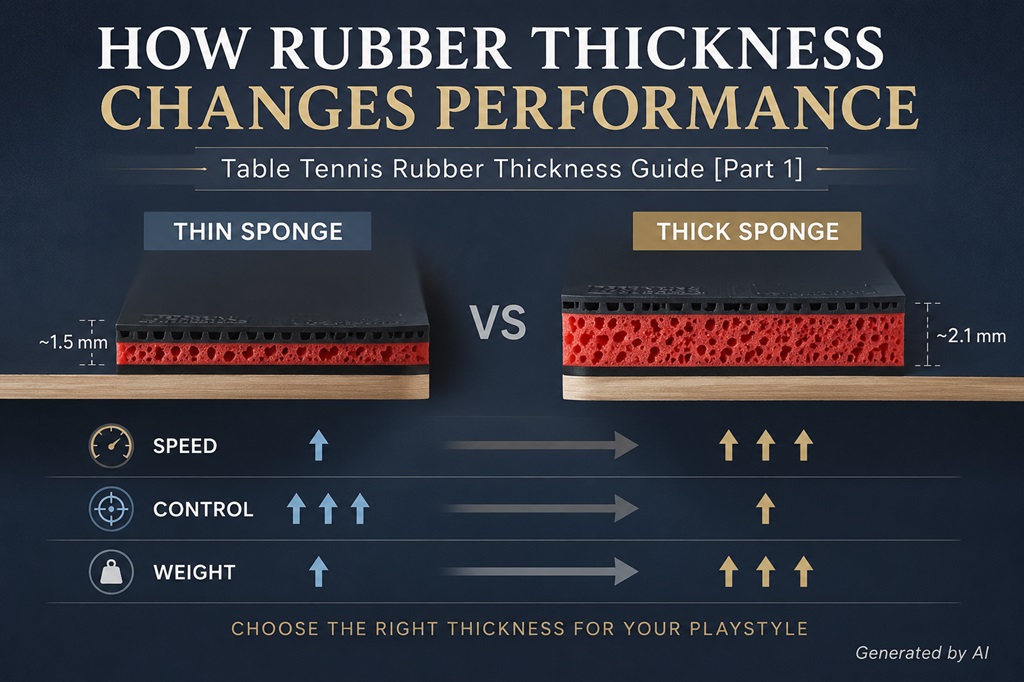
The thickness of table tennis rubber is one of the most important factors that affects both speed and racket weight.
Even within the same rubber model, changing the sponge thickness can make the rubber feel like a completely different piece of equipment.
Choosing the right thickness can help you:
- Generate more speed
- Improve control
- Reduce racket weight
- Match your playstyle and skill level
Understanding rubber thickness is an important step toward improving your equipment selection and overall performance.
In this article, I will explain:
- The basics of rubber thickness
- How thickness affects speed, control, and racket weight
- How sponge thickness changes overall playing feel
2.The Limit of Rubber Thickness
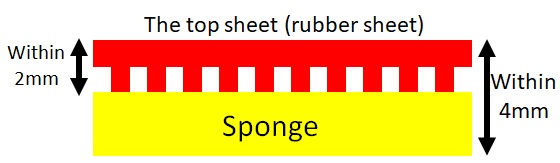
Table tennis rubber has a two-layer structure:
- Top sheet (rubber surface)
- Sponge
International rules strictly limit the maximum thickness of table tennis rubber.
Thickness regulations:
- Top sheet only: Up to 2.0 mm
- Total rubber thickness: Up to 4.0 mm
Rubbers without a sponge are also allowed.
These are called:
- Single Rubber
- OX (O-X)
Their main characteristic is minimal bounce.
Because of the 4.0 mm limit, manufacturers cannot simply increase sponge thickness endlessly to create more speed.
As a result, manufacturers constantly develop new technologies to maximize performance within the official rules.
💡[Column] Manufacturers Challenging the 4 mm Limit
One famous example is the andro Rasanter series released in 2017.
By using a thinner top sheet, andro succeeded in increasing sponge thickness to 2.3 mm (ULTRAMAX).
This design later became a major trend among high-end rubbers.
Today, many manufacturers use similar concepts.
Butterfly’s Xiah 03 is another representative example.
It uses the newly developed “Rico Sheet” to secure a thicker sponge while staying within the 4.0 mm rule.
As one of the newer rubbers attracting attention among advanced players, Butterfly’s Xiah 03 is worth checking out below.


3.How Rubber Thickness is Displayed
Rubber thickness labels vary depending on the manufacturer.
However, most brands display only the sponge thickness.
For example, Nittaku uses the following thickness categories:
Sponge Thickness Lineup
Quoted from the 2026 Nittaku Comprehensive Product Digital Catalog.
- MAX: 2.1mm – MAX
- Super Thick (Tokuatsu): 1.9mm – 2.1mm
- Thick (Atsu): 1.7mm – 1.9mm
- Medium Thick (Chu-atsu): 1.5mm – 1.7mm
- Medium (Chu): 1.4mm – 1.7mm
- Thin (Usu): 1.2mm – 1.4mm
- Super Thin (Goku-usu): 0.9mm – 1.2mm
- Ultra Thin (Cho-goku-usu): 0.4mm – 0.7mm
The reason manufacturers focus on sponge thickness is simple:
- The top sheet thickness is usually identical within the same product line.
- Sponge thickness has a much larger effect on speed and bounce.
Because of this, comparing sponge thickness alone is usually enough to estimate the rubber’s playing characteristics.
However, modern high-end rubbers require extra attention.
Some recent rubbers use thinner top sheets to maximize sponge thickness within the 4.0 mm rule.
Representative examples include:
- Butterfly: Xiah 03
- STIGA: DNA Platinum
- andro: Rasanter Series
These products prioritize:
- Larger sponge volume
- Higher rebound power
- Stronger ball bite
4.What Changes Based on Rubber Thickness?
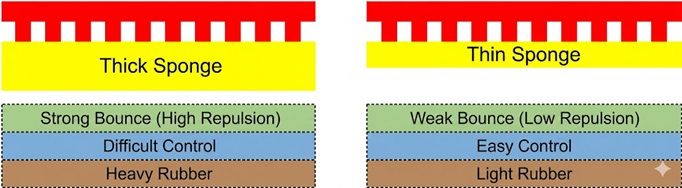
Changing rubber thickness affects three major elements:
- Speed (repulsion)
- Rubber weight
- Control
A thicker sponge increases both speed and rubber weight, while a thinner sponge improves control.
In general:
- Beginners are often recommended “Medium” or “Thick.”
- Advanced players tend to prefer “Super Thick” or “MAX.”
(1)Speed (Repulsion)
The thicker the sponge:
- The deeper the ball sinks into the sponge
- The more elastic energy is generated
- The easier it becomes to produce speed
On the other hand, thinner sponges create a stronger “blade feeling,” which reduces overall bounce.
(2)Racket Weight
The sponge has the biggest impact on rubber weight.
As sponge thickness increases:
- The racket becomes heavier
- Power increases
- Swing speed may decrease
A heavier racket can produce stronger shots, but it also requires more physical strength and can reduce maneuverability.
(3)Control Performance and Ease of Use
“Medium” and “Thick” rubber are often recommended for beginners because they provide better control and are easier to handle.
With extremely thick sponge rubbers, even small impacts can send the ball too far.
This often causes over-misses and unstable shots for developing players.
Using “Medium” or “Thick” rubber helps beginners develop the feeling of controlling the ball themselves.
For many players, choosing the right sponge thickness becomes one of the fastest ways to improve consistency and overall performance.
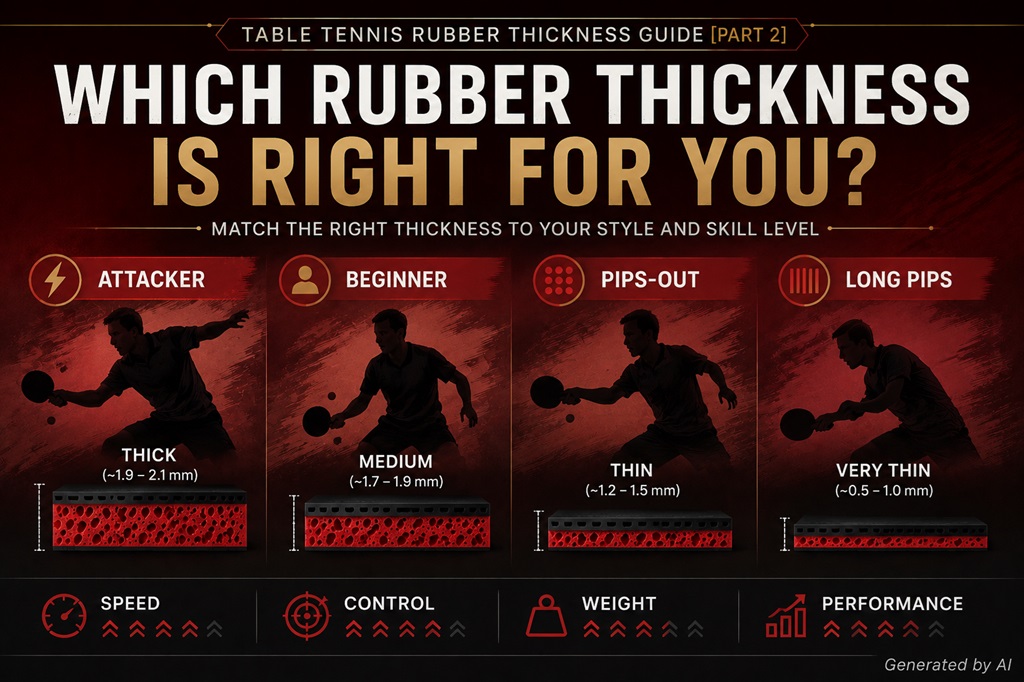
To be continued in Part 2, where we explain how to choose rubber thickness for inverted, pips-out, and long pips rubbers based on playing style and skill level.


-320x180.jpg)


コメント