
1. Introduction
Have you ever played against a player who uses long pips rubber?
Long pips rubber is a specialized rubber that uses the opponent’s spin to create unusual ball changes. If you are unfamiliar with it, these changes can make it difficult to play as usual.
Although its market is smaller than that of inverted rubber, more than 60 long pips models from Japanese and overseas manufacturers are available online.
In this article, I will explain the differences between long pips and short pips, including how pip shape, arrangement, and spacing affect performance. I will also use illustrations to make these differences easy to understand.
2. Differences Between Long Pips and Short Pips
Both long pips and short pips have small pips on the surface that contacts the ball.
However, their different pip shapes affect how easily the pips bend and how the ball behaves at impact. The two types are classified according to the shape ratio defined by the table tennis rules, as explained below.
The key differences are summarized below.
[Long Pips]
The pips bend easily at impact (long and thin pips)
[Short Pips]
The pips are less likely to bend at impact (short and thick pips)
As a result, the two types have different playing characteristics.
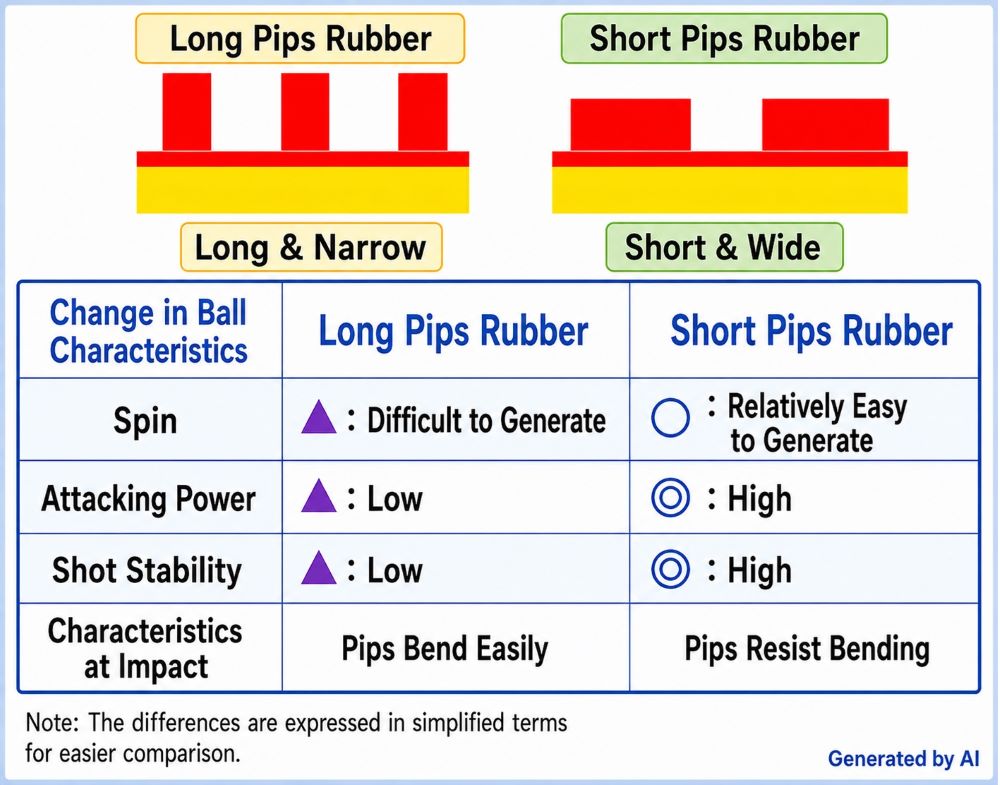
As the table shows, long pips are designed to use the opponent’s spin to change the ball and induce errors.
In contrast, they are less suited to taking the initiative with strong self-generated spin and aggressive attacking play.
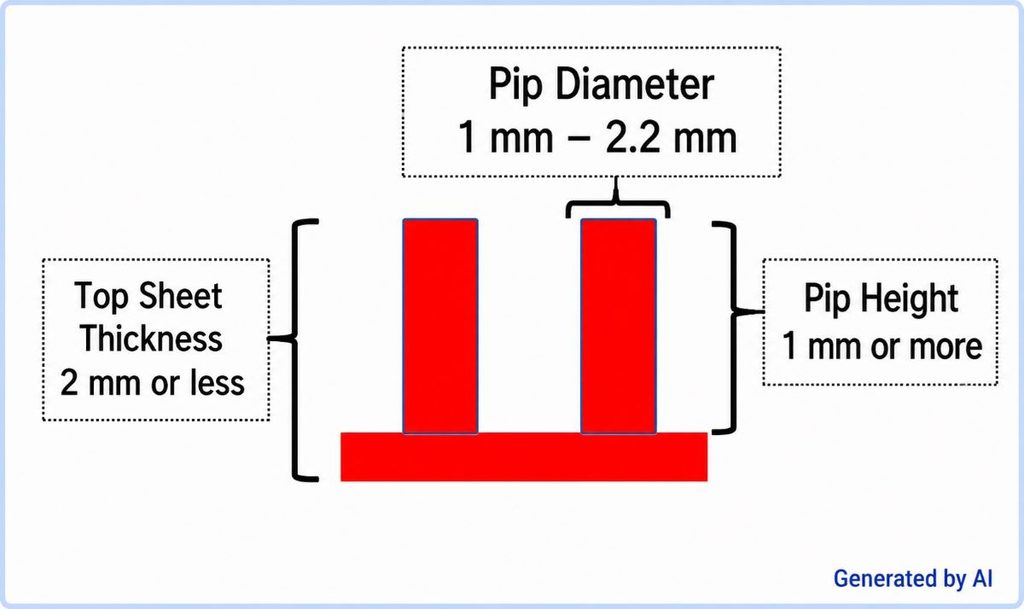
(1) Pip Shape Requirements (Rules for Both Short and Long Pips)
For reference, here are the rules regarding pip shape for long and short pips.
Feel free to skip this section if you are not interested in the details.
• Pip diameter: 1.0–2.2 mm
• Pip spacing: 1.0–2.0 mm
• Pip height: 1.0 mm or more
• Top sheet thickness: 2.0 mm or less
(2) Shape Ratio (Rule for Classifying Short and Long Pips)
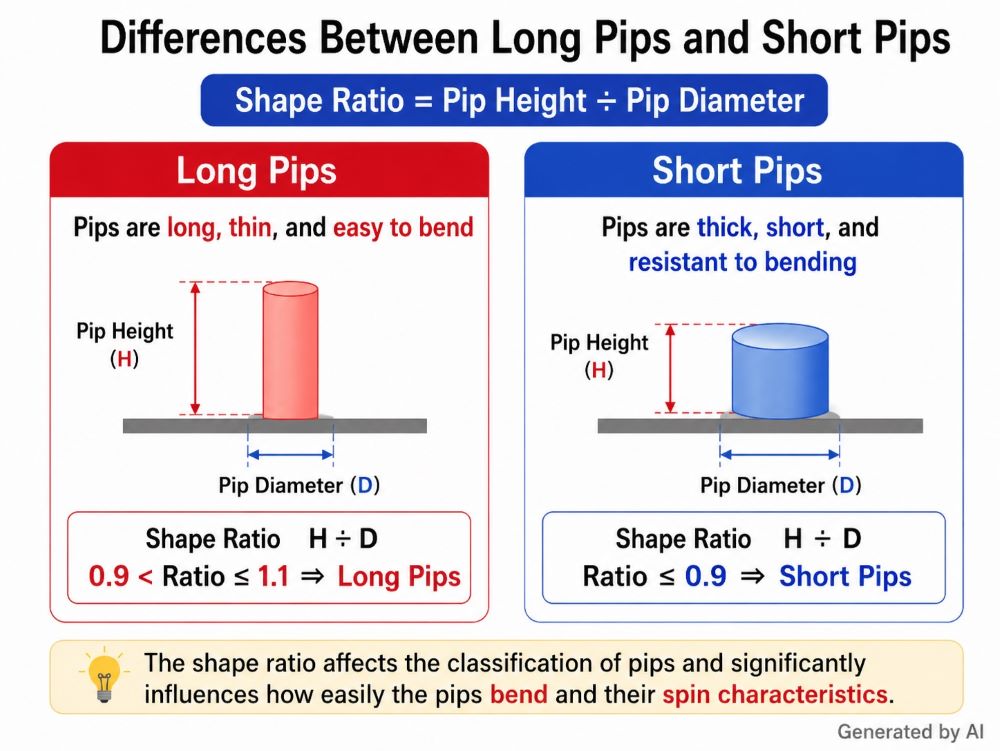
【Calculation Example】
Pip height: 1.0 mm (①)
Pip diameter: 1.0 mm (②)
① ÷ ② = 1.0
→ Since the shape ratio is greater than 0.9 and no more than 1.1, the rubber is classified as “long pips.”
3. Pip Shapes (2 Types)
One characteristic of long pips is their long, thin pip shape.
Although many products look similar at first glance, they can generally be divided into two types.
(1) Cylindrical Type
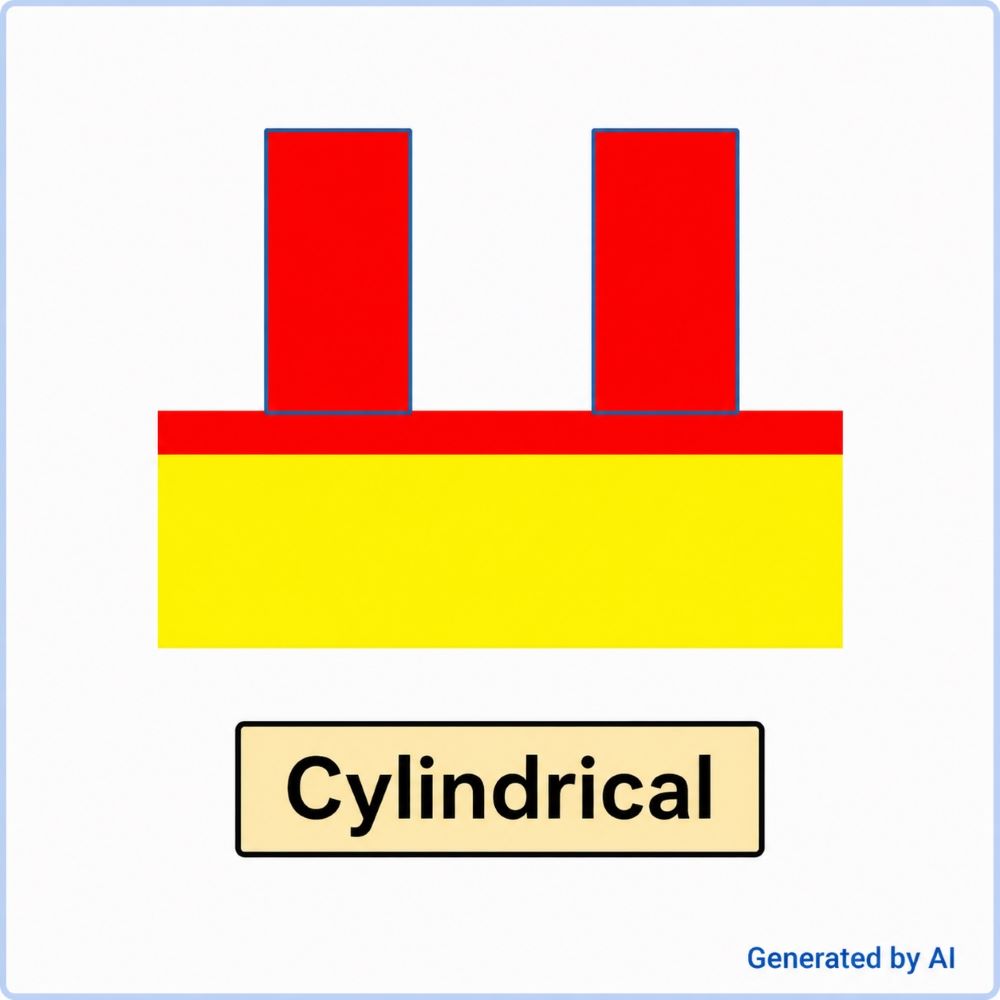
As the name suggests, the pips have a simple cylindrical shape.
Among long pips, this shape is generally considered more likely to bend at impact and produce greater variation in the ball.
(2) Cylindrical + Trapezoidal Type

Because the trapezoidal section supports the pips, this shape is generally considered less likely to bend at impact, making it easier to produce stable shots.
(3) Summary

In general:
- Pips that bend less → More stable shots (stability-focused)
- Pips that bend more → Less stable shots (variation-focused)
Because the rules limit pip diameter, pip shape is likely to have a greater effect on performance than pip size.
4. Pip Spacing
In long pips, the spacing between the pips also affects how the rubber plays.
Generally, a higher pip density means more pips contact the ball, while a lower density means fewer pips make contact. This results in the following differences.
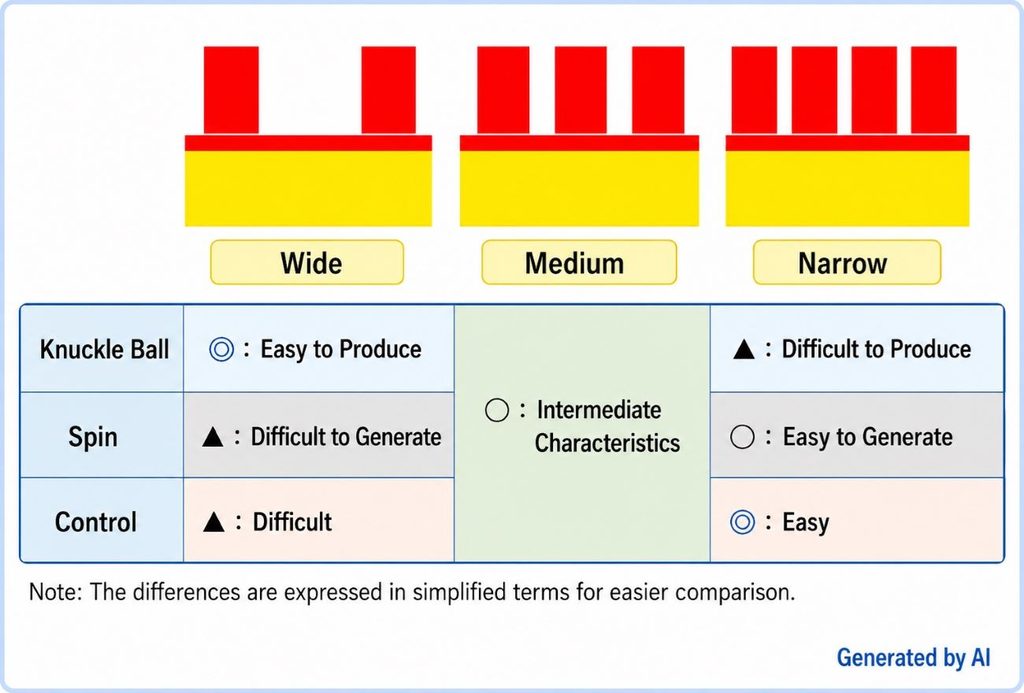
Long pips from different manufacturers typically have pip spacing of about 1.0–1.6 mm, yet even these small differences can affect feel and ball characteristics.
5. Pip Orientation (Vertical vs. Horizontal)
In long pips, performance is said to vary not only with pip shape and size, but also with pip orientation (vertical or horizontal).
Generally, vertical pips are said to make it easier to produce knuckle balls, while horizontal pips are said to make it easier to generate spin.
However, sources such as Table Tennis Kingdom present various views on vertical and horizontal pips, but within the scope of my research for this article, I could not find any scientific or quantitative studies verifying these differences. Therefore, current evaluations are largely based on experience.
In addition, the angle at which the racket contacts the ball and the swing direction vary slightly from player to player. Therefore, it is difficult to explain the differences based on pip orientation alone.
Furthermore, even a rubber with horizontal pips can be rotated by about 30° when applied to the racket, effectively making it a vertical pip orientation. This also suggests that performance is not determined by pip orientation alone. Factors such as pip shape, pip size, spacing, and sponge characteristics all work together to determine how the rubber plays.
For this reason, the characteristics described below should be considered general guidelines rather than definitive conclusions.
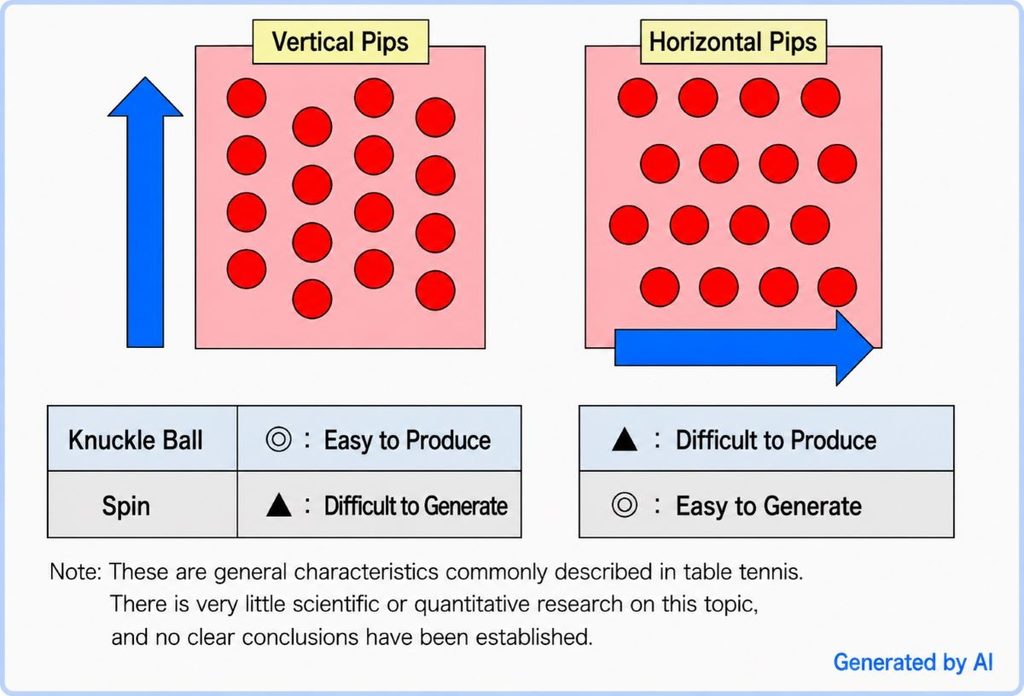
In fact, STIGA (Sweden) sells long pips in both Vertical and Horizontal versions as separate series, with the following design concepts:
- Vertical: Focus on attacking performance
- Horizontal: Focus on variation
However, actual performance depends on more than pip orientation. Playing style, swing technique, and the overall rubber design can significantly affect the feel. Therefore, use the characteristics described in this article as a guide when choosing equipment.
6. Representative Long Pips Rubbers
Here are two well-known long pips rubbers for reference.
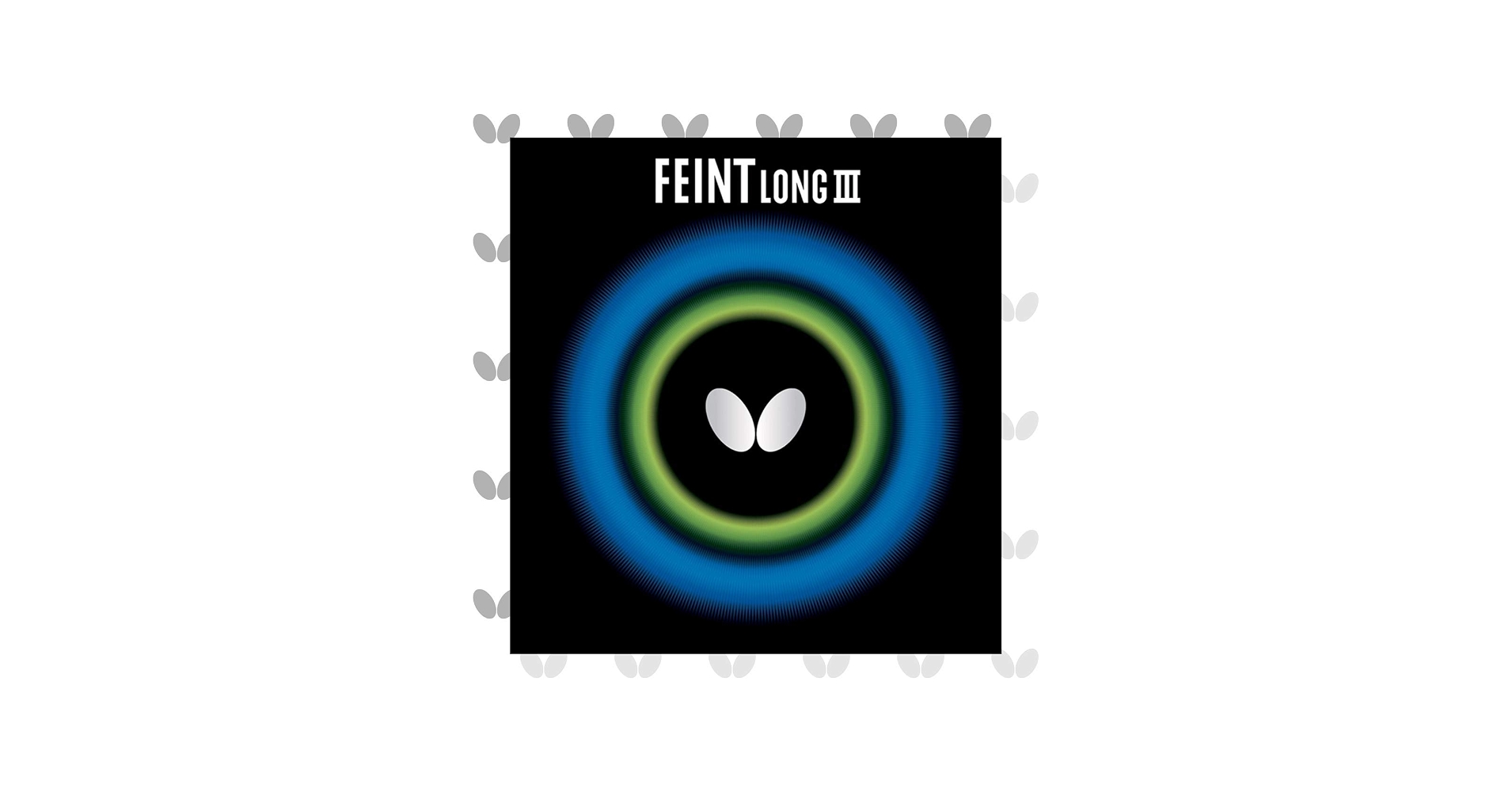
(1) Feint Long III (Butterfly)
One of Butterfly’s signature long pips rubbers, Feint Long III has been a popular choice among defensive players for many years.
It offers stable chopping and good control, making it suitable for players who prioritize defensive consistency as well as variation. It remains a classic long pips model worth considering.

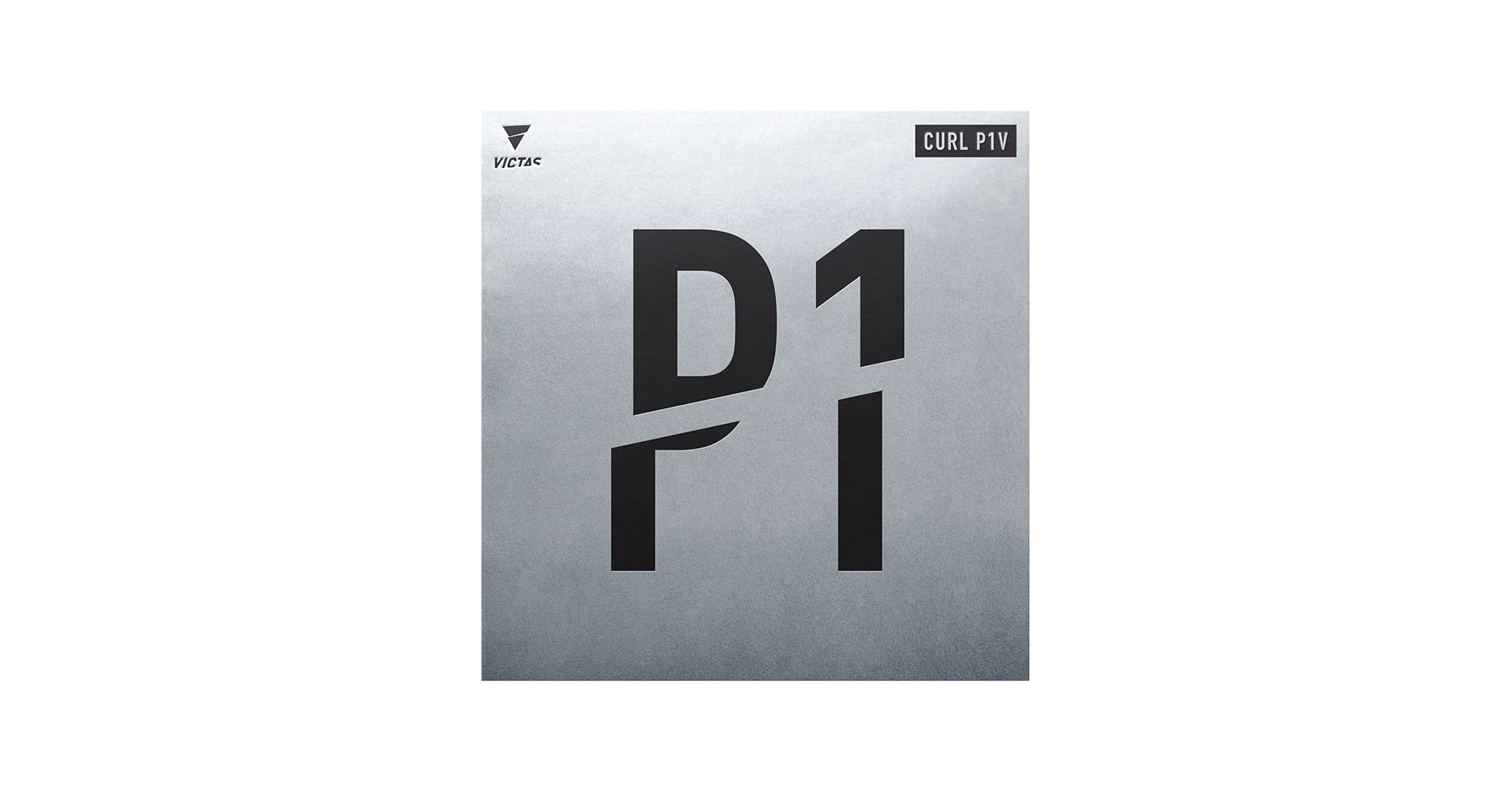
(2) CURL P1V (VICTAS)
CURL P1V is one of the classic long pips rubbers and has remained popular for many years. Many long pips players have tried it at least once.
It is particularly well known as a backhand rubber for defensive players. I have also experienced firsthand how difficult its sharp backhand chops can be to handle against topspin.

7. Conclusion
Long pips are different from inverted rubber: they are difficult to use to generate strong spin on their own, but can create a wide range of variations by utilizing the opponent’s spin.
Common playing styles that use long pips include defensive choppers (long pips on the backhand), penhold long pips (long pips on the forehand), and shakehand attackers with long pips (long pips on the backhand). Each style requires different performance characteristics from the rubber.
When trying long pips, it is important to first identify the playing style you want to develop and then choose equipment that suits it.
Short pips are classified separately under the rules. I have covered them in detail in another article, so please take a look if you are interested.
That concludes this guide. I hope you find it useful.
Related Articles
● Rubber Thickness

● Blade and Rubber Combination

● Rubber Hardness

コメント