1. Introduction
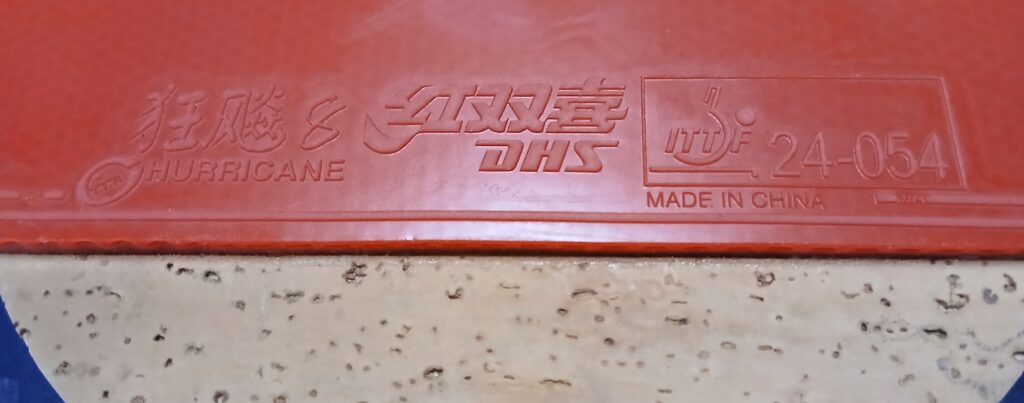
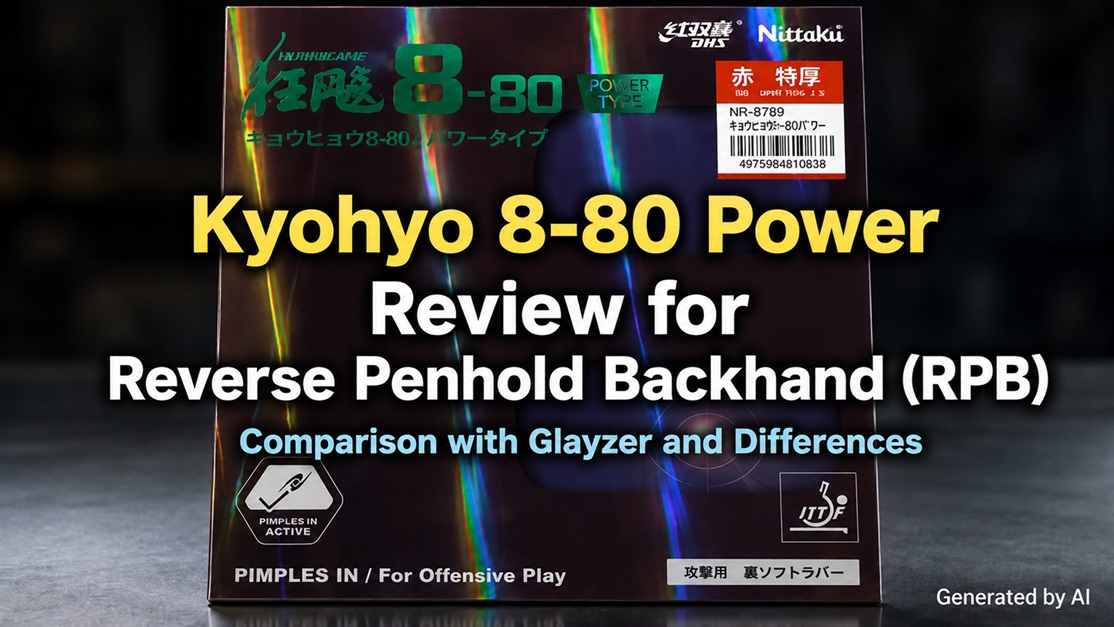
In this review, I share my experience using DHS Kyohyo (Hurricane) 8-80 Power as a rubber for the Reverse Penhold Backhand (RPB).
Over the years, I have tested many RPB rubbers. This time, I evaluated Hurricane 8-80 Power, a Chinese sticky rubber, during actual practice sessions and reviewed its performance in various RPB techniques.
This article is intended for players who already have basic RPB skills.
If you are just starting to learn RPB, I personally recommend beginning with an ultra-thin rubber. Once you develop a good feeling for the ball, upgrading to a high-performance rubber like Hurricane 8-80 Power will be much easier.
2. Equipment Setup
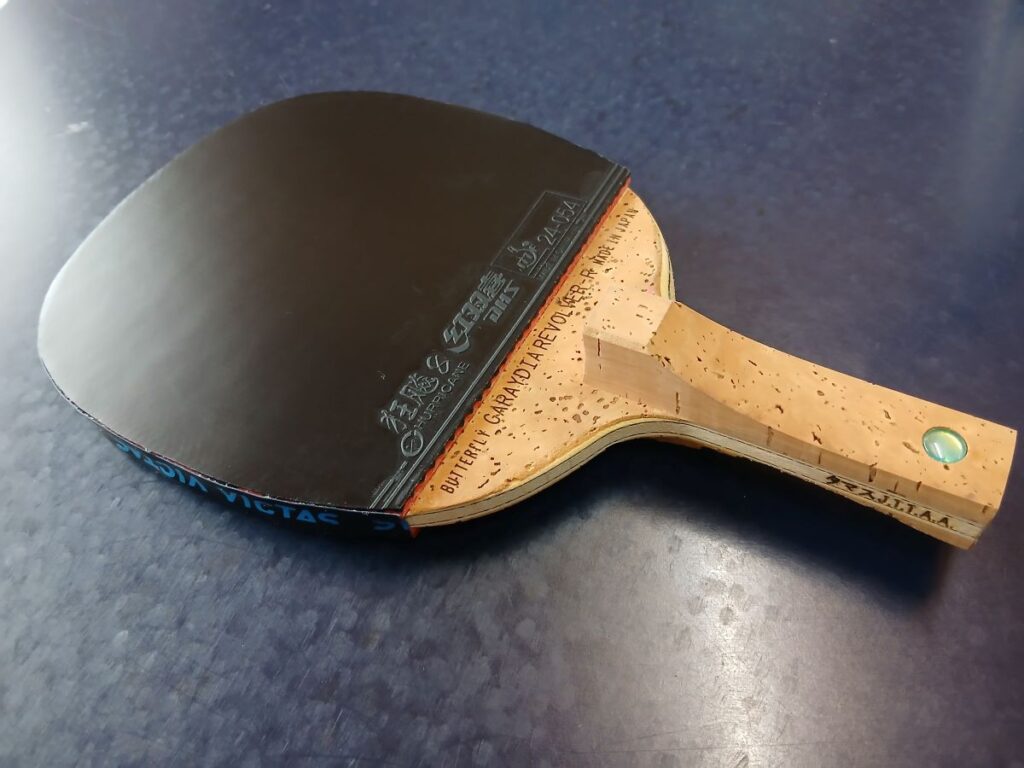
Here is the equipment setup used for this review.
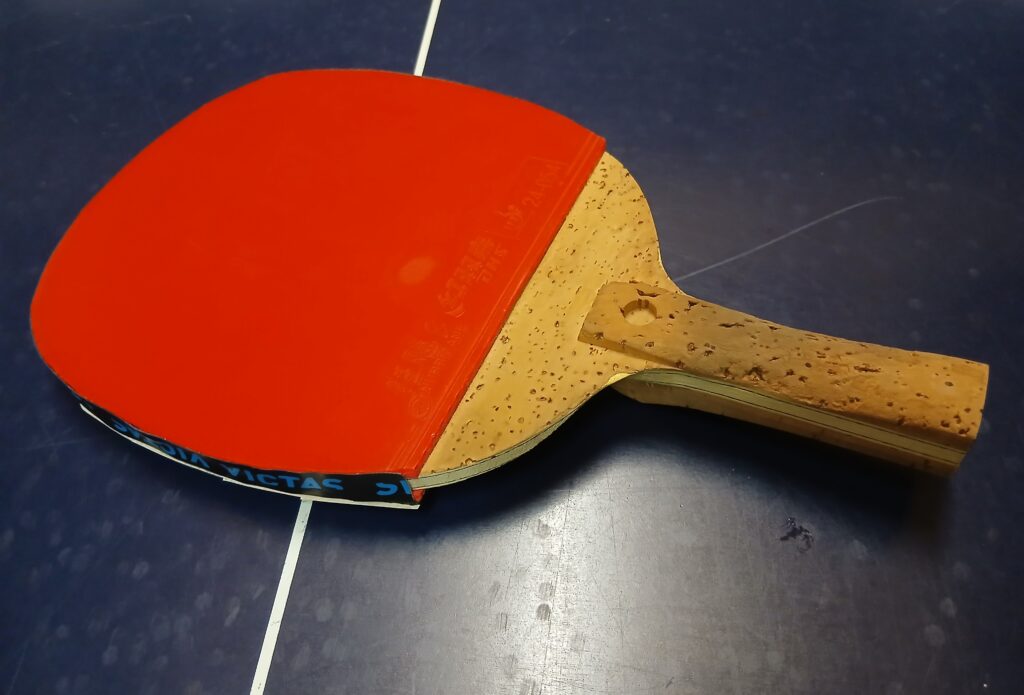
- Blade: Butterfly Galeidia Revolver (Chinese Penhold, Reversible)
- Forehand: DHS Hurricane 8-80 (Max Sponge)
- Backhand (RPB): DHS Hurricane 8-80 Power (Max Sponge)
- Total Weight: 152 g
- Playing Style: Offensive Chinese Penhold player using Reverse Penhold Backhand (RPB)
The Butterfly Galeidia Revolver is a lightweight blade with a 3-ply wood construction reinforced by Arylate Carbon. It offers excellent control without excessive speed, making it a great match for Chinese sticky rubbers.
This review focuses on the performance of Hurricane 8-80 Power on the RPB side. If you are interested in the standard Hurricane 8-80 used on the forehand side, please see my detailed review below.
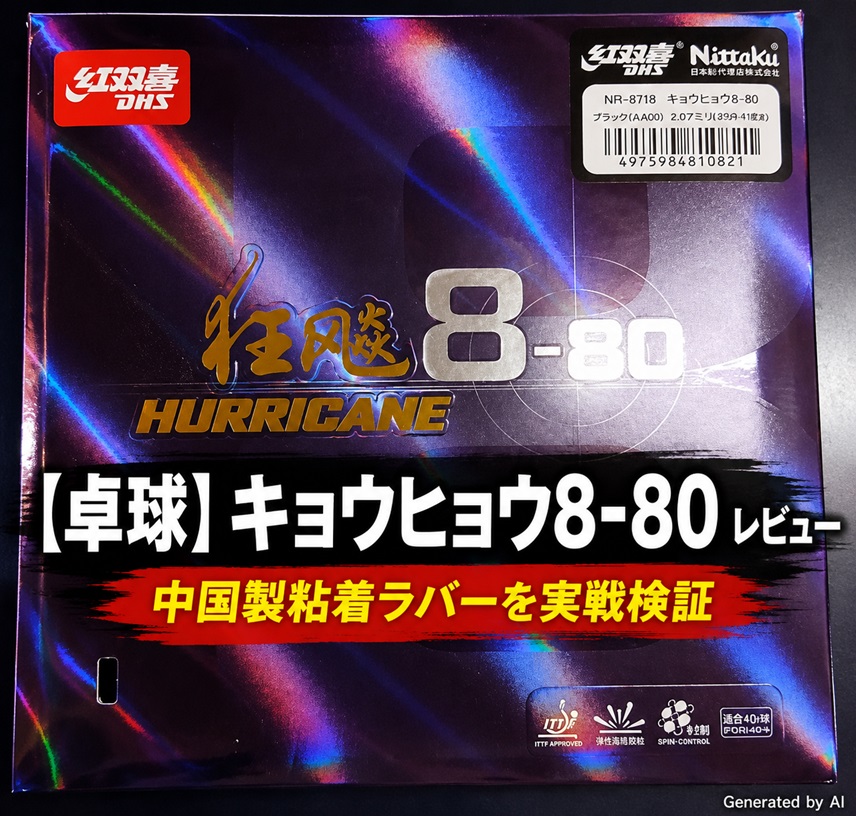
I also introduce this equipment setup in a video. If you’re interested, be sure to watch it at the end of this article.
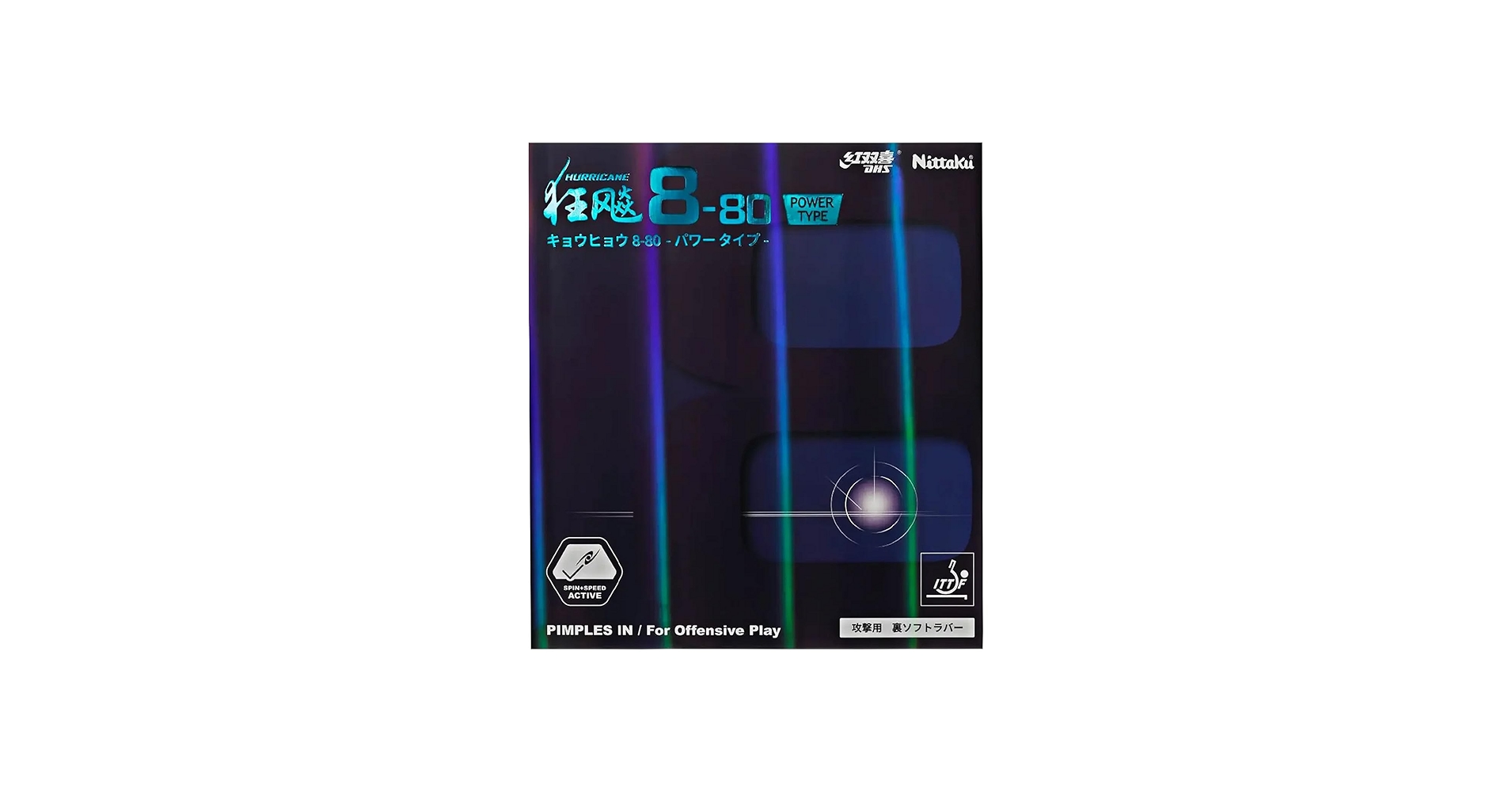
●Check the latest price below.

3. Rubber Weight Analysis
First, let’s compare the weight of each rubber.
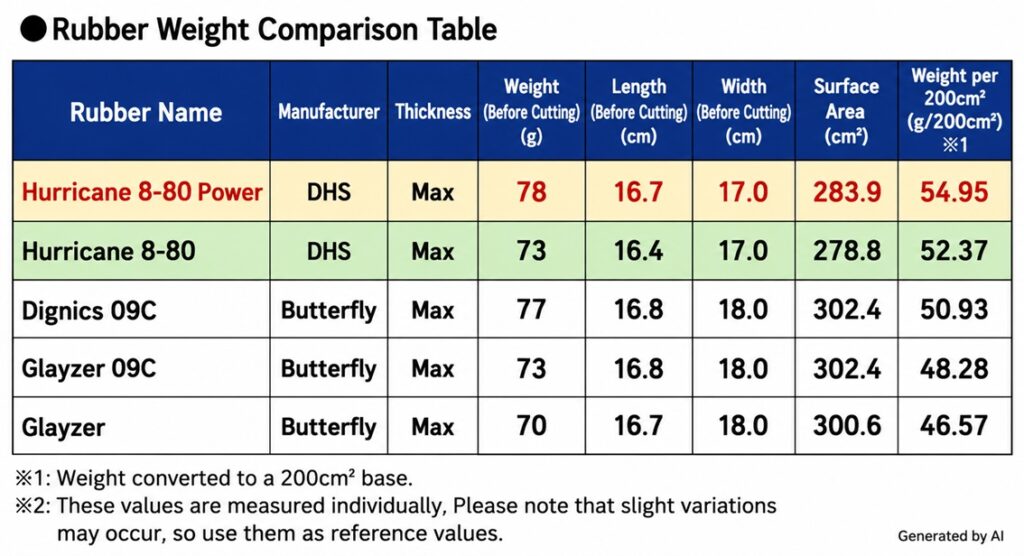
Among the rubbers compared in this review, Hurricane 8-80 Power was the heaviest.
However, for a Chinese sticky rubber, its weight is fairly typical. Compared with modern tension rubbers, though, it is noticeably heavier, so you should consider the total weight of your racket setup.
It weighs about 5 g more than Butterfly Dignics 09C and approximately 8 g more than Butterfly Glayzer.
While the difference is only 5–8 g on one side, using heavy rubbers on both sides can increase the total racket weight by around 10–16 g.
A typical Chinese Penhold blade weighs around 80–90 g. When paired with heavy rubbers such as the Hurricane 8-80 series on both sides, the total racket weight can easily exceed 180 g.
If you prefer a lighter setup, consider using a lightweight blade or choosing a thinner sponge to keep the overall weight under control.
My Butterfly Galeidia Revolver weighs only 55 g after modification, so even with Max Sponge Hurricane 8-80 rubbers on both sides, the total racket weight is just 152 g. If you want to use heavy Chinese sticky rubbers on both sides, pairing them with a lightweight blade is an excellent option.
4. Performance in Reverse Penhold Backhand (RPB)
(1) Blocking
The biggest surprise for me was its blocking performance.
To be honest, blocking with RPB has never been one of my strengths. Even so, I found that simply holding the racket against the ball produced a controlled block, allowing me to return many powerful shots with confidence.
When I used tension rubbers, I often reacted late to unexpected shots and sent the ball long because the rubber was too lively.
With Hurricane 8-80 Power, however, even rushed blocks frequently landed safely on the table.
That feeling of “being able to get the ball back somehow” is a huge advantage in match play.
Tension rubbers make it easy to generate speed with little effort, but I sometimes found them difficult to control during quick reactions.
Hurricane 8-80 Power doesn’t always produce a fast counterattack, but it makes it much easier to keep the ball on the table and stay in the rally.
There were even a few occasions when I was completely wrong-footed and instinctively reached out with my RPB, expecting to miss the ball. Instead, the ball caught the rubber and landed on the opponent’s side. Because my opponent didn’t expect the return, I even won several points this way.
That said, I believe part of this excellent blocking performance also comes from my Butterfly Galeidia Revolver. Its lightweight 3-ply wood and Arylate Carbon construction provides outstanding control. Therefore, these impressions reflect my complete racket setup rather than the rubber alone.
(2) RPB Topspin
When I contacted the ball with a slightly forward impact, Hurricane 8-80 Power produced powerful RPB topspins with an excellent balance of speed and spin.
What impressed me most was the ball trajectory. After bouncing on the opponent’s side, the ball stayed low and skidded forward, making it difficult for opponents to time their blocks.
From mid-distance, where I had enough time to make a full swing and engage the sponge more effectively, I was able to generate even more powerful topspin shots.
When I contacted the ball at the ideal timing, even opponents with strong blocking skills commented that the ball was “fast, stayed low after the bounce, and curved unexpectedly,” making it extremely difficult to return.
I believe this is because many players are accustomed to the higher trajectory of tension rubbers, while the lower, dipping trajectory of a Chinese sticky rubber feels unfamiliar.
Of course, my opponents gradually adjusted during longer rallies. However, the unique trajectory was clearly an advantage when they faced it for the first time.
(3) Loop Topspin
Loop topspins are one of the greatest strengths of Chinese sticky rubbers.
Hurricane 8-80 Power also performed exceptionally well in this area. By brushing the ball with the rubber surface, I was able to generate heavy topspin with ease.
One of the most distinctive features of this rubber is its unique trajectory. To opponents, it often feels as if the ball accelerates after the swing, a characteristic that is typical of Chinese sticky rubbers.
(4) Flat Hits
Flat hits are another shot I use more often than expected when playing with Reverse Penhold Backhand (RPB).
Low balls can usually be attacked with an RPB topspin, but when the ball bounces high, it becomes surprisingly difficult to find the correct racket angle. In those situations, I often choose a flat hit instead.
Flat hits felt very comfortable with Hurricane 8-80 Power.
Of course, high-tension rubbers can produce faster shots with less effort. However, because Hurricane 8-80 Power is less bouncy, I could swing with confidence while aiming precisely at my target.
I also like the slightly harder feel of this Chinese sticky rubber, which allows me to produce flat hits with a slight knuckle effect. However, this is largely a matter of personal preference.
(5) RPB Banana Flick Receive
I was also very impressed with the RPB banana flick receive.
What stood out the most was the confidence I felt when the ball gripped the rubber firmly at contact.
Because the rubber grips the ball so well, I can generate heavy spin with confidence. Even when I miss a shot, I know it was due to my technique—not the rubber.
I also found the speed of my banana flicks to be more than adequate for match play. Although it is not as fast as a high-tension rubber, a solid impact still produces enough speed to put pressure on the opponent.
A banana flick with heavy spin is always a dangerous weapon. However, if the ball is too slow, opponents will quickly adapt during a match. Hurricane 8-80 Power offers an excellent balance of spin and speed, making it highly effective in competitive play.
On the other hand, its high spin potential also makes it more sensitive to the opponent’s serve spin. A strong impact can overcome the incoming spin, but otherwise, reading the serve accurately becomes even more important.
In my own experience, using this rubber has made me pay much closer attention to reading my opponent’s serve. As a result, I feel that my concentration during receive has also improved.
5. Hurricane 8-80 Power vs. Glayzer
(1) Comparison with Glayzer
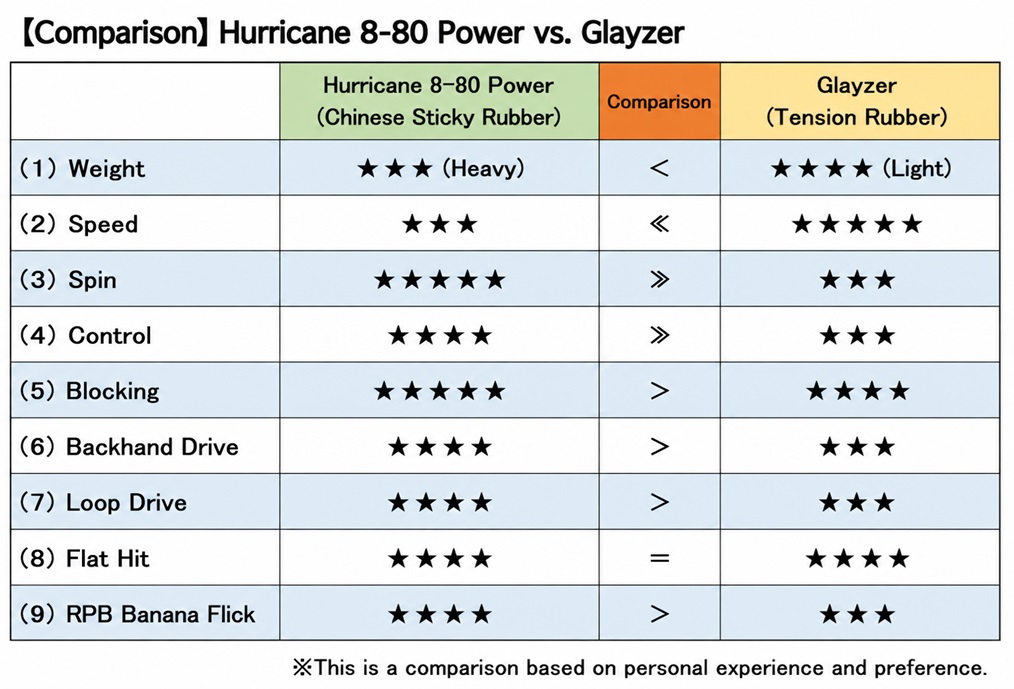
Before switching to Hurricane 8-80 Power, I used Butterfly Glayzer as my RPB rubber.
Glayzer is an excellent all-around rubber, but I wanted to increase the amount of spin in my game, which led me to choose Hurricane 8-80 Power.
As shown in the comparison table, Hurricane 8-80 Power is heavier, but it offers better spin, control, and blocking performance. Glayzer, on the other hand, has the advantage in speed.
Since I value spin more than outright speed, I have been very satisfied with this change.
Choose Glayzer if you prioritize speed. Choose Hurricane 8-80 Power if you value spin and control.
(2) Comparison with Hurricane 8-80
I also compared Hurricane 8-80 Power with the standard Hurricane 8-80.
Overall, the differences between the two rubbers were surprisingly small, and I rarely noticed a clear difference during actual play.
If I had to point out a difference, Hurricane 8-80 Power produced a slightly higher-pitched sound at impact and felt just a little faster.
By comparison, Hurricane 8-80 had a slightly firmer feel, which made it easier to generate heavier spin on loop topspins.
For my own playing style, I prefer Hurricane 8-80 on the forehand, where I prioritize powerful loop topspins and maximum spin. On the backhand, Hurricane 8-80 Power is a better fit because it offers slightly more speed and pairs exceptionally well with Reverse Penhold Backhand (RPB).
6. The Unique “Awkward Ball” Effect
The appeal of Chinese sticky rubbers goes beyond their impressive spin. They can also produce what Japanese players often call an “awkward ball”—a shot with an unusual trajectory and bounce that opponents find difficult to handle.
For me, this unique ball behavior is one of the main reasons I continue to use Chinese sticky rubbers.
The “awkward ball” effect is a fascinating topic that deserves its own article, so I won’t cover it in detail here. If you’d like to learn more, please check out the article below.
7. Final Verdict
Hurricane 8-80 Power has been one of the most satisfying RPB rubbers I have ever used. As a player who values spin above all else, it perfectly matches my playing style.
I was especially impressed by its blocking performance, spin potential, and the confidence it gave me to control the ball. Compared with a high-tension rubber, it is slightly slower, but the additional spin and consistency more than make up for that trade-off.
If you are an RPB player who values spin and consistency over outright speed, I can confidently recommend Hurricane 8-80 Power.
On the other hand, it may be difficult for players who are just beginning to learn Reverse Penhold Backhand (RPB).
On this blog, I recommend starting with an ultra-thin rubber to develop proper RPB technique before moving on to more advanced rubbers like Hurricane 8-80 Power. You can learn more about ultra-thin rubbers in the article below.
If you already have a solid foundation in RPB, I highly recommend giving Hurricane 8-80 Power a try.
At this point, it is one of the best RPB rubbers I have ever used, and I expect it to remain in my racket for the foreseeable future.
●Check the latest price on Amazon below.
You can also see my complete equipment setup in the video below.
Related Articles
Hurricane 8-80 Review (Forehand)

Butterfly Galeidia Revolver Review

How to Choose a Chinese Sticky Rubber
コメント