1. Introduction
I often check table tennis manufacturers’ catalogs to see the average weight of their blades.
One day, I decided to compare blade weights across different brands. After creating a comparison table, I found the results surprisingly interesting. That’s why I decided to share them in this article.
My previous article was based on the 2024 catalogs.
After reviewing the latest 2026 catalogs, I was surprised to find that the number of blades weighing less than 80g had increased significantly compared to 2024.
• 2024: 16 blades
• 2026: 26 blades
This article compares the catalog-listed average weights of Chinese penhold blades from major table tennis brands.
If you’re looking for a lightweight blade, I hope you’ll find this comparison helpful.
All data in this article is based on the official 2026 catalogs published by each table tennis equipment manufacturer.
You may wonder why this is a “Top 16” ranking instead of a Top 10 or Top 20.
The reason is simple. Among the 121 Chinese penhold blades included in this survey, 26 weighed less than 80g. For this ranking, I selected only the blades weighing 76g or less, which I consider to be truly lightweight.
Finally, I’ll also introduce the blade used by Félix Lebrun, one of the world’s top Chinese penhold players.
2. Notes on This Comparison
(1) Manufacturers Included in This Comparison
This comparison covers nine manufacturers that either publish Japanese catalogs or provide average blade weights on their official websites.
For Butterfly, I used the latest weight data available on its official website.
Instead of relying on printed catalogs, Butterfly updates its website regularly. This allows the company to provide the most accurate and up-to-date product information.
I appreciate Butterfly’s commitment to keeping its product data accurate and current.
I did not include Chinese table tennis manufacturers because I could not find Japanese-language catalogs. If such catalogs exist, please accept my apologies for overlooking them.
DONIC and XIOM were excluded because their websites do not list average blade weights.
JOOLA, Killerspin, and Dr. Neubauer were also excluded because they do not appear to offer Chinese penhold blades.
I was also unable to verify Avalox because its official website is no longer available. As someone who remembers the brand well, I found this a little disappointing.
Manufacturers Compared: 9
Butterfly, Nittaku, VICTAS, Yasaka, TIBHAR, Mizuno, STIGA, andro, JUIC
(2) How Average Blade Weight Is Listed
The way manufacturers list average blade weights varies slightly. For this comparison, all values are treated as equivalent.
Example (Average Blade Weight: 80g)
Butterfly: Average Weight 80g
STIGA: Average Weight (g) 80 ± 5
(3) About This Article: A Comparison of Catalog Specifications
This is not a hands-on equipment review. Instead, it is a comparison of the average blade weights published in the official catalogs and websites of each manufacturer.
I have not personally tested every blade included in this article. Therefore, this ranking is not intended to evaluate playing performance or recommend specific models.
Please use this article as a reference when comparing catalog specifications.
Note: I have included brief comments on the blades that I personally own or have used.
For some lower-ranked blades that I find particularly interesting, I’ve also included photos.
Now, let’s take a look at the ranking.
*All USD prices in this article are approximate and calculated using an exchange rate of US$1 = ¥150.
3. Lightweight Chinese Penhold Blade Ranking (No. 13 and Below)
Let’s start with the blades ranked 13th and below.
13th Place (Average Weight: 76g)
Titanium Turbo (JUIC) – ¥25,300 (tax included)
Pimple Blade C (Nittaku) – ¥8,800 (tax included)
Fistarc C (Nittaku) – ¥8,250 (tax included)
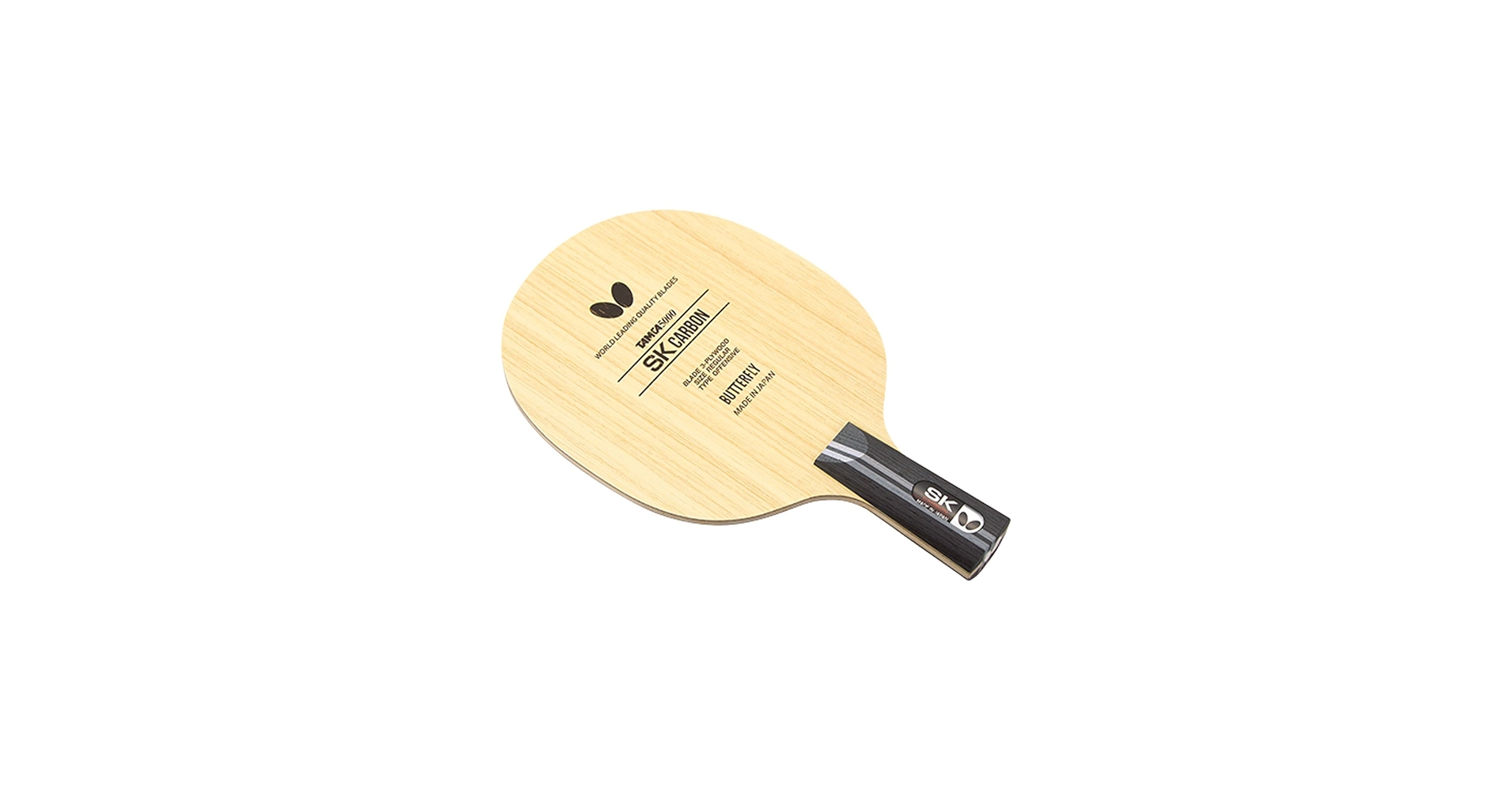
SK Carbon-CS (Butterfly) – ¥8,580 (tax included)
Personally, the SK Carbon-CS is one of my favorite blades because of its stylish design.
Since it uses composite material, the blade has a relatively crisp feel. However, thanks to its 3-ply construction, it feels softer than many other composite blades.
I think it’s a great choice for players who want to try a composite Chinese penhold blade for the first time.
Note: In general, blades become heavier and feel harder as the number of plies increases (3-ply → 5-ply → 7-ply).

4. Lightweight Chinese Penhold Blade Ranking (7th Place)
Next, six blades share an average weight of 75g.
7th Place (Average Weight: 75g)
- PROSPIRE 7 OFF (andro) – ¥9,020 (US$60, tax included)
- PROSPIRE 5 OFF (andro) – ¥7,920 (US$53, tax included)
- TIMBER 5 OFF (andro) – ¥7,150 (US$48, tax included)
- Blockman CHN (VICTAS) – ¥8,250 (US$55, tax included)
- Arsnova (VICTAS) – ¥7,920 (US$53, tax included)
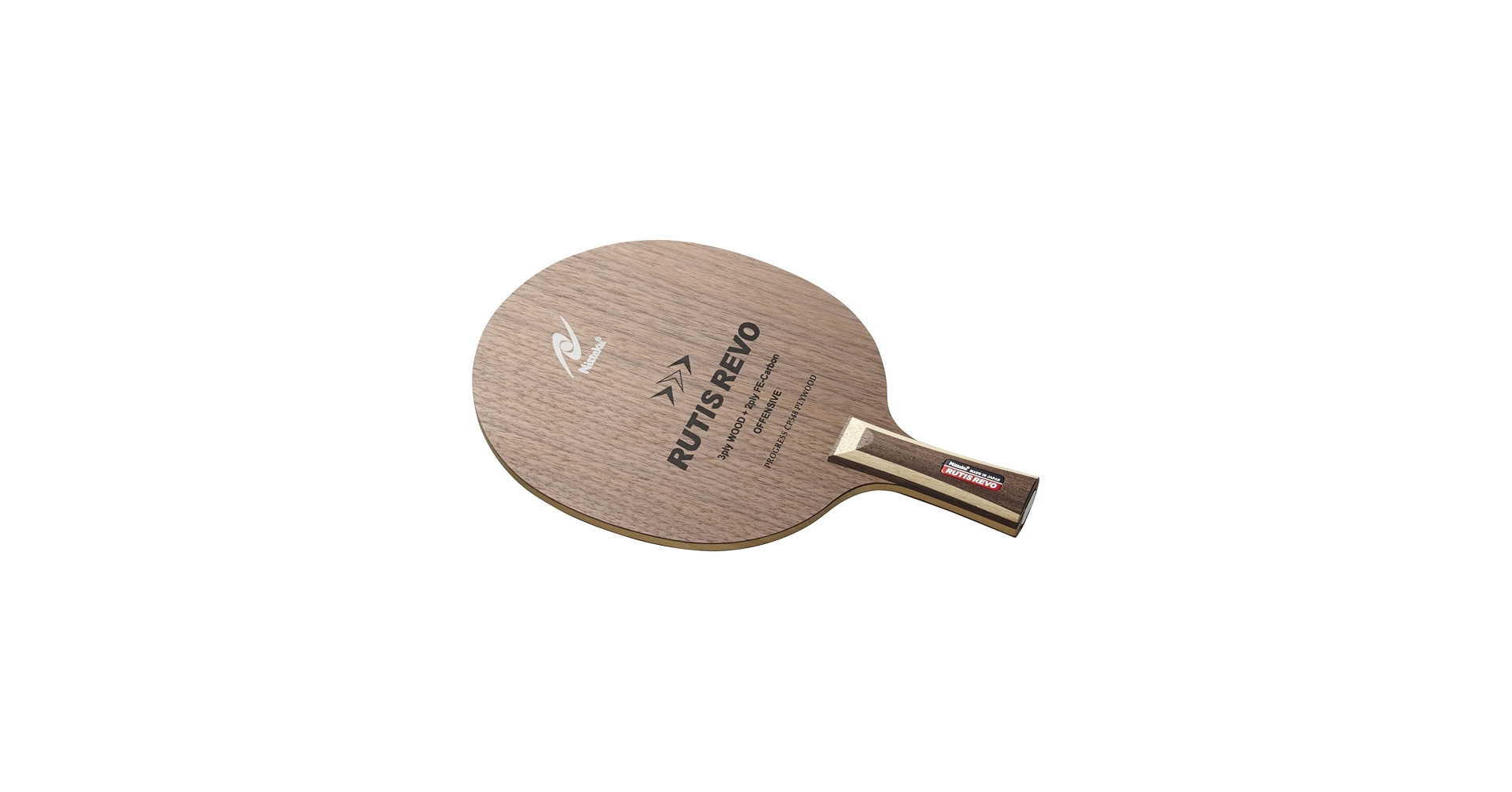
- Rutis Revo C (Nittaku) – ¥14,300 (US$95, tax included)
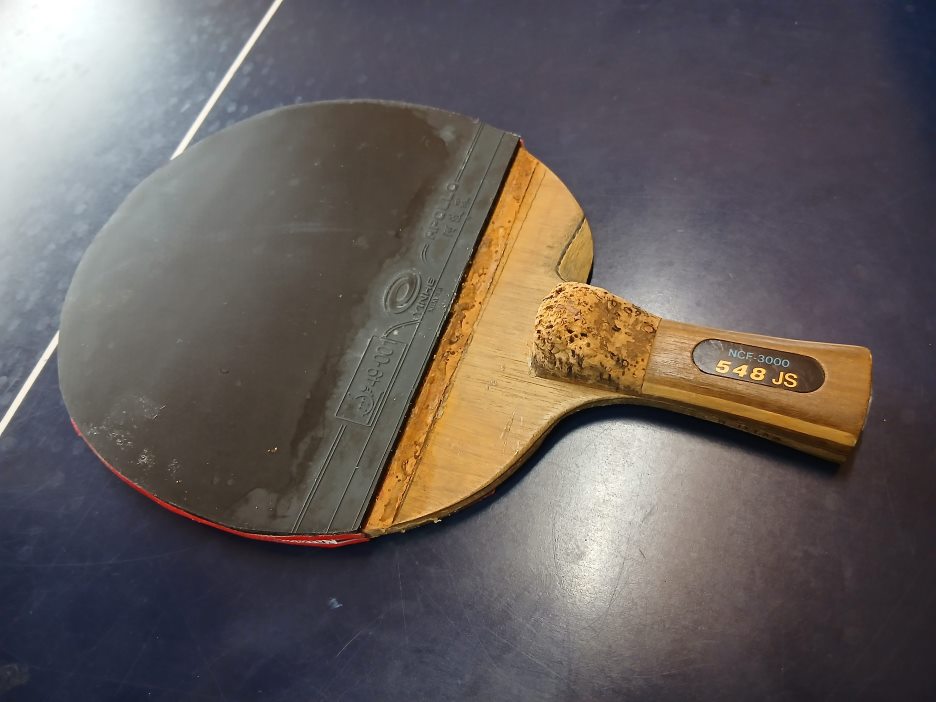
Among these blades, the Rutis Revo C is the one I’m most familiar with.
More than 20 years ago, this blade was sold under the name “548JS.” The current Rutis Revo C inherits its shape and playing characteristics.
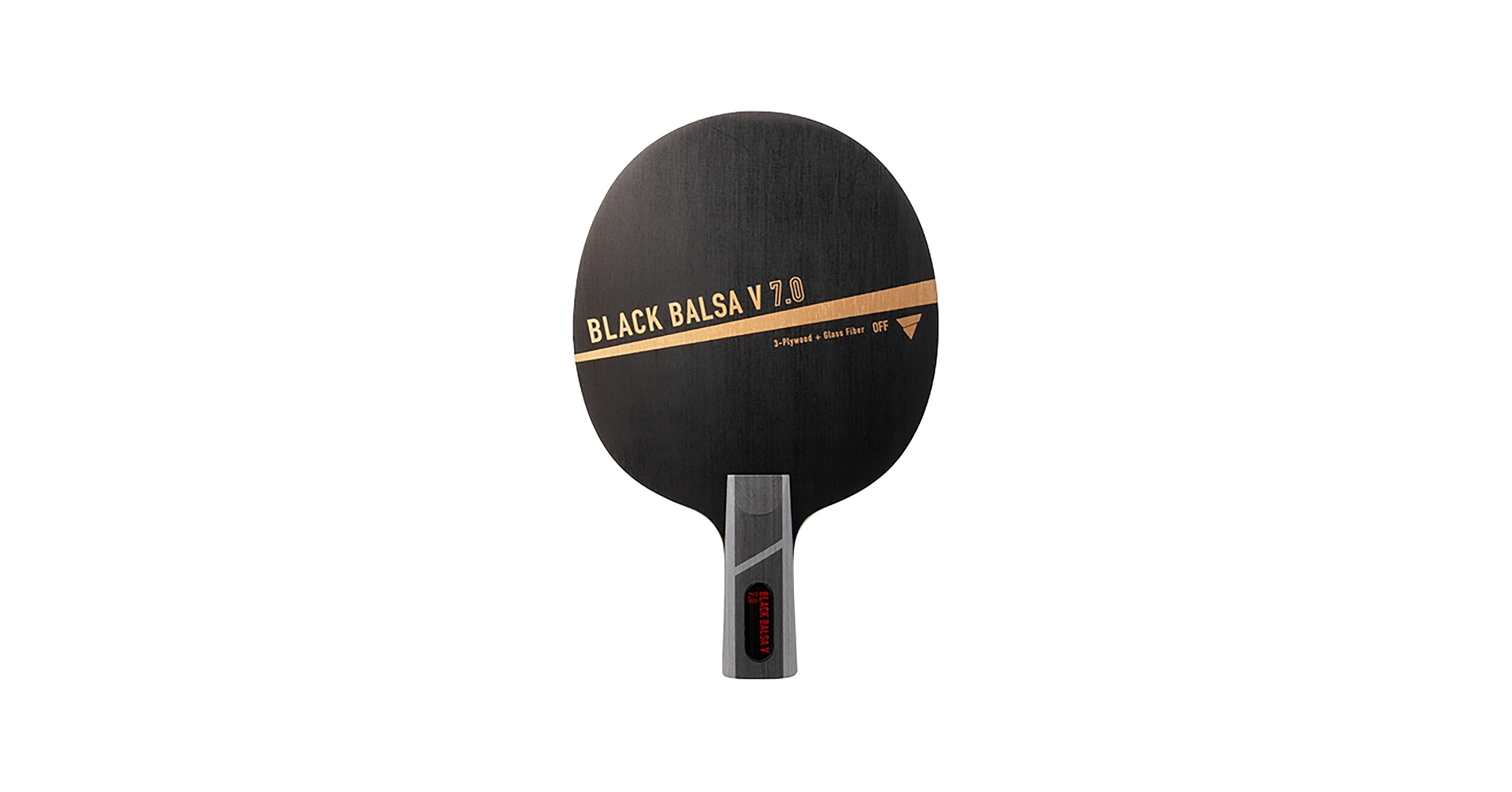
This blade is available in two versions. One is a standard Chinese penhold model, while the other features a cork-covered grip that can be held like a Japanese penhold blade, as shown in the photo below.
Some experienced players at my local club still enjoy using this blade later in life, often pairing it with long pimple rubber on the backhand side.
Like many composite blades, it has a crisp feel. However, it is easy to control, making it one of my personal recommendations.

5. Top 6 Lightweight Chinese Penhold Blades

6th Place (Average Weight: 72g)
Titanium Turbo CH+S (JUIC) – ¥25,300 (US$169, tax included)
When I last checked, this blade was priced in the US$60–70 range. It now costs about ¥25,300 (US$169), nearly twice as much.
Note: The Chinese penhold version of the Titanium Turbo is available in two grip sizes.
Standard grip (CH): 76g
Slim grip (CH+S): 72g (lighter due to the slimmer grip)
The most powerful blade in the JUIC Titanium Series.
Source: JUIC Official Website
The titanium mesh material provides excellent rebound and control, making attacking play easier. Its lightweight design allows players to swing freely even with rubbers on both sides, making a wide variety of techniques easier to perform.
5th Place (Average Weight: 65g)
TIMBER 5 DEF (andro) – ¥8,250 (US$55, tax included)
When I last checked, this blade was priced at ¥7,480 (about US$50). Even after the price increase, I think the current price of ¥8,250 (US$55) is still reasonable.
A defensive blade with outstanding ball control.
Source: andro Official Website
Its low-rebound design absorbs the power of incoming shots, making it easier to return the ball with consistency. It is an excellent choice for defensive players who want to improve their fundamentals, stability, and overall defensive play.
4th Place (Average Weight: 60g)
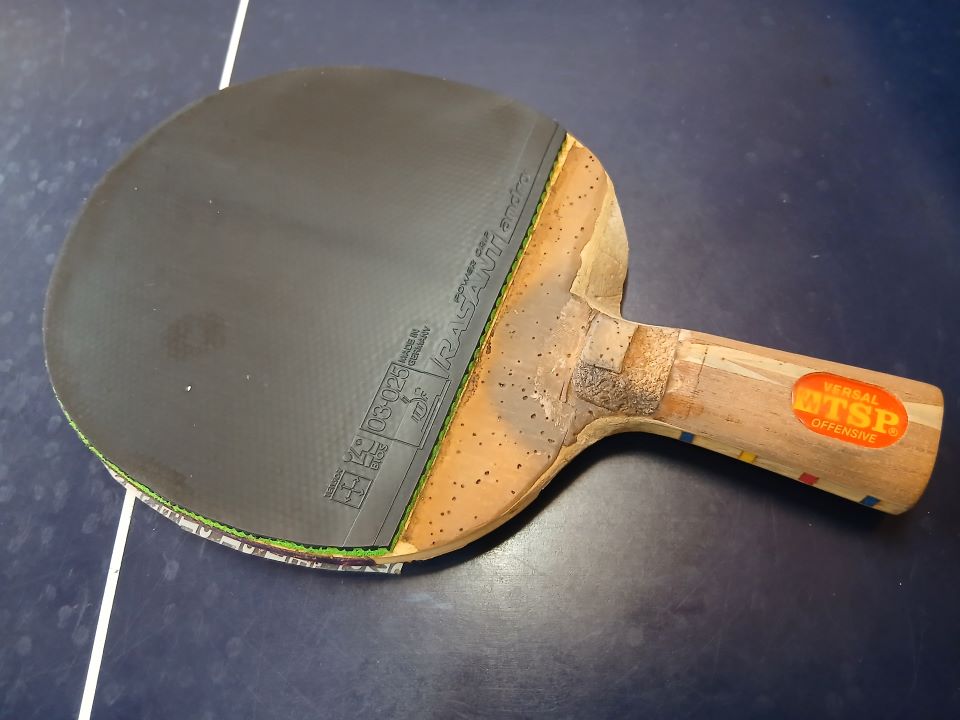
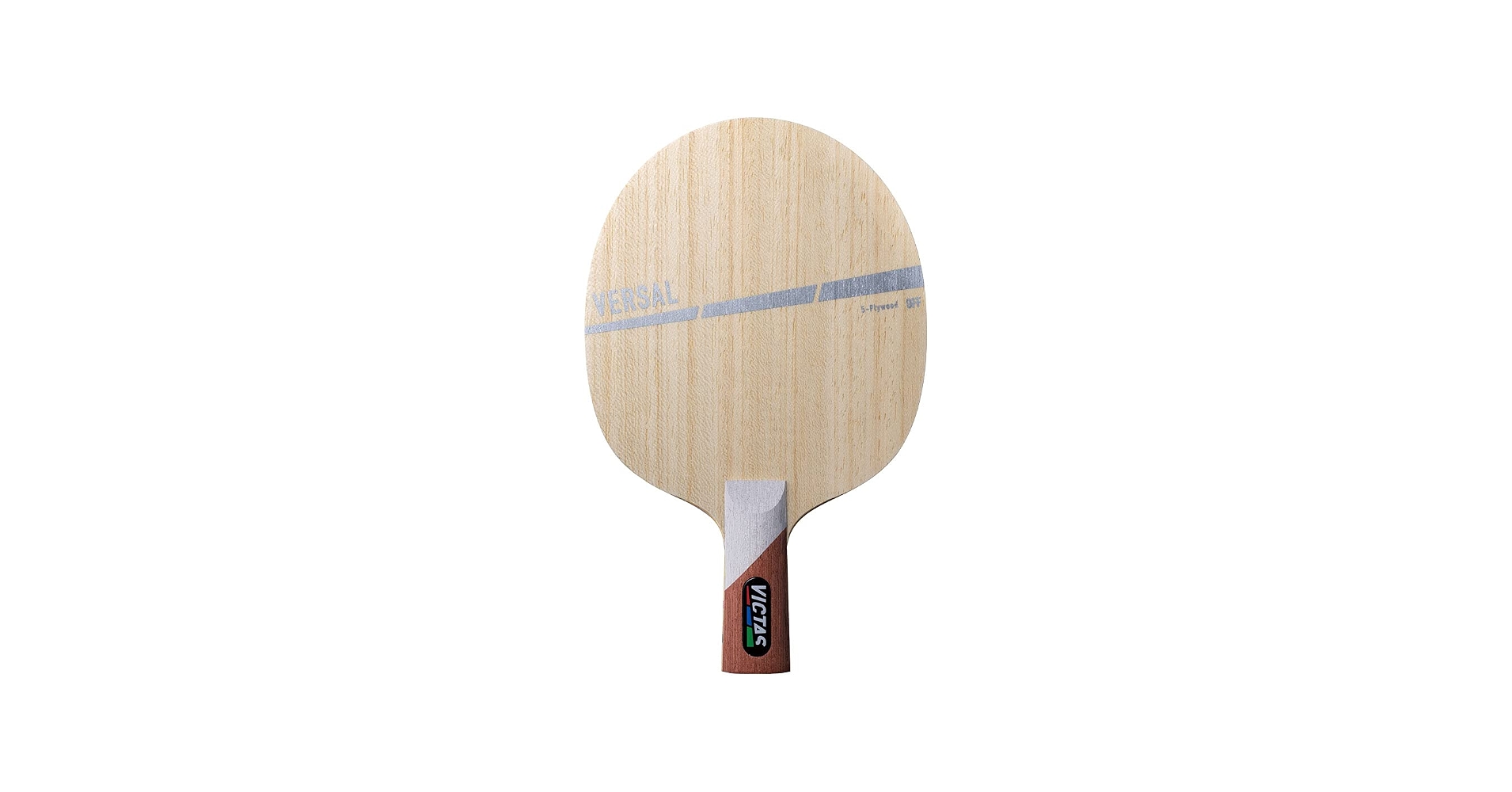
Balsa CHN (VICTAS) – ¥9,240 (US$62, tax included)
From this point on, every blade in the ranking weighs 60g or less. All of the remaining blades are made with ultra-lightweight balsa wood.
For reference, here’s my own Balsa CHN. I purchased it when it was still sold under the TSP brand (now integrated into VICTAS), and it weighs an incredible 53g.
Note: I’ve modified it quite a bit over the years, so it’s a little embarrassing to show!
An ultra-lightweight blade designed for fast swings.
Source: VICTAS Official Website
Its 6 mm thick balsa core keeps the blade exceptionally light despite its thickness, while the sponge built into the handle provides a comfortable feel at impact.

3rd Place (Average Weight: 58g)
KANTER FO OFF (andro) – ¥12,100 (US$81, tax included)
As an overseas manufacturer, andro is one of the few companies that continues to offer Chinese penhold blades. I also like the clean, modern design of their products.
A lightweight offensive blade built for continuous attacking play.
Source: andro Official Website
Its balsa core and high-performance TXL fiber outer layers deliver excellent speed while keeping the blade exceptionally light. The easy-to-swing weight helps players maintain fast, continuous rallies with powerful attacking strokes.
2nd Place (Average Weight: 53g)
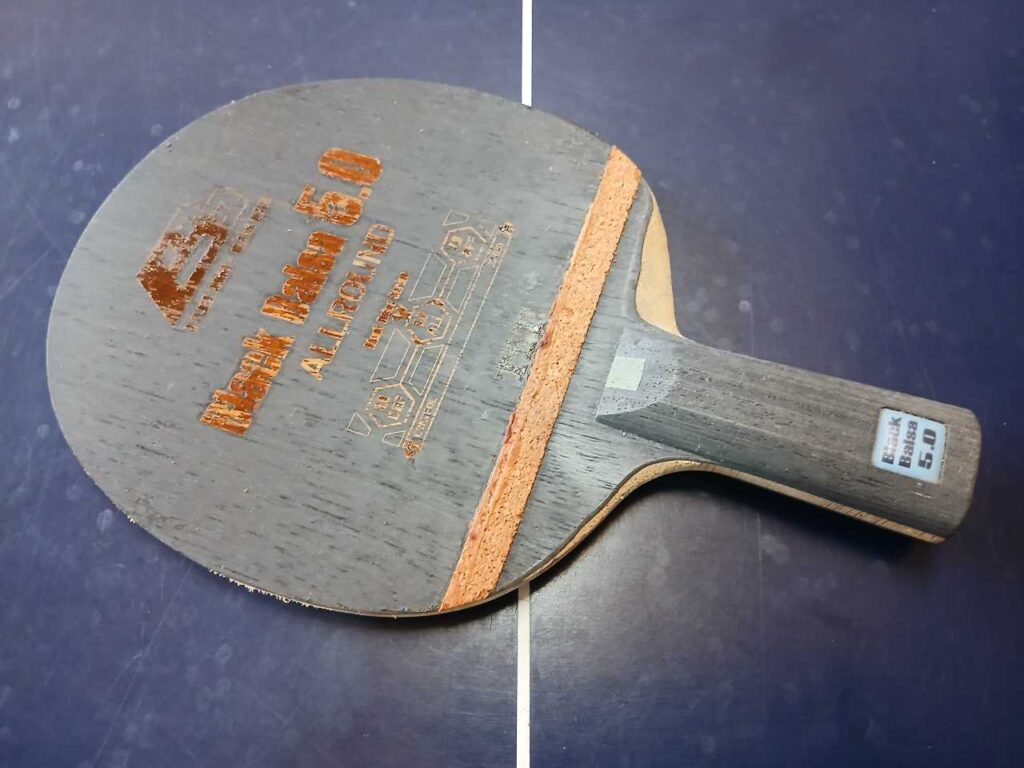
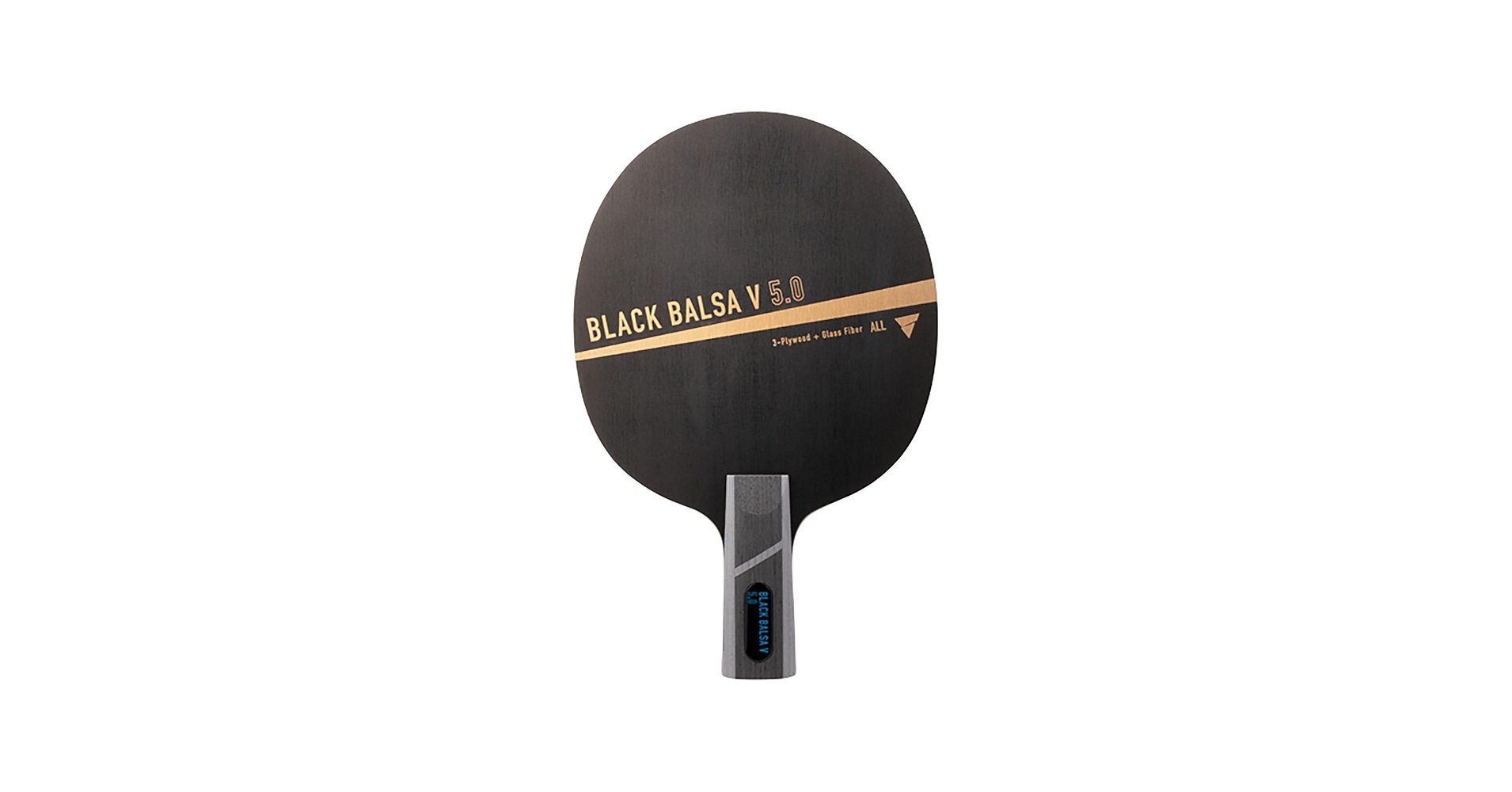
Black Balsa V 5.0 CHN (VICTAS) – ¥9,240 (US$62, tax included)
As a big fan of lightweight blades, I also played with the original Black Balsa 5.0 CHN back when it was sold under the TSP brand. It was incredibly light and extremely easy to maneuver.
However, its rebound at ball impact is relatively low, making it better suited for defensive or all-round play than aggressive attacking.
Since I prefer an offensive playing style, I eventually stopped using it because I wanted more speed. However, I think it could be an excellent choice for players who prioritize control and defensive play.
Note: Although the blade has been updated and is now sold as the Black Balsa V, I don’t believe its playing characteristics have changed significantly.
A well-balanced all-round blade with the added advantage of exceptional lightness.
Source: VICTAS Official Website
Its 5 mm thick balsa core keeps the blade remarkably lightweight while providing the stability needed for a wide range of playing styles.

1st Place (Average Weight: 52g)
Black Balsa V 7.0 CHN (VICTAS) – ¥9,240 (US$62, tax included)
Before it was renamed, I used the Black Balsa 7.0 CHN under the TSP brand for about five to six years. Because of its exceptionally light weight, it was one of the easiest blades I’ve ever used to maneuver.
Its thick 7 mm construction compensates for the lower rebound of balsa wood, giving it outstanding speed for a balsa blade and making it an excellent choice for offensive players.
Since I prefer an attacking style, this became one of my favorite blades for many years.
The only drawback, in my opinion, is that the handle is slightly larger than average. Because I have relatively small hands, I often wished it had a slimmer grip.
Note: Although it has been updated and is now sold as the Black Balsa V, I don’t believe its playing characteristics have changed significantly.
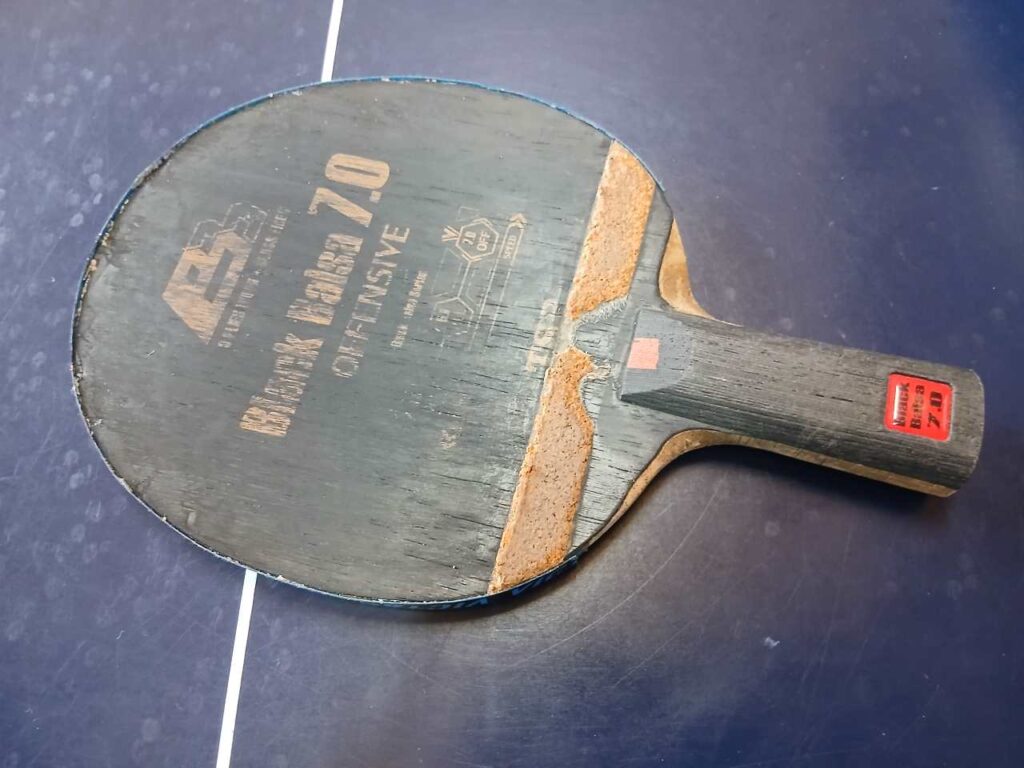
Discover a new level of attacking power through ultra-lightweight design.
Source: VICTAS Official Website
Its thick balsa core and composite material provide higher rebound while maintaining an exceptionally light weight, making it ideal for powerful offensive play.

6. Félix Lebrun’s Chinese Penhold Blade
As a reference, let’s take a look at the equipment used by Félix Lebrun (France), who is widely regarded as one of the strongest penhold players in the world today.
Blade: Félix Lebrun Hyper Carbon (TIBHAR)
Rubber: Hybrid K3 (TIBHAR)
Average Blade Weight: 85g
TIBHAR did not appear in this lightweight ranking, but the company currently offers an impressive lineup of nine Chinese penhold blades. With Félix Lebrun representing the brand, TIBHAR is definitely a manufacturer worth watching for Chinese penhold players.
Based on the specifications, I estimate that Félix Lebrun’s complete racket setup (blade and both rubbers) weighs at least 185–190g.
My estimate is based on the following factors:
• Average blade weight: 85g
• Both sides of the blade are fully covered with rubber.
• Hybrid K3 is a heavy, tacky rubber with a firm topsheet.
Its characteristics are similar to Butterfly Dignics 09C, which I own, so I estimate each sheet weighs around 50g after assembly.
Personally, I don’t think most players should try to copy this racket weight. It may be manageable for casual play, but during serious training, a setup this heavy would put tremendous stress on the wrist for most players.
I imagine he follows a highly disciplined strength and injury-prevention program to handle such demanding equipment. I have tremendous respect for that.
What’s even more impressive is that he uses heavy tacky rubbers on both the forehand and backhand while maintaining incredible swing speed and ball speed. That’s honestly on another level from anything I’ve experienced.
I’m always cheering for Félix Lebrun whenever I watch him play—except, of course, when he’s facing a Japanese player!

7. Why I Care So Much About Racket Weight
For me, using a heavier racket comes with several disadvantages. That’s why I’m very particular about finding the weight that suits me best.
Disadvantages
• Slower swing speed.
• Slower transitions between forehand and backhand.
• Wrist pain during long practice sessions or matches.
A lighter racket isn’t always better, and a heavier racket isn’t always better either.
The ideal combined weight of a blade and rubbers depends on each player’s physical strength and playing style, so it can change over time.
At the moment, I feel that my ideal racket setup weighs between 150g and 152g. To stay within that range while still using the rubbers I prefer, I need to start with a lightweight blade.
If you’d like to learn more about how I choose the ideal racket weight, please check out the article below.
8. Conclusion
What do you think of this ranking?
To be clear, lighter isn’t always better. If you can comfortably swing a heavier blade, it also offers many advantages.
However, if you use heavy rubbers on both sides, starting with a lightweight blade makes it much easier to keep the overall racket weight under control.
I created this ranking by compiling the average blade weights published by each manufacturer. I hope it serves as a useful reference when choosing your next Chinese penhold blade.
If any of these blades catch your interest, I encourage you to check out the individual product specifications before making your decision.
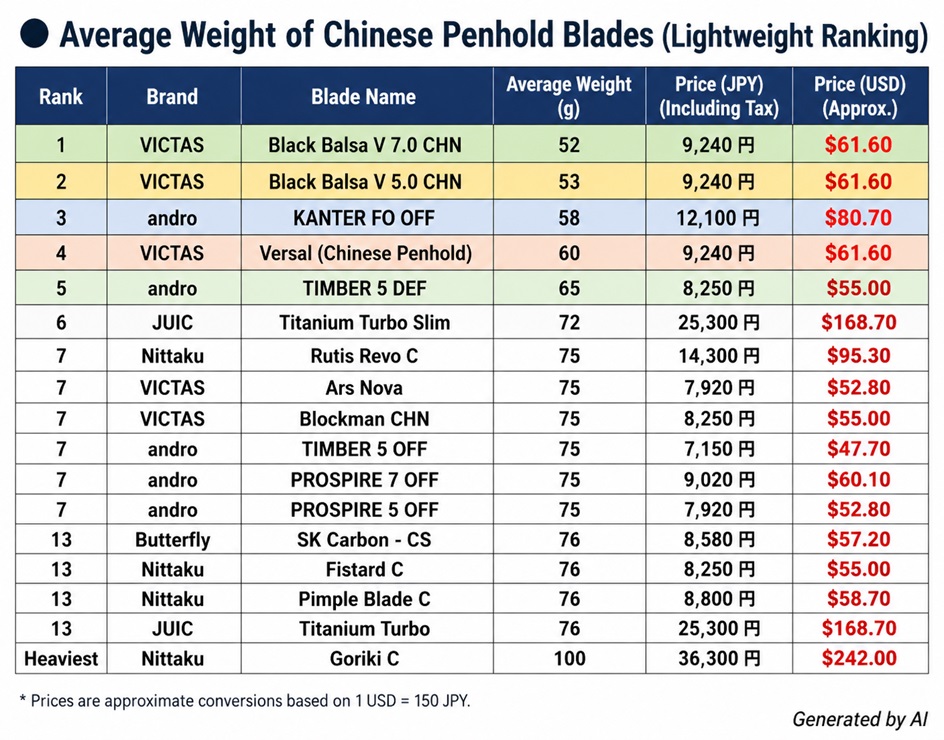
Finally, here’s a summary table of the ranking for quick reference.
Related Articles
● Average Weight of Shakehand Blades
● Average Price of Penhold Blades
● Average Price of Shakehand Blades


コメント