
1. Introduction
I installed Hurricane 8-80 on my forehand side and tested it over three practice sessions.
Several years ago, I used a highly tacky Chinese rubber called Apollo 5 (YINHE) for an extended period. Although it was not very fast, it produced exceptional spin and allowed me to fully appreciate the unique playing characteristics of Chinese tacky rubbers.
Later, I switched to hybrid tacky rubbers such as Glayzer 09C and Dignics 09C to improve my attacking game, especially against defensive players and choppers.
However, I never forgot the unique feeling of using a Chinese tacky rubber to create deceptive shots and force opponents into mistakes. Rather than relying solely on speed, I wanted to build points through heavy spin and variation once again.
With that in mind, I decided to test Hurricane 8-80 on my forehand. Among the famous Hurricane series, it is known for offering extra speed while retaining the distinctive characteristics of a Chinese tacky rubber.
In this review, I will share my honest impressions after using it in actual practice.
2. Equipment Setup
For this review, I used the following equipment setup:
- Blade: Butterfly Garaydia Revolver (Reversible Penhold)
- Forehand: DHS Hurricane 8-80, Max Thickness
- Backhand: DHS Hurricane 8-80 Power, Max Thickness
- Total Weight: 152 g
- Playing Style: Offensive Chinese penhold player who frequently uses the reverse penhold backhand (RPB)
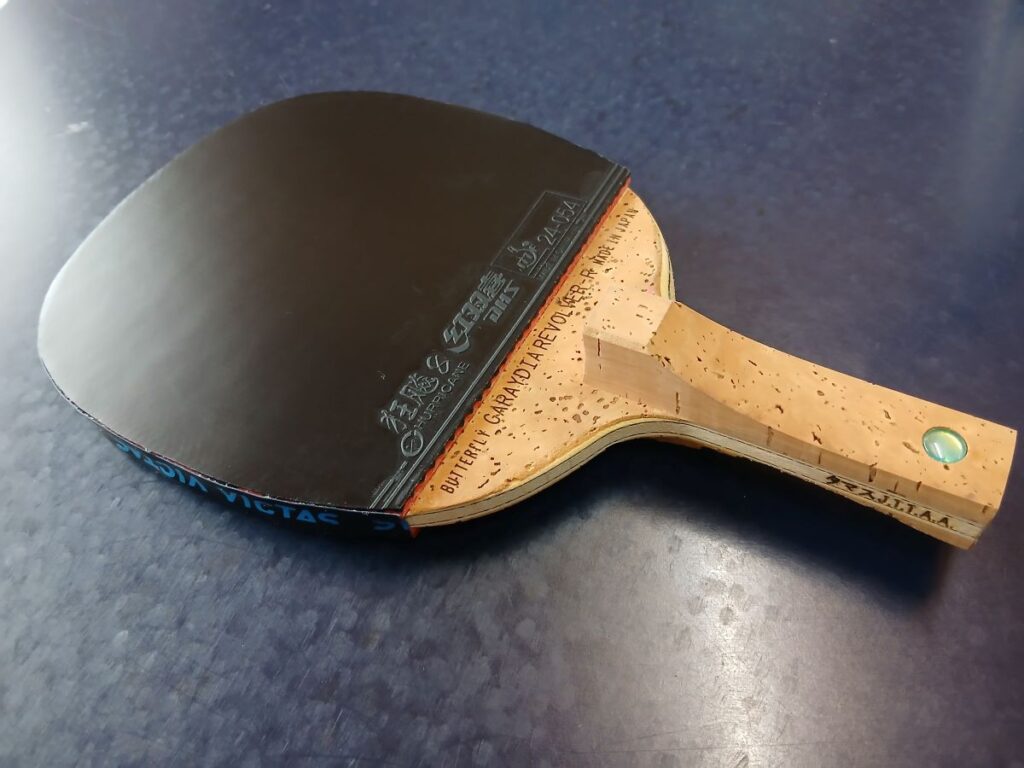
This review focuses primarily on my experience using Hurricane 8-80 on the forehand side. I plan to publish a separate article covering Hurricane 8-80 Power on the backhand in more detail.
I also recorded videos showing this equipment setup process. If you’re interested, be sure to check them out at the end of this article.
3. Performance in Different Strokes

(1) Push
The push was the most impressive stroke for me during this test.
Thanks to the strong tackiness and controlled speed of the rubber, I could confidently generate heavy backspin while keeping my pushes fast and consistent.
It was also easy to play short pushes. By mixing long and short placements, I often disrupted my opponent’s rhythm and forced mistakes. One practice partner even told me that the spin on my pushes felt unpredictable and difficult to read.
I believe that varying not only the placement but also the depth of my pushes can make this stroke a reliable way to create scoring opportunities.
(2) Stop
Because the rubber is not overly bouncy, stop shots naturally stayed short. I often found the ball stopping even shorter than my opponents expected, and it reminded me how effective it is to win points gradually through delicate table play rather than flashy attacks.
Another advantage was the excellent touch around the net. Since it was easy to adjust the length of my stop shots, I felt I could prevent my opponent from attacking first and control the flow of the rally.
(3) Serve
One aspect that particularly impressed me was how easy it was to execute short serves. In pressure situations, I sometimes worry that the second bounce will go off the end of the table and give my opponent an easy attack. However, because Hurricane 8-80 is not overly bouncy, I found it much easier to keep my serves short and under control. This is a major advantage in real matches.
I also frequently use knuckle serves against players using pimpled rubbers and other unusual surfaces. Although the serves were not especially fast, the rubber made it easy to produce deceptive knuckle serves with an unusual trajectory that could trouble opponents.
Compared with Dignics 09C, the feeling on serves was slightly different. Because Hurricane 8-80 is less bouncy than a hybrid rubber, the first bounce tended to land shorter than expected. I needed some time to adjust, but I believe this can be overcome with practice.
Even when striking the ball firmly, I was able to generate heavy spin without worrying about hitting too long.
(4) Topspin
For a Chinese tacky rubber, Hurricane 8-80 offers excellent topspin performance and sufficient power. However, I found that its full potential is easier to unlock by using the characteristic Chinese-style impact, almost as if driving the racket directly into the ball.
At contact, the ball seemed to stick to the rubber for a split second before releasing, giving me an excellent sense of ball grip. One of my practice partners even commented that the ball appeared to stay on the racket briefly before taking off.
This characteristic allowed me to produce fast topspins with direct contact or heavy loop drives with tremendous spin by brushing the ball more finely.
Even close to the table, the arc remained stable and consistent, allowing me to swing aggressively with confidence.
I was especially impressed by the loop drive. Opponents sometimes told me that the ball seemed to arrive slightly later than expected, making the timing surprisingly difficult. This made me feel that Hurricane 8-80 produced the distinctive ball quality often associated with Chinese tacky rubbers.
Counter-topspins were also stable, and I could swing through the ball confidently without being overwhelmed by my opponent’s pace.
(5) Block
Because the rubber is not overly bouncy, blocking felt extremely stable. Even against powerful attacks, it was easy to keep the ball under control. I often felt that simply getting the racket on the ball was enough to keep it safely on the table.
That said, I believe this stability is also influenced by the Garaydia Revolver blade, which combines a 3-ply wood construction with Arylate-Carbon and offers excellent control. Therefore, these impressions reflect my complete setup rather than the rubber alone.
(6) Forehand Flick
I was also very impressed with the forehand flick. It has never been one of my strongest shots, and when using bouncier hybrid rubbers, I often hesitated because I was afraid of overshooting the table.
With Hurricane 8-80, I could make solid contact without losing control, allowing me to swing with confidence even on aggressive forehand flicks. I felt that it could significantly improve my success rate when attacking over the table.
In fact, using this rubber inspired me to experiment with deceptive touch play similar to Germany’s Dang Qiu, where opponents struggle to distinguish between a stop and a flick until the last moment. I believe its controlled speed could open up even more possibilities for creative over-the-table play.
4. Differences from Dignics 09C

Compared with Dignics 09C, I felt that Hurricane 8-80 provides a stronger sensation of gripping the ball before releasing it.
I noticed this difference most clearly in short-game techniques such as pushes and stop shots. Dignics 09C can certainly produce sharp pushes, but because it is bouncier, I sometimes worried about sending the ball too long or making my stop shots travel farther than intended.
I also noticed a clear difference in topspin play. One of the biggest strengths of Dignics 09C is its ability to produce fast, penetrating shots with a low trajectory. However, in my case, I sometimes struggled to create enough arc when playing close to the table, which occasionally resulted in overshooting the end line.
By contrast, Hurricane 8-80 grips the ball exceptionally well and makes it easier to generate heavy spin. As a result, it naturally produces a stable arc, allowing me to swing with greater confidence.
Another advantage is its controlled rebound. Because it is not overly bouncy, I felt comfortable applying maximum spin on pushes and keeping stop shots short without fear of sending the ball long.
It also gave me the distinctive sensation of holding the ball briefly before releasing it, providing the unique feel that many players associate with traditional Chinese tacky rubbers.
That said, hybrid tacky rubbers and traditional Chinese tacky rubbers require different forehand mechanics and impact techniques. For that reason, I am not ready to say that one is objectively better than the other. Instead, I plan to continue testing Hurricane 8-80 in important matches and against a wider variety of opponents before reaching a final conclusion.
5. Overall Review
Rather than overwhelming opponents with pure speed, I found that Hurricane 8-80 excels at generating heavy spin, offering outstanding control, and using the unique deceptive ball quality of a Chinese tacky rubber to break down an opponent’s game.
In particular, short-game techniques such as pushes and stop shots become major weapons. Although these strokes may not look spectacular, they can force errors through spin variation and changes in depth, allowing you to build points steadily.
At the same time, its topspin performance is impressive for a Chinese tacky rubber. I was able to execute both loop drives and counter-topspins with confidence and without hesitation.
For that reason, I believe Hurricane 8-80 is an excellent option for players who want to try a traditional Chinese tacky rubber for the first time, as well as for those looking to transition from a hybrid tacky rubber to a more classic Chinese-style rubber.
The Hurricane 8-80 series also includes the faster Hurricane 8-80 Power. I am currently using it on my backhand side, and I plan to publish a separate review discussing its performance, including its suitability for the reverse penhold backhand (RPB), once I have spent more time with it.
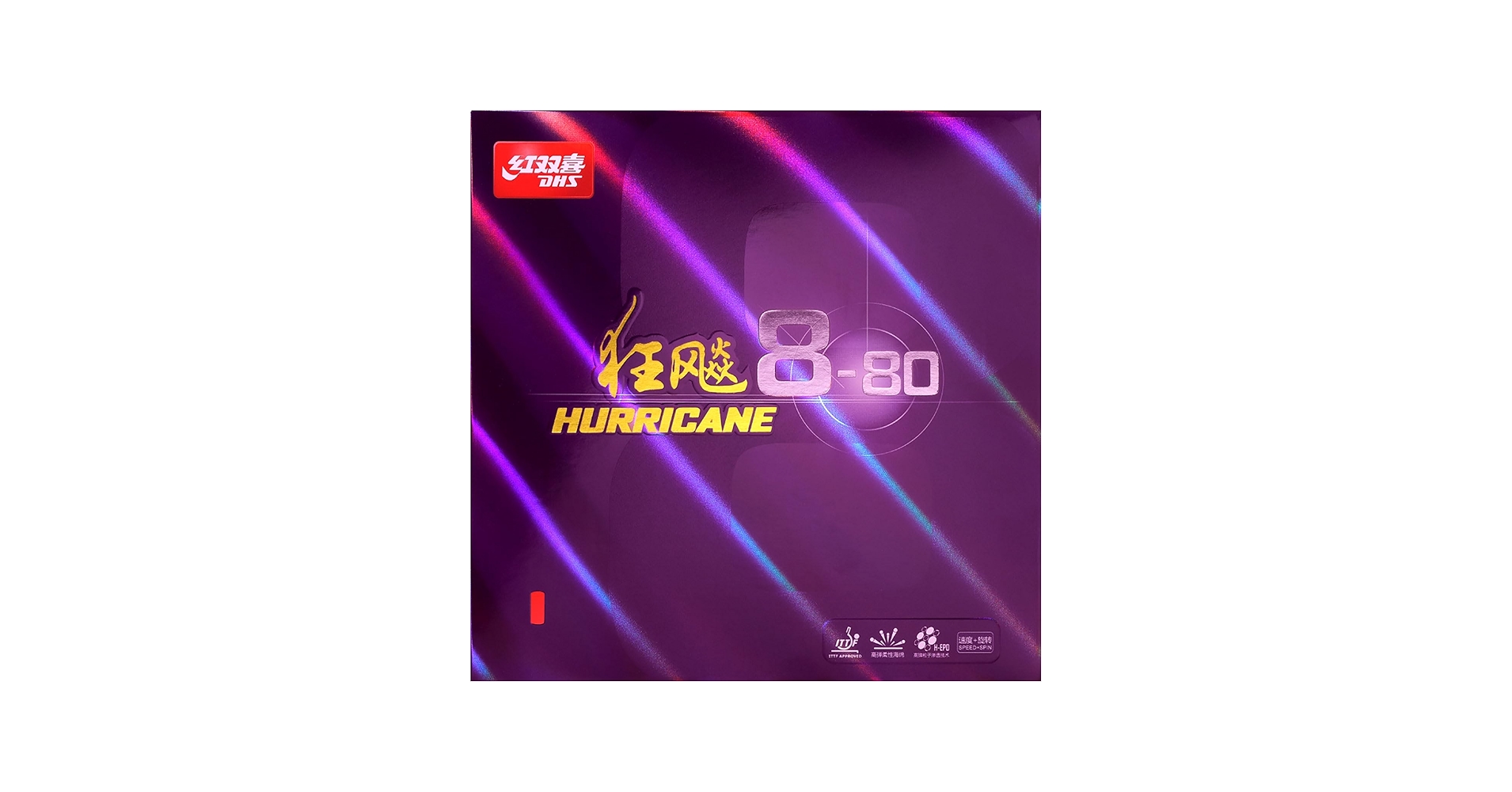

If you’re interested, I also introduce the unboxing process, rubber installation, and the final racket weight in the YouTube videos below. Feel free to check them out as well.
You can also read more about the equipment setup used in this review in the following article.

If you’d like to learn more about the unique deceptive ball characteristics of tacky rubbers, check out the article below.

For more articles about tacky rubbers, take a look at the guides below.


コメント