
In a previous article, I explained the overall concept of rubber placement on a Chinese penhold racket, including both the forehand and backhand sides.
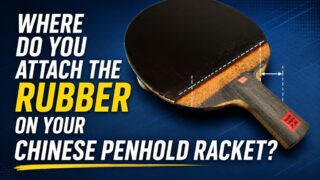
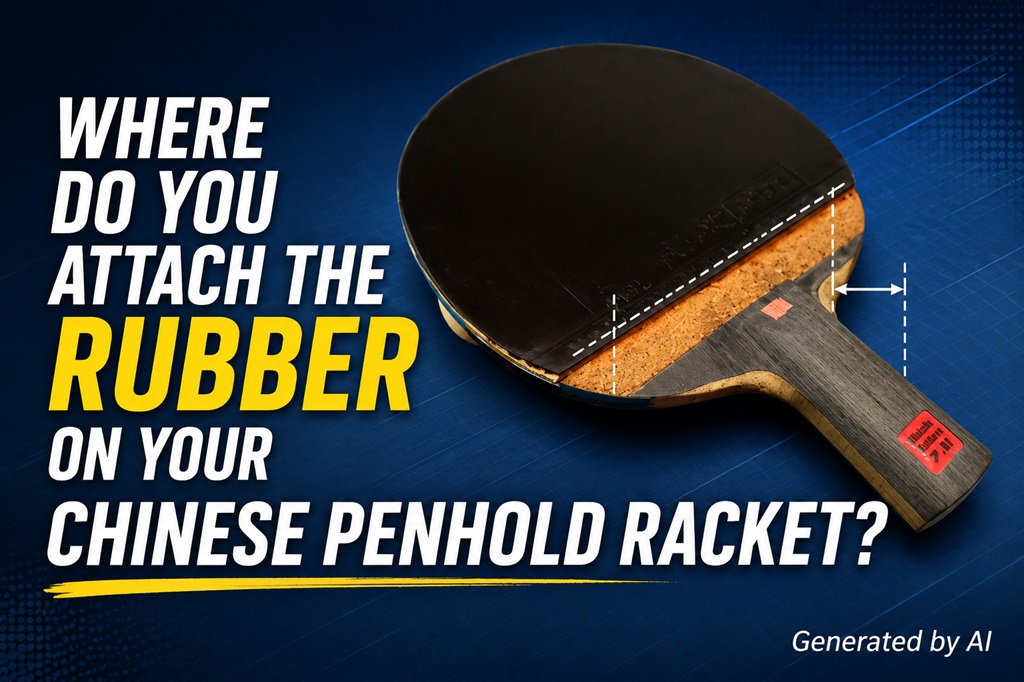
In this article, I will focus specifically on how close the forehand rubber should be placed to the handle.
Based on my own experience of playing with the forehand rubber positioned very close to the handle, I will examine its advantages, disadvantages, and the types of players who may benefit from this setup.
1. Introduction
Because I had used a Japanese penhold racket for many years, I always believed that the forehand rubber should be placed slightly away from the handle so that my thumb and index finger would not touch the rubber.
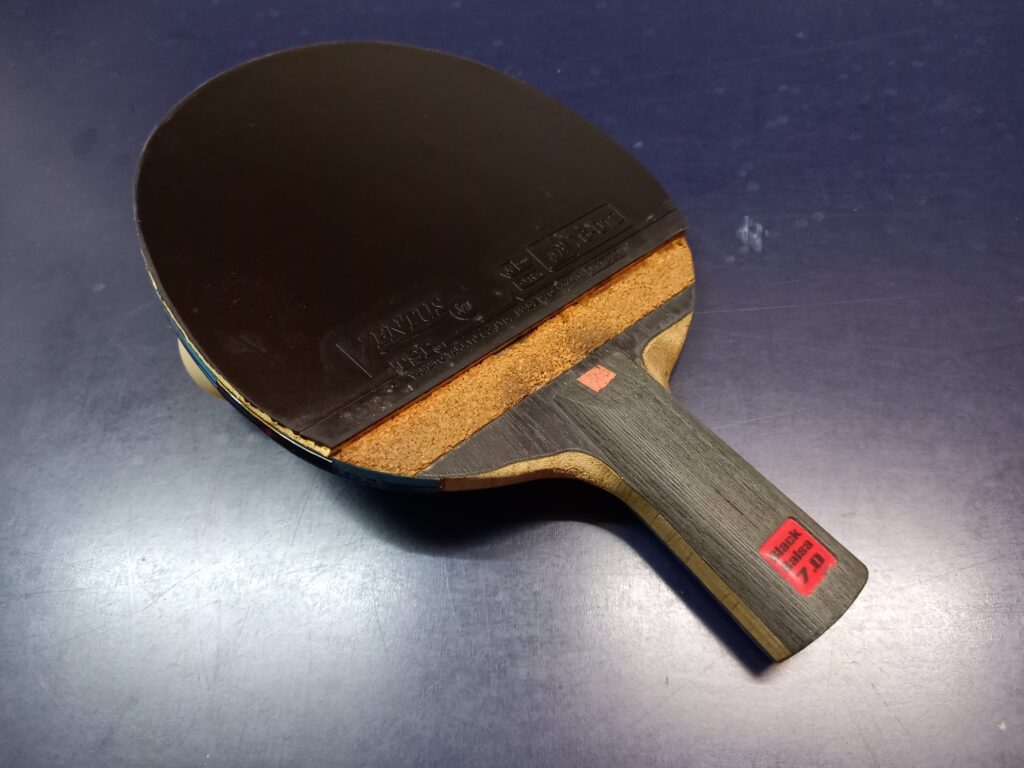
Note: I attached a small piece of cork as a guide to make it easier to position the rubber accurately.
Even after switching to a Chinese penhold racket, I continued using the same setup.
However, when I looked closely at the racket used by former Chinese world champion Wang Hao, I noticed that the forehand rubber extended much closer to the handle, allowing both the thumb and index finger to rest on the rubber.
I wondered, “Is this setup really easier to play with?” So I decided to try it myself and see how it affected my game.
2. Trying a Forehand Rubber Placement Close to the Handle
To be honest, I thought this setup would feel awkward to play with. Still, I decided to give it a try.
Note
In this article, I use the term “full coverage” for simplicity. However, even moving the forehand rubber just a few millimeters closer to or farther from the handle can noticeably change the grip feel. In my experience, leaving a gap of about 7–10 mm from the handle felt the most natural.
Based on photos and videos, Wang Hao also appears to leave a gap of roughly 7–8 mm between the handle and the forehand rubber.
The photo below shows the setup I tested.
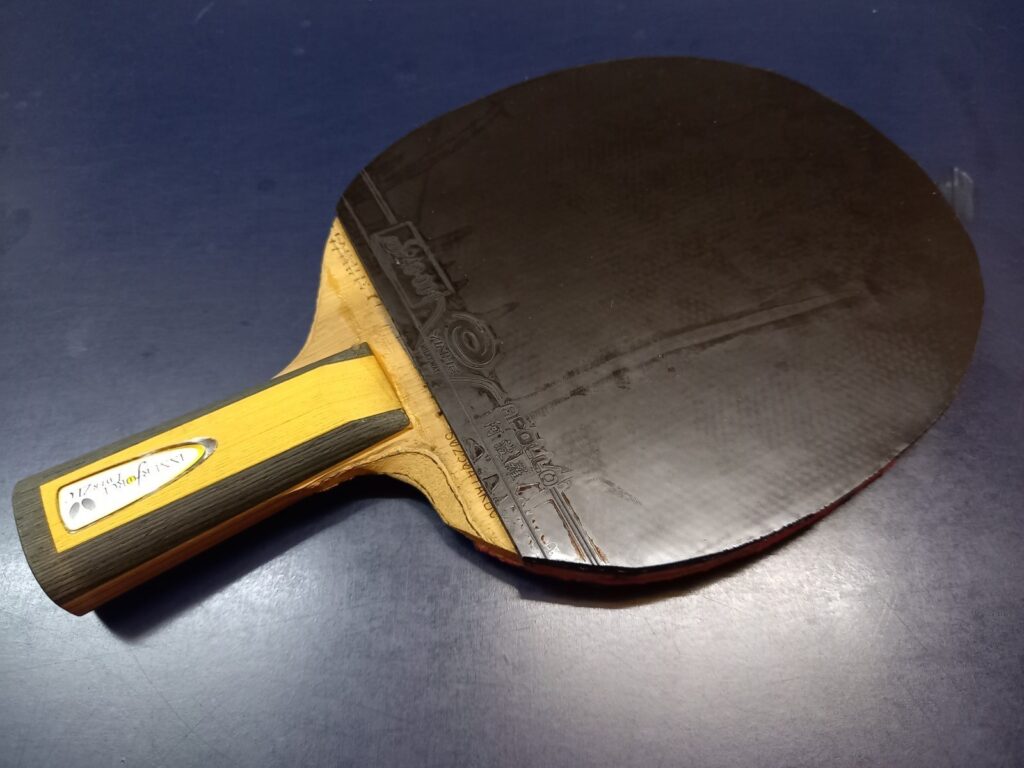
With this setup, my thumb rested on the black rubber, while my index finger hooked around the base of the handle.
Additional Note
Some top players today, such as Félix Lebrun of France, also appear to place the forehand rubber almost flush with the handle based on match footage and photos.
With this type of setup, both the thumb and index finger rest almost entirely on the rubber. As a result, the racket angle and ball feel can change significantly. It may feel unusual at first, but it is an interesting configuration that has been adopted even at the highest level of competition.
3. Advantages of Placing the Forehand Rubber Close to the Handle
(1) More Stable Reverse Penhold Backhand (RPB) Shots
With my thumb resting on the rubber, the racket head naturally tilted slightly upward. As a result, the racket felt noticeably different during play.
I also believe that because my thumb was no longer in direct contact with the blade, I felt less vibration when striking the ball.
As a result, it became easier to set the racket angle for RPB shots, making them more consistent and stable.
(2) Easier RPB Drives Down the Forehand Line
I believe this was also due to the slightly higher racket-head position. RPB drives directed down the forehand line became easier to execute, and it was also easier to vary my shot placement.
Being able to hit confidently down the line is an important weapon for players who rely on RPB, so I considered this a significant advantage.
4. Disadvantages of Placing the Forehand Rubber Close to the Handle
If there had only been advantages, I would have switched to this setup immediately. However, I also found several drawbacks.
(1) The Feel of Forehand Shots Changes Significantly
I often use loop drives when playing close to the table. However, the feeling of brushing the ball on my forehand changed completely, which led to more mistakes. I might have adapted over time, but the setup felt quite unnatural at first.
(2) RPB Shots Become Less Deceptive
Although it became easier to contact the ball cleanly with RPB, I felt that my RPB drives and RPB Chiquitas had less curve and variation, making it harder to disrupt my opponent.
(3) Finger Slippage Caused by Sweat
When using RPB, I support the racket mainly with my middle and ring fingers. Because of this, I found it more stable when my thumb was in direct contact with the wooden blade rather than the rubber. During hot or humid conditions, my thumb sometimes slipped on the rubber due to sweat, which affected the grip.
5. Should You Place the Forehand Rubber Close to the Handle or Leave a Gap?
In my opinion, the best forehand rubber placement depends on what you want to prioritize. Based on my experience, here are my recommendations.
(1) If You Prioritize Reverse Penhold Backhand (RPB)
Place the forehand rubber close to the handle.
I was surprised by how much easier RPB became simply because the racket head pointed slightly upward.
(2) If You Prioritize Forehand Drives and Short Game Control
Leave a small gap between the forehand rubber and the handle.
With my thumb touching the wooden blade directly, I can feel the impact of the ball more clearly during delicate shots such as loop drives, flicks, and stops. For me, this provides better touch and control than having my thumb rest on the rubber.
At the moment, I prefer to prioritize forehand drives and short game play, so I leave a small gap between the forehand rubber and the handle.
6. Conclusion
So, which setup would you choose?
After weighing the pros and cons, I personally prefer leaving a small gap between the forehand rubber and the handle because I value forehand loop drives and short game control.
If I had to rate the advantages and disadvantages based on my own experience, they would look like this:
- Ease of executing Reverse Penhold Backhand (RPB): +1 point
- Ease of forehand drives and short game play: -3 points
Overall, I felt that the disadvantages outweighed the advantages.
Personally, I find it easier to feel the ball and play with confidence when my thumb is in direct contact with the wooden blade.
That said, if you become comfortable with placing the forehand rubber close to the handle, it could become a powerful asset in your game.
In recent years, some world-class players, such as Félix Lebrun, appear to place the forehand rubber almost flush with the handle. There is no single correct setup, so I believe the best choice depends on your playing style and what feels most comfortable in your hand.
If you’re interested in this topic, be sure to check out my previous article covering the overall approach to rubber placement on Chinese penhold rackets.
Thank you for reading. I hope you found this article helpful.





コメント