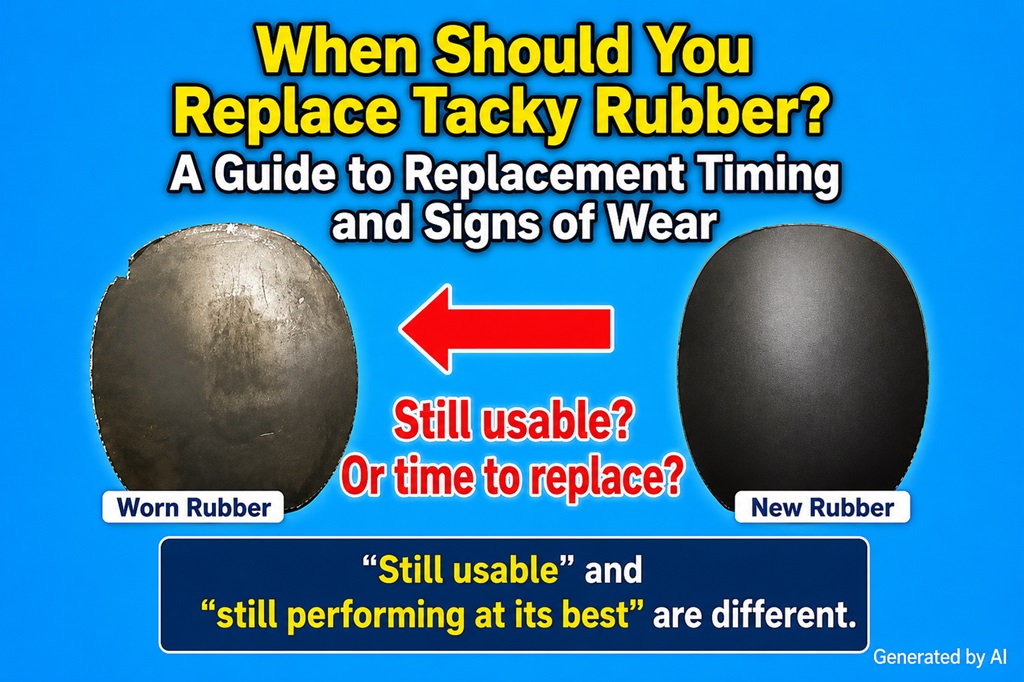
1. Introduction
I use tacky rubber on both sides of my main racket. In recent years, Chinese-made tacky rubbers have improved significantly in quality, and many high-performance products are now available.
You can also buy a high-performance rubber for around ¥4,000–5,000 (approximately US$27–33), making tacky rubber an excellent value for money.
On the other hand, tacky rubber is a consumable product. Regular replacement is necessary to maintain its performance, but replacing it more often than necessary can increase your costs.
In this article, I will share my personal experience and explain how I determine when it is time to replace tacky rubber.
Many articles recommend replacing rubber every few months. However, in reality, the lifespan of rubber can vary significantly even when players spend the same amount of time practicing. I will explain why in detail throughout this article.
2. When Should You Replace Tacky Rubber?
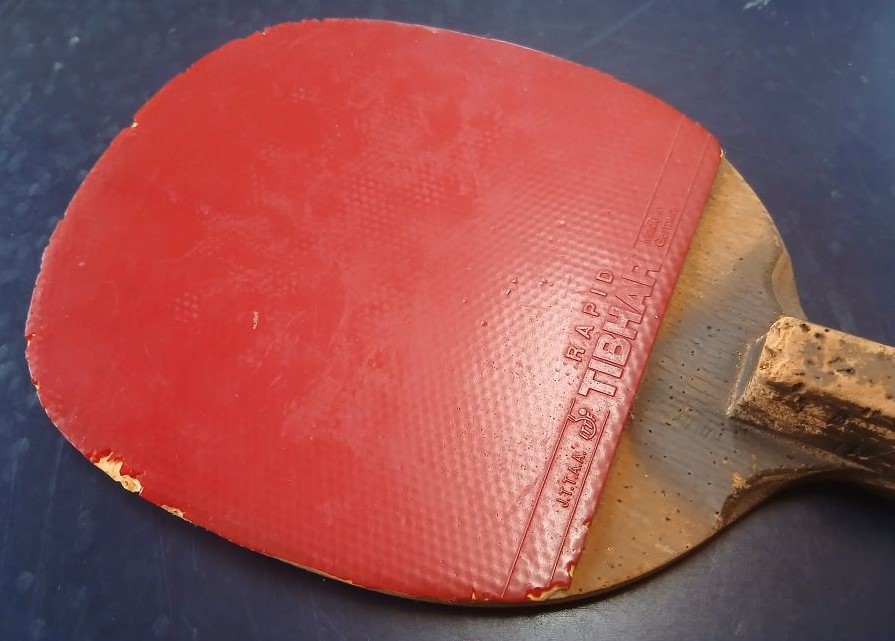
The short answer is that the right time to replace your rubber is not determined by practice time alone.
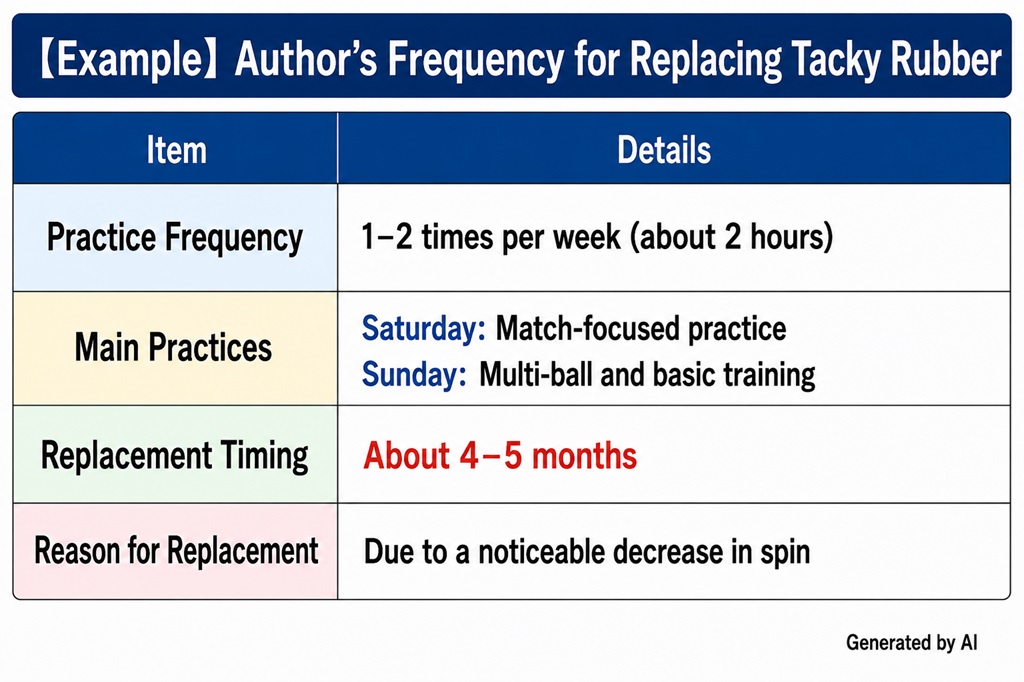
In my case, I use about four months of practice as a guideline, based on practicing once or twice a week for about two hours per session.
I replace the rubber when I feel that the amount of spin on serves, pushes, and loop drives has decreased.
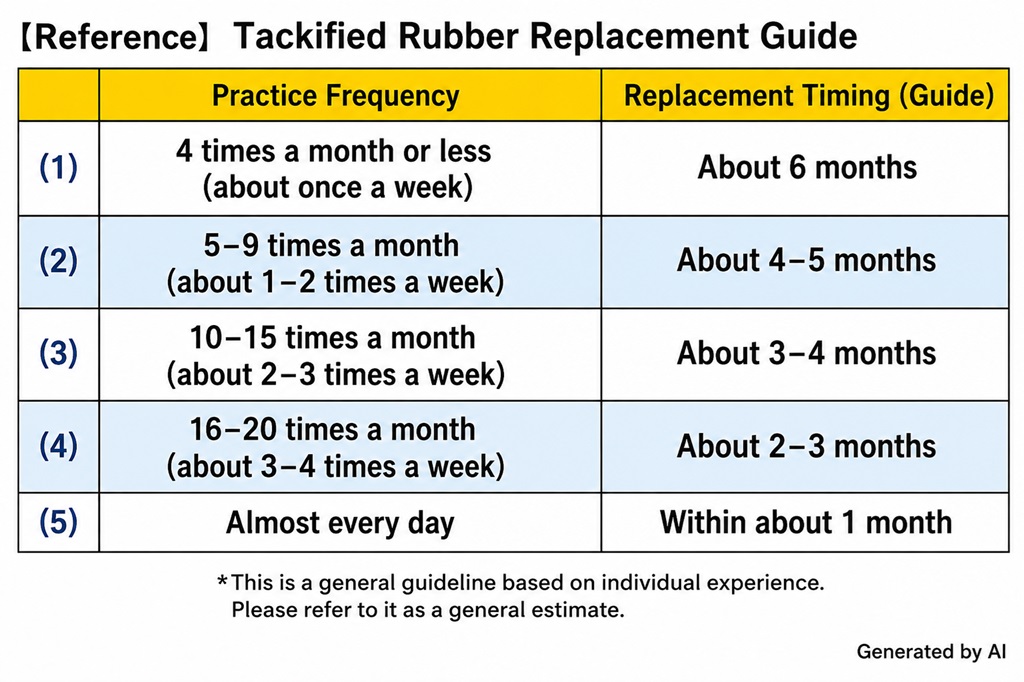
However, this is only my personal guideline.
3. Two Types of Rubber Deterioration Occur Simultaneously
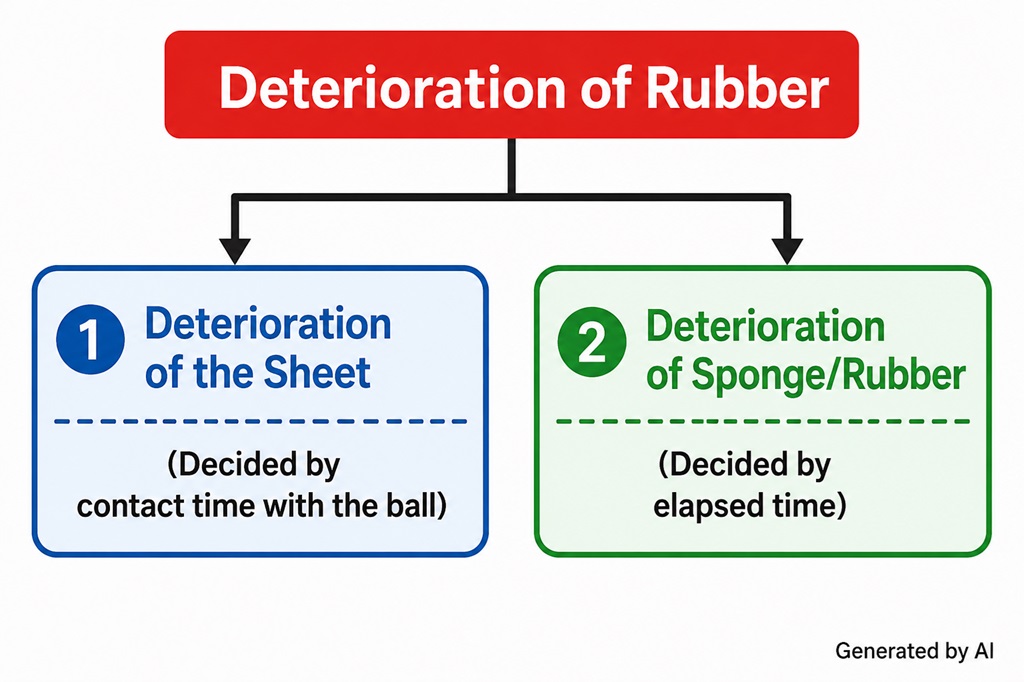
The lifespan of rubber is not determined simply by how many months it has been used.
In fact, ① topsheet deterioration and ② rubber and sponge deterioration occur simultaneously, gradually reducing the rubber’s performance.
(1) Topsheet Deterioration
On this website, I use the term “ball-contact time” for the cumulative time the ball is in contact with the rubber.
Longer ball-contact time can lead to:
- Wear on the rubber surface
- Loss of tackiness
- Reduced spin performance
In other words, topsheet lifespan depends less on practice time than on the amount of ball-contact time.
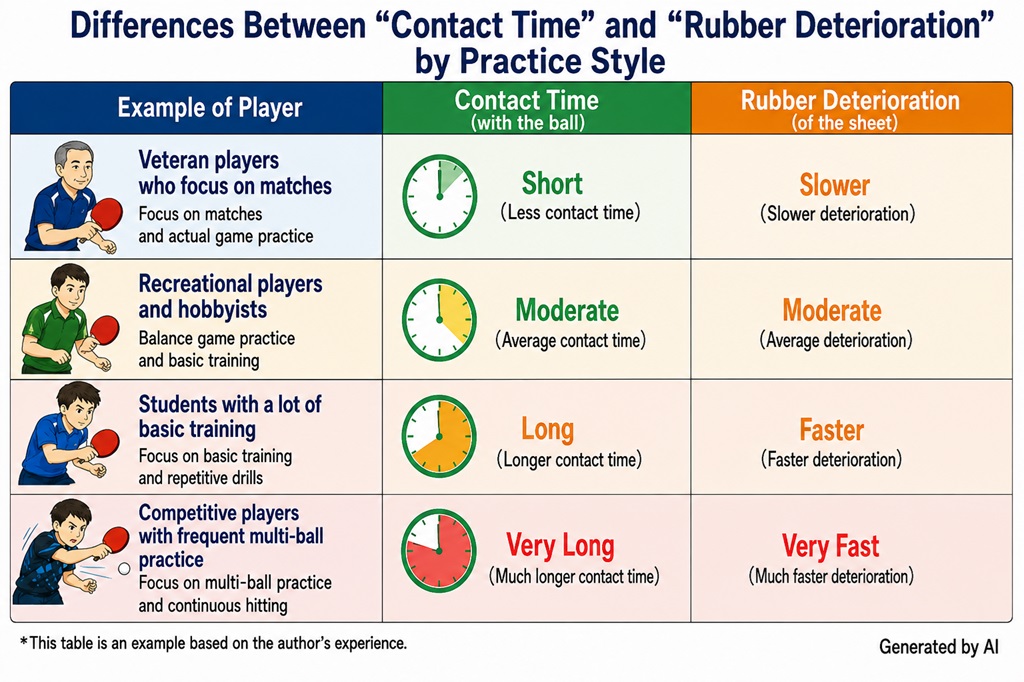
I use about four months as my replacement guideline when I practice once or twice a week for about two hours per session. I play practice matches on Saturdays and focus on multiball and basic drills on Sundays. This gives me relatively long ball-contact time, which may affect how often I replace my rubber.
Also, advanced players tend to hit the same area of the rubber with greater impact. This can cause faster topsheet wear, especially around the sweet spot.

In short, topsheet lifespan depends on more than practice time. Ball-contact time, impact, contact location, practice style, and playing level all affect how quickly the rubber wears.
(2) Rubber and Sponge Deterioration
Rubber gradually deteriorates even when it is not being used.
While topsheet deterioration is driven by “ball-contact time,” rubber and sponge deterioration occurs over time.
The two main causes are:
- Oxidation caused by oxygen in the air
- Degradation caused by ultraviolet (UV) light
In particular, rubber gradually becomes harder and less elastic as it reacts with oxygen in the air. UV light and high temperatures can also accelerate rubber deterioration.
Rubber is a consumable product that deteriorates both with use and over time.
Therefore, when judging rubber lifespan, it is important to consider both “ball-contact time” and “elapsed time”
4. My Playing Conditions and Replacement Guideline
As discussed above, rubber lifespan depends on both “ball-contact time” and “elapsed time”
Here is my experience and replacement guideline.
I have used Chinese-made tacky rubber on my main racket for about 10 years.
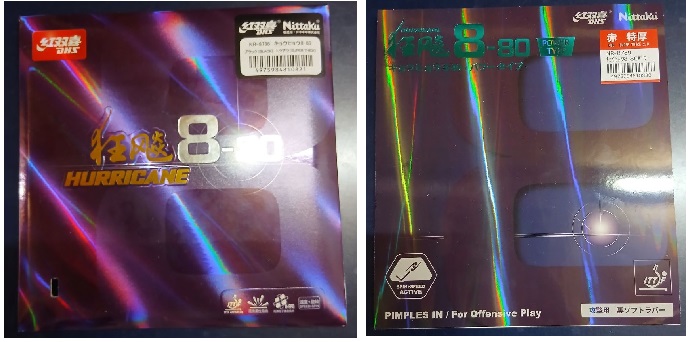
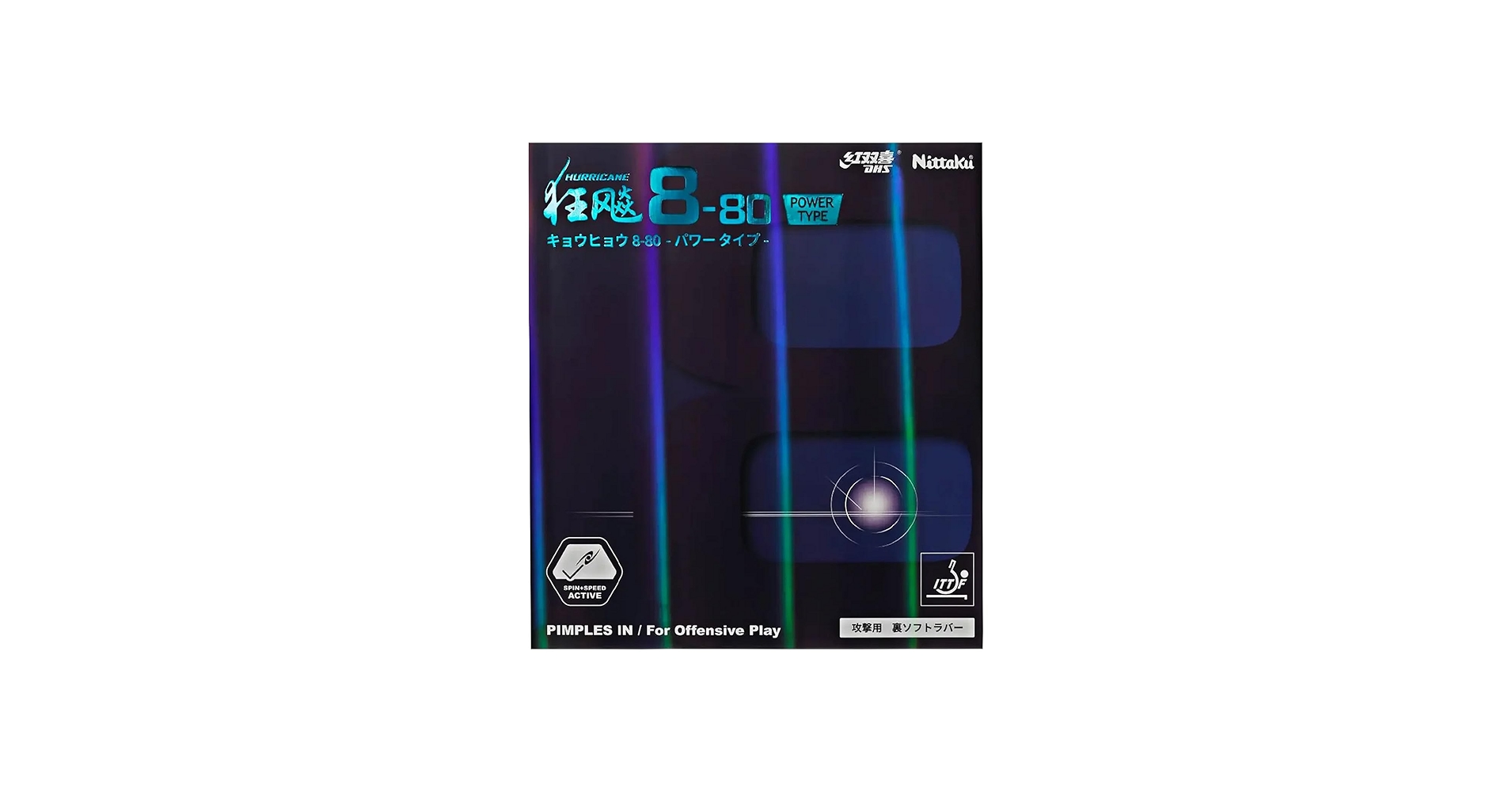
I used the Apollo 5 series for more than five years and now use the Hurricane 8-80 series.
Even after about one month of use, I am impressed by the excellent durability of the Hurricane 8-80 series.
However, if I notice any decline in the performance that makes tacky rubber unique, I plan to replace it after about four months, as I have in the past.
The next section explains what makes tacky rubber unique and how its performance changes as it deteriorates.
5. What Happens When Tacky Rubber Loses Its Unique Performance?

What I value most about tacky rubber is its ability to produce more spin than opponents expect, not only on drives but also on serves, pushes, and short stops, compared with conventional high-elasticity rubbers and high-tension rubbers.
I often notice its effect when an opponent unexpectedly hits the net or sends the ball long. These small differences can quietly win points.
Modern tacky rubbers are much more durable than before, and they can remain playable for six months or more. However, continued use gradually wears the topsheet, reducing the extra spin and deceptive quality that make tacky rubber unique.
As a result, it becomes harder to force the opponent into net or long errors, which can gradually affect your scoring ability in matches.
I would prefer to replace my rubber more frequently, but I also need to consider the cost. For me, about four months is a practical replacement cycle.
6. Conclusion
In my experience, worn tacky rubber loses its characteristic spin and starts to feel like a low-bounce, high-elasticity rubber.
Modern tacky rubbers are highly durable and remain playable for a long time. However, their characteristic spin and deceptive quality gradually decline.
Rubber replacement should not be based on how many months you have used it alone. Consider both topsheet deterioration from ball-contact time and rubber and sponge deterioration over time.
Tacky rubber is a consumable product. I recommend replacing it when necessary to maintain the performance that makes tacky rubber unique, based on your practice habits and playing style.
“Still playable” and “still performing at its best” are not the same thing. I hope this article helps you decide when it is time to replace your rubber.
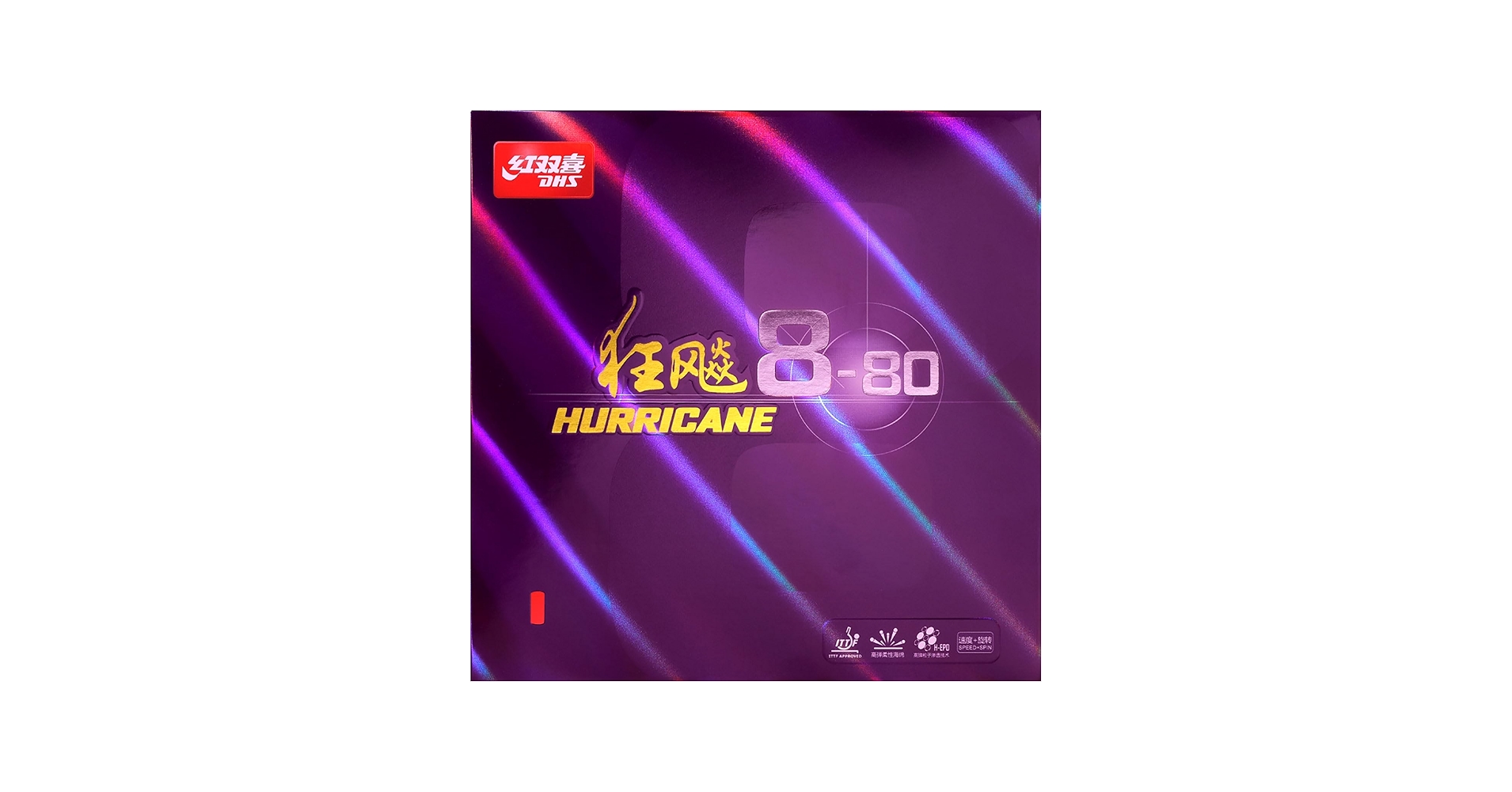
Note: The Chinese-made tacky rubber used by the author is the Hurricane 8-80 series.


Related Articles
Learn how to choose tacky rubber here:

Why I recommend tacky rubber for middle-aged and older players:

What is the “awkward ball” effect of tacky rubber?

Watch the video showing how I modified my penhold racket.


コメント