1. Introduction
Have you ever heard phrases like these in table tennis videos or equipment reviews?
- “Tacky rubbers produce awkward balls.”
- “Chinese rubbers produce unique shots.”
- “The ball feels heavy.”
Beginners often wonder:
- What exactly is an “awkward ball”?
- How is it different from a normal shot?
Tension rubbers are currently the standard in modern table tennis.
Tension rubbers offer several advantages:
- High speed
- Easy to use
- Consistent and predictable shots
However, many top players still use tacky rubbers.
One major reason is the unique ball quality often called “awkward balls.”
The term is often used informally, so it can be difficult for beginners to understand.
In this article, we will explain:
- What tacky rubbers are
- Why they create awkward balls
- Why some top players still prefer them
in a beginner-friendly way.
2. What Are Tacky Rubbers?
Table tennis rubbers are mainly divided into two types:
- Pips-out rubbers
- Inverted rubbers
Today, inverted rubbers are the mainstream choice in table tennis.
Let’s briefly look at the basic structure of a table tennis rubber.
Most rubbers have a two-layer structure:
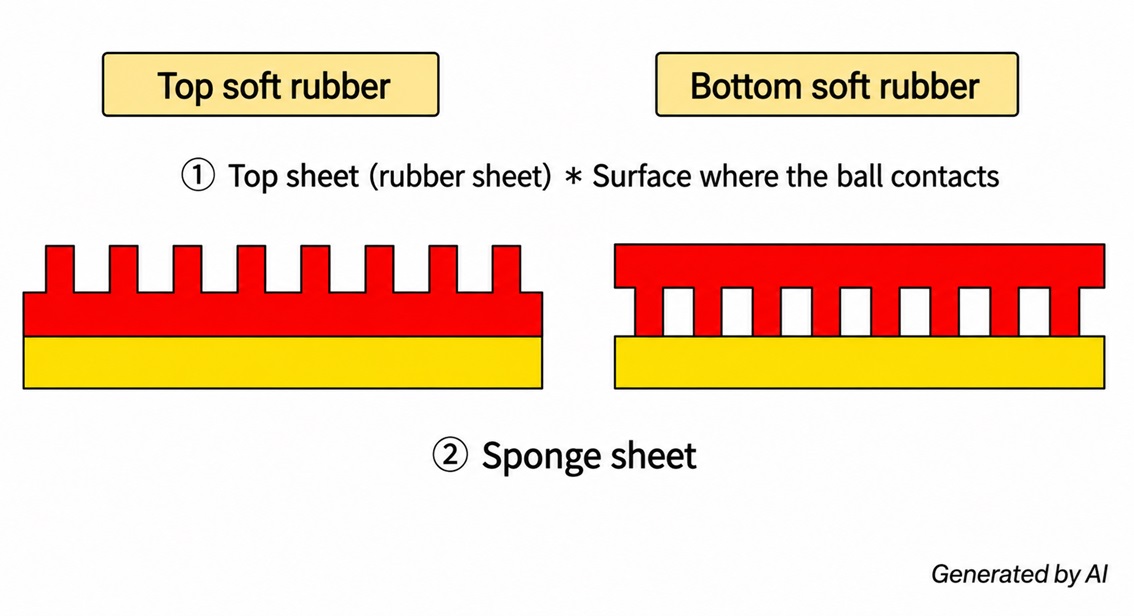
- Topsheet: the rubber surface that contacts the ball
- Sponge: the sponge layer underneath the topsheet
Some rubbers use only the topsheet without a sponge. These are called “OX” or “sponge-less” rubbers.
The topsheet also contains pimple structures:
- Pimples facing outward → Pips-out rubber
- Smooth surface facing outward → Inverted rubber
Tacky rubbers are a type of inverted rubber.
Most professional players also use inverted rubbers.
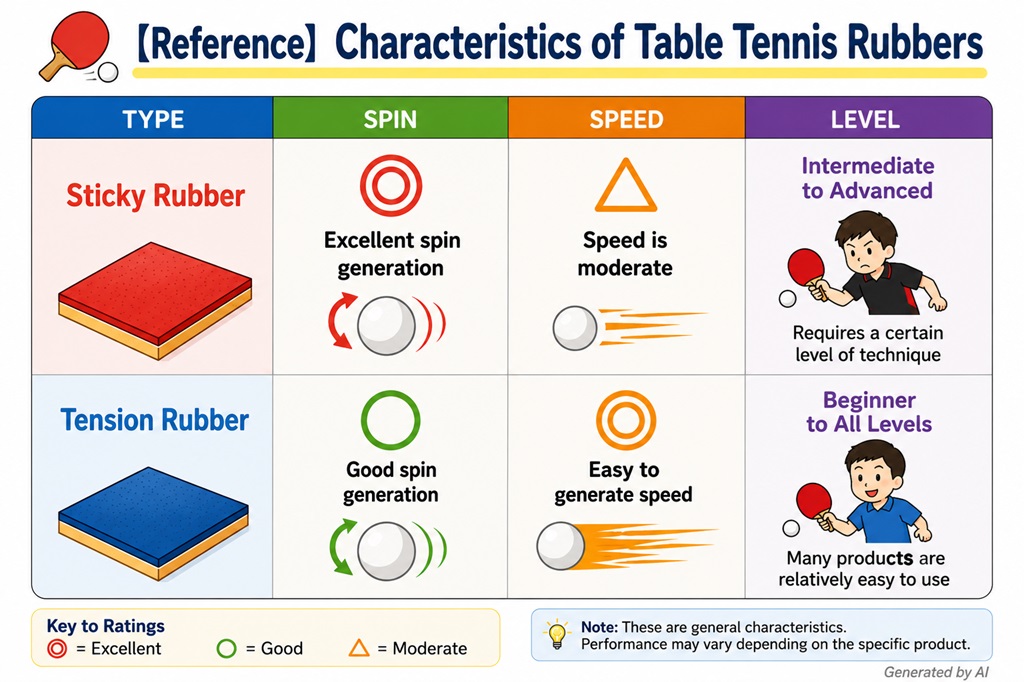
Tacky rubbers increase friction by adding adhesive properties to the topsheet.
As a result, they can generate very heavy spin.
New tacky rubbers often feel slightly sticky when a ball is lightly pressed against the surface.
However, not all tacky rubbers are the same.
There are different ways manufacturers add tackiness:
- Adding tackiness to the rubber surface
- Mixing tacky materials throughout the entire topsheet
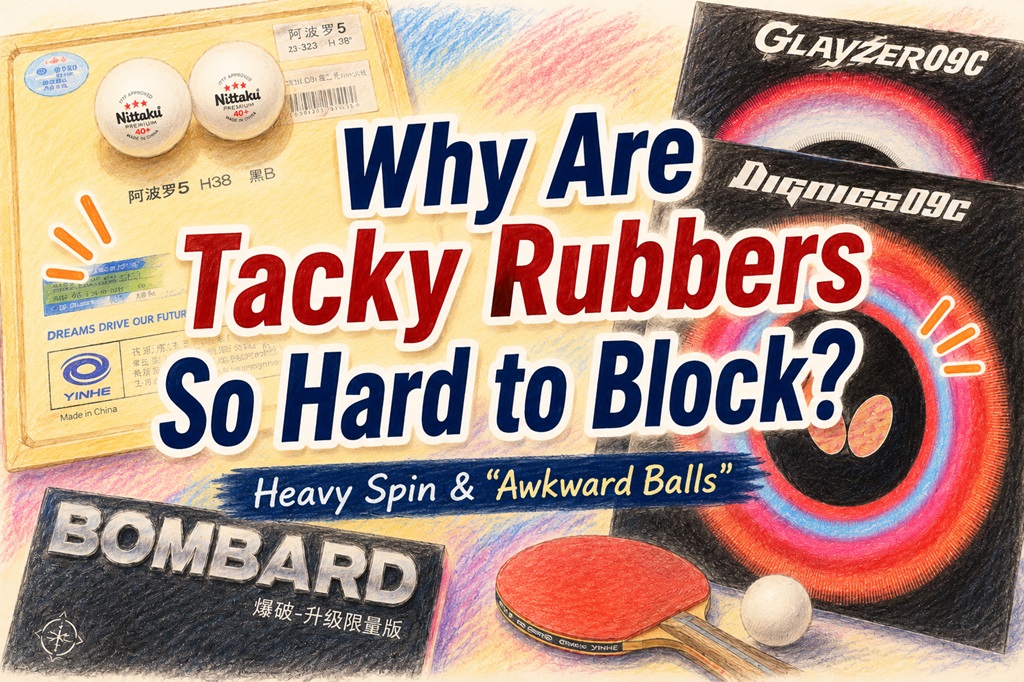
For example, Butterfly’s Dignics 09C mixes tacky components throughout the topsheet.
In contrast, many Chinese tacky rubbers use a much stickier surface layer.
A new Apollo 5 rubber can be sticky enough for the ball to briefly remain attached to the topsheet when turned upside down.

3. What Are “Awkward Balls”?
One characteristic often associated with tacky rubbers is the so-called “awkward ball.”
However, this concept can be difficult for beginners to understand.
To understand awkward balls, we first need to look at the characteristics of tension rubbers.
(1) Characteristics of Tension Rubbers
Tension rubbers are designed to let the ball sink into the sponge and rebound strongly after impact.
They absorb incoming spin and power relatively well, making shots more stable and predictable.
Even if the racket angle is slightly off, the rubber helps correct the shot to some extent.
Because they are easy to use with less precise racket control, some players describe them as having an “automatic” feel.
In other words, tension rubbers tend to produce consistent ball quality.
(2) Characteristics of Tacky Rubbers
Tacky rubbers often use hard sponges to maximize grip and spin.
Compared with tension rubbers, the ball sinks into the rubber less deeply.
As a result, even small racket angle mistakes can lead to errors, making tacky rubbers more difficult to control.
On the other hand, tacky rubbers absorb less of the opponent’s spin and power.
This allows more of the incoming spin and ball quality to remain in the returned shot.
This is closely related to the “awkward balls” effect.
Hard sponges are used because tacky topsheets rely heavily on friction to generate spin.
Spin generation mainly comes from:
- Surface friction
- Rubber elasticity and stretching effect
Tacky rubbers especially emphasize friction-based spin generation.
(3) So, What Is an “Awkward Ball”?
Tacky rubbers are more sensitive to incoming spin and power.
As a result, even similar swings can produce different ball behaviors:
- The ball accelerates after the bounce
- The trajectory suddenly drops
- Blocks tend to fly long
- The amount of spin becomes harder to read
In short, the ball quality becomes less predictable.
This is what many table tennis players call an “awkward ball.”
However, this does not mean the ball moves randomly like a “magic ball.”
Unlike high-tension rubbers, tacky rubbers produce less predictable spin and trajectory, making the ball harder to read visually.
4. Advantages of Using Tacky Rubbers

As we have seen, tacky rubbers have several unique characteristics.
(1) They Can Produce “Awkward Balls”
Tacky rubbers are strongly affected by incoming spin and shot quality.
As a result, the returned ball can become difficult for opponents to read and control.
- The ball accelerates after the bounce
- The trajectory suddenly drops
- Blocking becomes more difficult
These effects can make it harder for opponents to time blocks and counters correctly.
Tacky rubbers tend to produce less consistent spin and trajectory depending on impact strength and incoming spin.
Because of this, opponents often struggle to judge the amount of spin simply by watching the ball.
In contrast, tension rubbers usually produce more stable and predictable shots.
(2) Easier Trajectory Control
The hard sponge plays an important role here.
Because the ball sinks into the rubber less deeply, racket angle changes affect the shot more directly.
Although tacky rubbers are less forgiving, precise racket angles allow players to create the trajectory they want.
For example, players can more easily create:
- Low, dipping loops
- Drives that kick forward after the bounce
- Heavy-spin loop drives
This gives players greater freedom to shape their shots.
Tension rubbers, on the other hand, provide stronger rebound and automatic correction, making shots easier and more stable but often less unique.
Tacky rubbers are difficult to master, but they offer a high level of shot control and creativity.
This is one reason why some top players still choose tacky rubbers today.
5. Conclusion
In this article, we explained the unique characteristics of tacky rubbers, especially the concept of “awkward balls.”
Unlike high-tension rubbers, tacky rubbers tend to produce less consistent spin and trajectory.
Incoming spin, impact strength, and racket angle can significantly change the ball quality.
As a result, opponents often find it harder to judge the spin and trajectory visually.
There are many types of tacky rubbers, ranging from demanding Chinese-style rubbers to easier-to-use hybrid tacky tension rubbers.
In recent years, more beginner-friendly tacky rubbers have also become available.
If you choose a rubber that matches your playing style, you can enjoy the unique spin and ball quality that tacky rubbers offer.
If you have ever been curious about “awkward balls,” try using a tacky rubber for yourself.



Thank you for reading. I hope this article was helpful.

コメント