![[Table Tennis] Wood vs. Synthetic Rackets: Which is Better? A Comprehensive Guide to Performance and Selection](https://tabletennis-lab.com/wp-content/uploads/2026/05/e3415ed453513fdb460cc90626ed033b.jpg)
1. Introduction
Is your racket an all-wood blade?
Or does it contain carbon or other synthetic fibers?
Many beginners do not realize this, but the material structure of a racket can dramatically affect:
- Speed
- Control
- Spin
- Ball trajectory
- Feeling at impact
In this article, we compare:
- Wood rackets
- Composite rackets
and explain which type may suit your playing style better.
Many advanced players use composite rackets today, but wood blades still have unique advantages.
【Quiz】
Among the rackets in the image, only one is a composite racket.
Can you guess which one it is?
(The answer is at the end of the article.)
2. What is a “Composite Racket”?
A composite racket is a table tennis blade reinforced with synthetic fibers such as:
- Carbon fiber
- Arylate fiber
- Glass fiber
- ZL Fiber
According to official rules, at least 85% of the blade thickness must consist of natural wood.
This is why even “carbon rackets” still feel partly like wood.
However, manufacturers are allowed to insert thin layers of synthetic materials into the blade.
As a result, many modern rackets combine:
- Natural wood
- Synthetic fibers
to improve performance.
Composite rackets are generally divided into three categories:
- Carbon-only rackets
- Fiber-only rackets
- Hybrid rackets combining carbon and other fibers
In this article, we collectively refer to these as “composite rackets.”
[Reference photo: Author’s collection] “Innerforce Layer ZLC” (Butterfly)
![[Reference photo: Author's collection] "Innerforce Layer ZLC" (Butterfly)](https://tabletennis-lab.com/wp-content/uploads/2023/09/d01f9b392e990ca23485b129e79913f0.jpg)
3. Composite Rackets are Mainstream
Currently, composite rackets are the mainstream choice in top-level table tennis.
For example, all 16 players who reached the Round of 16 in the 2026 All Japan Table Tennis Championships (Men’s Singles) used composite rackets.
The main reason is simple:
- Higher repulsion
- More speed
- Greater power during rallies
These characteristics suit the fast pace of modern table tennis.
A similar trend can also be seen in women’s table tennis.
However, some defensive players — especially choppers who prefer lower rebound and better control — still choose all-wood rackets.
That said, composite rackets are not the only correct choice.
All-wood rackets also offer unique advantages, which we will explore in the following sections.
4. Differences Between Wood and Composite Rackets
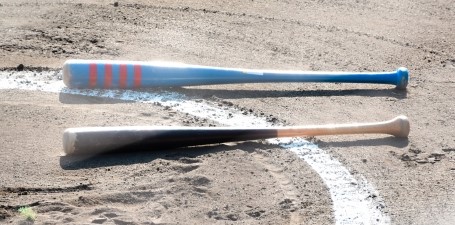
(1) Sweet Spot and Consistency
The difference between wood and composite rackets is sometimes compared to the difference between wooden and metal baseball bats.
- Wood rackets reward clean contact with exceptional feel and power.
- Composite rackets provide more stable performance even on off-center hits.
Wood Racket (Wooden Bat)
- Outstanding feel on the sweet spot
- Powerful and satisfying impact
- Requires precise technique
Composite Racket (Metal Bat)
- More forgiving on off-center shots
- Easier to produce stable shots
- Larger effective hitting area
The biggest difference is how much the racket rewards accurate contact.
When I used a single-ply Hinoki wood blade, the feeling of hitting the exact sweet spot was truly exceptional.
(2) Ball Trajectory
Wood Racket
- Produces a higher arc
- Easier to create topspin
- Helps reduce unforced errors
Composite Racket
- Produces a flatter trajectory
- Faster and more direct
- Better suited for aggressive attacks
In table tennis, a higher arc generally provides more safety and consistency during topspin rallies.
By contrast, flatter shots are more aggressive, but they also increase the risk of overshooting or hitting the net.
(3) Ball Speed and Spin
Wood Racket
- Lower repulsion
- Longer dwell time
- Easier to generate heavy spin
Composite Racket
- Higher rebound speed
- Faster ball release
- Easier to generate power and speed
Wood rackets tend to hold the ball slightly longer, which helps players create more spin.
By contrast, composite rackets rebound the ball more quickly, making fast and aggressive shots easier.
(4) Consistency and Individual Variation
Wood Racket
- Bounce and feel can vary between individual blades
- Fewer plies often lead to greater variation
- Single-ply blades are especially unique
Composite Racket
- More consistent performance between blades
- Smaller individual differences
- Easier to match with a spare racket
Wood rackets — especially single-ply blades — often have noticeable differences in feel and rebound from one blade to another.
By contrast, composite materials are manufactured with highly uniform properties, resulting in more stable and consistent performance.
If you want a spare racket with an almost identical feel, composite rackets are generally the safer choice.
(5) Price
Wood Racket
- Generally more affordable
- Excellent value for money
Composite Racket
- Often more expensive
- Special materials increase manufacturing costs
The advanced materials used in composite rackets tend to raise production costs, which is reflected in the retail price.
As a result, all-wood rackets remain highly popular because they offer excellent feel and performance at a more affordable price.
5. Popularity of ALC (Arylate Carbon)
ALC (Arylate Carbon) is a composite material made by weaving together:
- Carbon fiber
- Arylate fiber
Carbon provides:
- High repulsion
- Power
- Stability
Arylate helps:
- Absorb vibration
- Improve feel
- Increase control
Because of this balance, ALC has become one of the most popular materials at the professional level.
At the 2026 All Japan Table Tennis Championships (Men’s Singles), 3 of the top 4 players used ALC rackets.
Many elite players have trusted ALC blades for years, including:
- Fan Zhendong (China)
- Timo Boll (Germany)
- Qiu Dang (Germany)
ALC remains popular across different generations and playing styles because it offers an excellent balance of speed, stability, and feel.
This is why many intermediate players also choose ALC blades when transitioning from all-wood rackets.
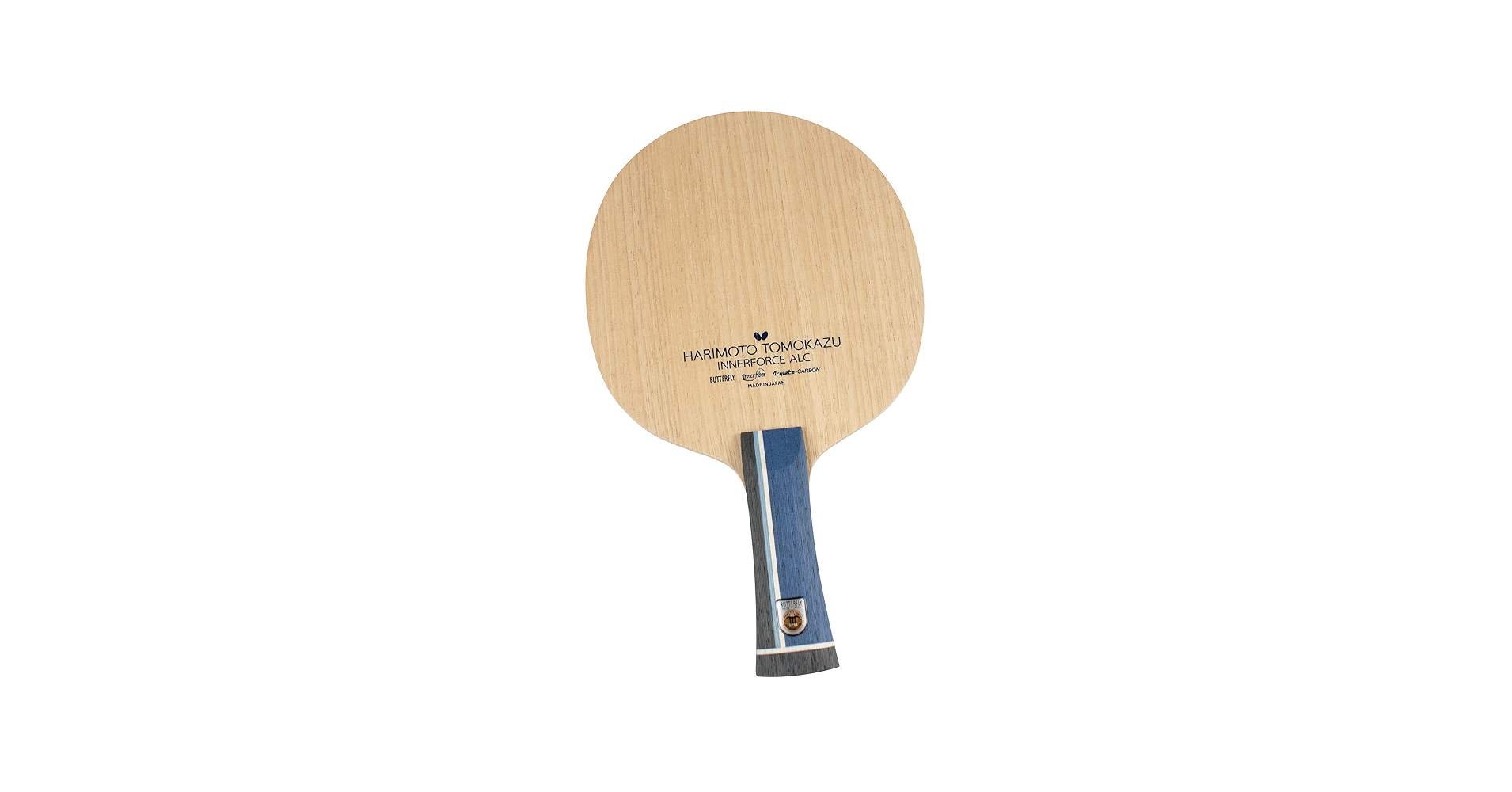
*Below, we introduce an ALC racket used by Tomokazu Harimoto. Please check the links for price and details.

6. Conclusion

To summarize the differences:
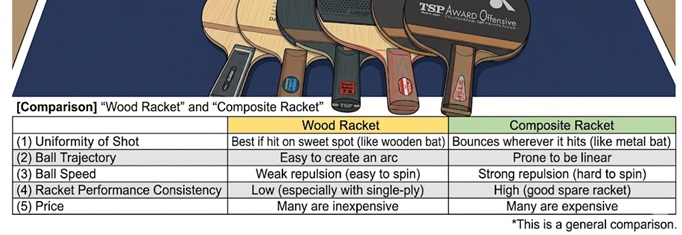
*Please note that we have performed a general comparison; there are also “bouncy wood rackets” that use high-repulsion wood and “composite rackets with suppressed bounce.”
What do you think? While composite rackets are now mainstream, wood rackets also have many great qualities.
Also, the disadvantages of both can be compensated for by the rubber. To find equipment that suits your playing style, you need to consider the combination of racket and rubber.
If you prefer better control and a softer feel, an all-wood blade may still be an excellent choice for improving consistency and overall touch.
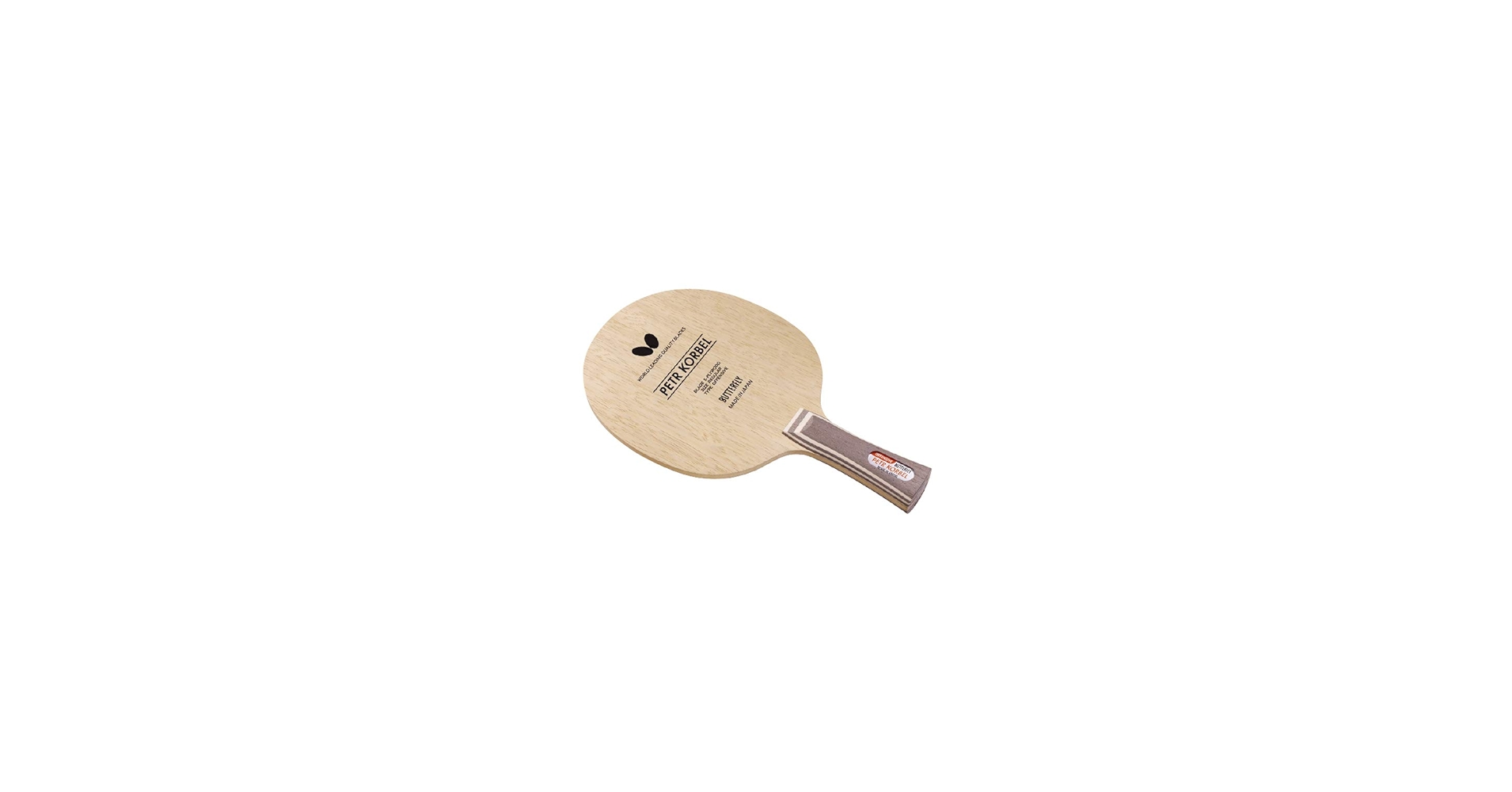
The Butterfly Korbel remains one of the most respected all-wood blades because of its balance of control, feel, and long-term usability.

We discuss blade and rubber combinations in a separate article. If you’re interested, please check it out!
That concludes today’s guide. I hope this information is helpful when choosing the right equipment!
Quiz Answer: Ignito (XIOM) (far left)






コメント