1. Introduction
Have you ever picked up a table tennis racket at a shop and thought, “This feels great!”—only to find that once you put the rubbers on, it felt much heavier than expected and completely different from what you had imagined?
The difference may not simply be due to the added weight of the rubbers.
How a racket feels when you swing it depends not only on its weight, but also on where its center of gravity is located.
In tennis and badminton, “balance” is commonly listed as a racket specification. In table tennis, however, it is not nearly as common as weight.
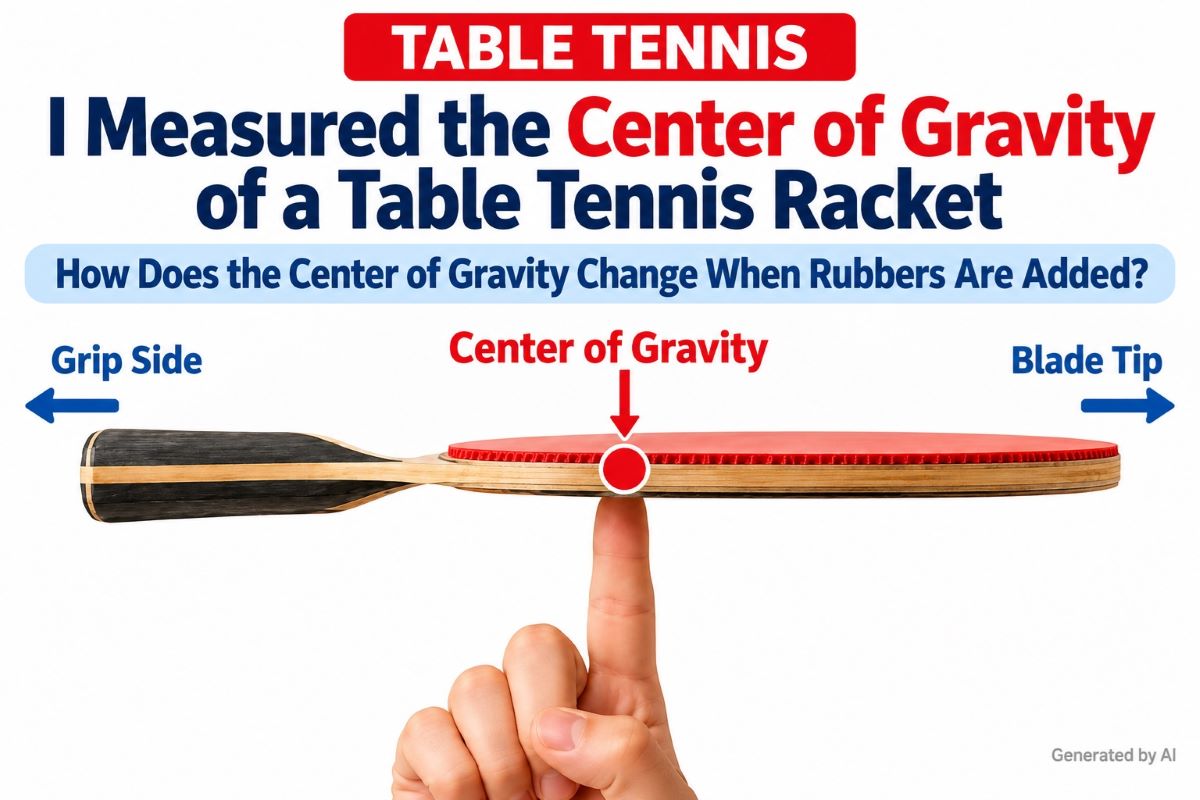
So, in this article, I focus on the “center of gravity” of a table tennis racket and measure it using a simple method.
2. What Is the Center of Gravity of a Table Tennis Racket?
Simply put, the center of gravity is the point where the racket’s weight can be considered to be concentrated.
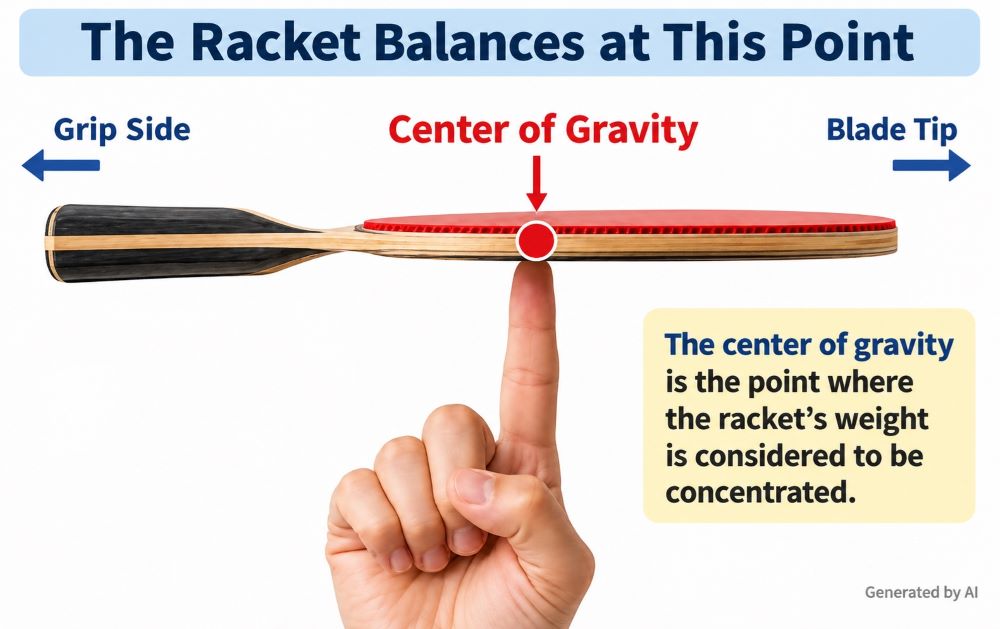
Even if two rackets weigh the same 150 g, they can feel different when you swing them depending on whether the center of gravity is closer to the grip or toward the blade tip.
In tennis and badminton, specifications often include numerical values or classifications that describe a racket’s “balance” in addition to its weight.
In table tennis, however, although racket weight is usually listed in the product specifications, I have never seen a table tennis racket specified with a precise center-of-gravity measurement such as “140 mm.”
At most, you may see general descriptions such as “more weight toward the blade tip” or “more weight toward the handle.”
Table tennis rackets differ from tennis and badminton rackets in shape and construction. In addition, the rubbers you attach can change both the final weight and the center-of-gravity position of the completed racket.
These differences may be one reason why the center of gravity is not commonly listed as a standard specification for table tennis rackets.
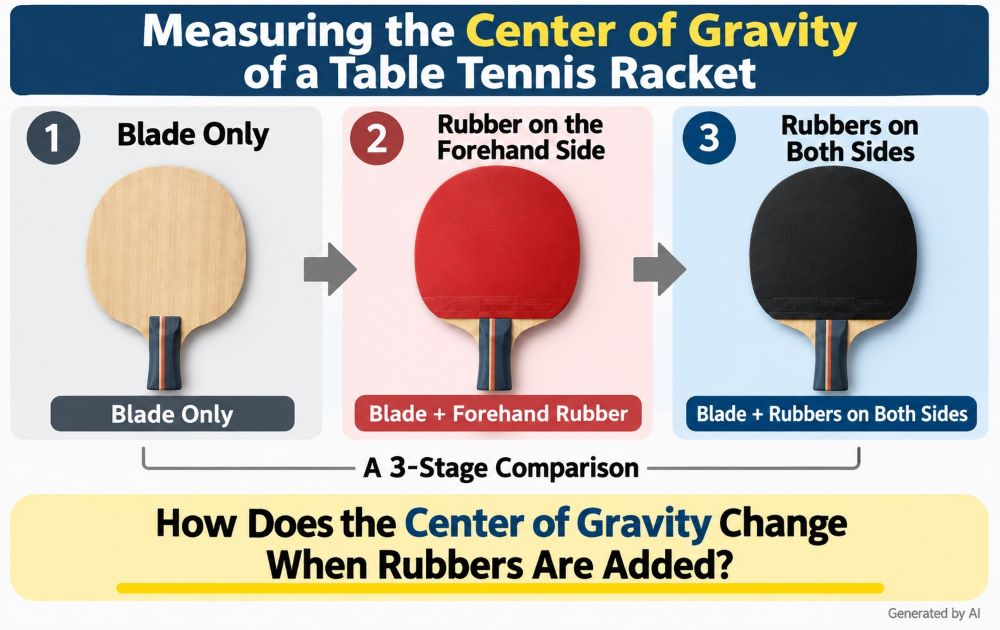
So, in this article, I will measure the center of gravity at three stages, including the racket with rubbers attached, to see how attaching rubbers changes the racket’s center of gravity.
3. A Simple Method for Measuring the Center of Gravity
Measurement Method
I used two digital scales to measure the racket’s center of gravity.
I placed 1 cm (10 mm) of each end of the racket on a scale, leaving the middle section suspended in the air.
The left scale supported the grip side, while the right scale supported the blade tip side. I calculated the center-of-gravity position from the weight measured by each scale.
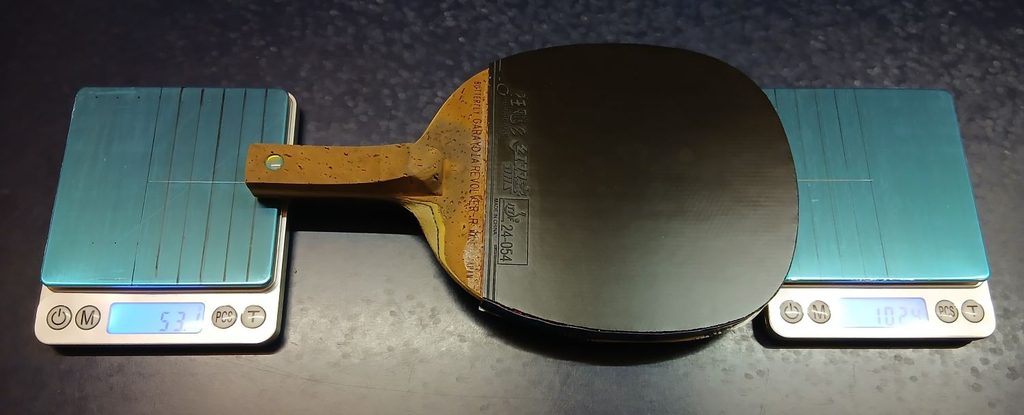
I took five measurements under the same conditions and used the average of the remaining three measurements after excluding the highest and lowest values.
How the Center-of-Gravity Position Is Calculated
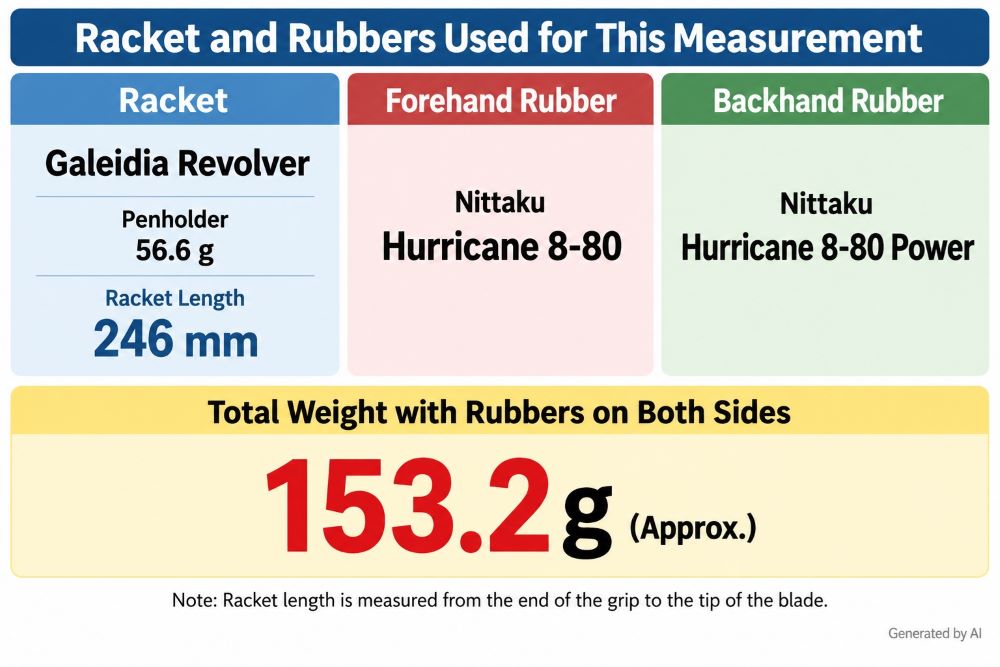
For this measurement, I treated the center of the 10 mm section resting on each scale as a virtual support point. For a racket measuring 246 mm in length, the support point on the grip side is 5 mm from the end of the grip, while the support point on the blade side is 5 mm from the blade tip. Therefore, the distance between the two virtual support points is 236 mm.
If the weight measured on the left scale is L, the weight measured on the right scale is R, and the total racket length is B, the distance from the end of the grip to the center of gravity can be calculated using the following formula:
Center-of-gravity position = 5 + {R ÷ (L + R)} × (B − 10)
For the racket used in this experiment, B = 246 mm, so I calculated it as “5 + {R ÷ (L + R)} × 236”.
Please note that this method does not measure the racket’s exact physical center of gravity. Instead, I use it as a simple indicator for comparing changes in the racket’s center of gravity.
Interestingly, when I placed my index finger near the calculated center-of-gravity position and supported the racket, I was actually able to balance the racket at that point.
Although this is a simple measurement method, the calculated value was reasonably close to the actual balance point when supporting the racket with one finger. This suggests that the method can be useful as a reference for comparing changes in a racket’s center of gravity.
4. How Did the Center of Gravity Change?
I measured the center-of-gravity position at three stages:
- Racket blade only
- One rubber attached to the forehand side
- Rubbers attached to both sides
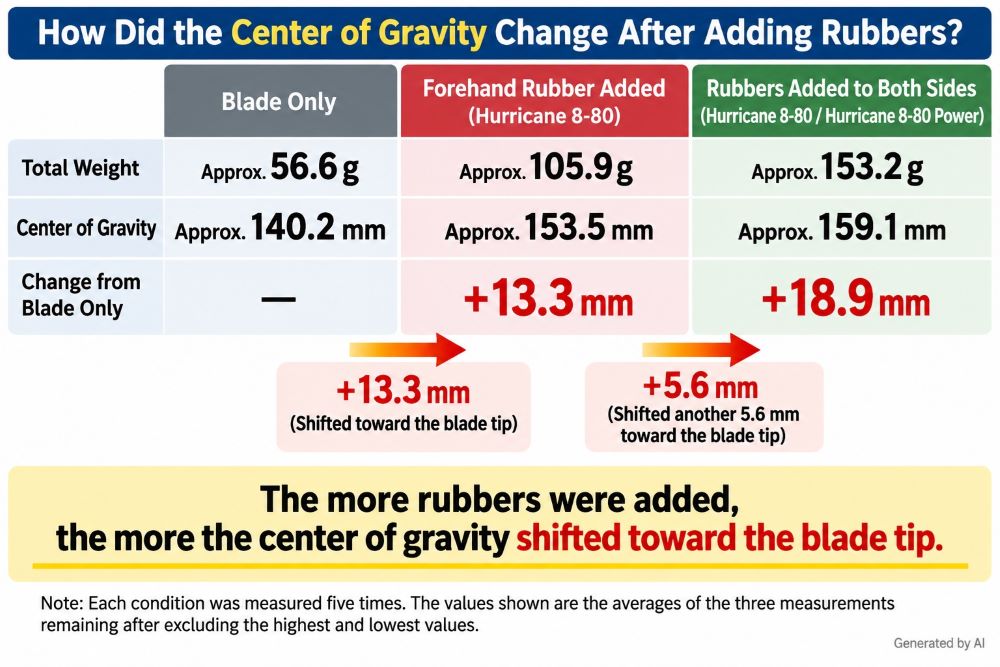
The center-of-gravity position of the racket blade alone was approximately 140.2 mm. After attaching one rubber to the forehand side, it shifted to approximately 153.5 mm—about 13.3 mm toward the blade tip.
After attaching another rubber to the backhand side, the center-of-gravity position shifted further to approximately 159.1 mm. In the completed racket, the center of gravity had moved about 18.9 mm toward the blade tip compared with the racket blade alone.
In other words, adding rubbers changes not only the racket’s weight, but also its center-of-gravity position.
5. What Racket Weight Alone Cannot Tell You
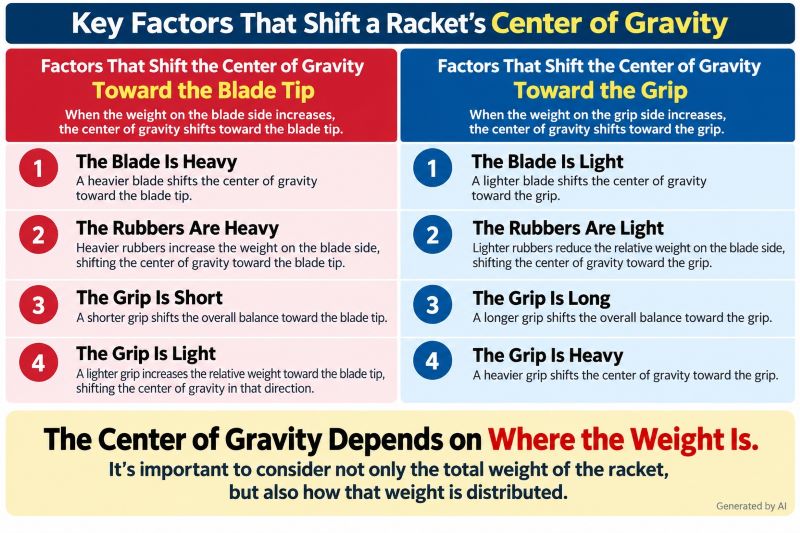
Butterfly also explains that a heavier blade tends to shift the center of gravity toward the blade tip, while a lighter blade tends to shift it toward the handle. The length and weight of the grip can also affect the center-of-gravity position.
In other words, even two rackets weighing the same 150 g can have different center-of-gravity positions depending on where the weight is distributed.
Of course, many factors affect how easy a racket is to swing, including the blade’s shape and thickness, the materials used, the shape of the grip, and the rubbers.
In addition, the preferred center-of-gravity position varies depending on the player’s playing style and personal feel.
Therefore, it is not as simple as saying, “A center-of-gravity position of X mm will make a racket easier to swing.”
Even so, considering weight and center-of-gravity position together could provide another useful way to compare rackets when choosing one.
6. Conclusion
In this article, I used a simple method to measure the center of gravity of a table tennis racket and examined how it changes when rubbers are attached.
As a result, for the racket used in this test, the center-of-gravity position shifted about 18.9 mm toward the blade tip, from approximately 140.2 mm with the racket blade alone to approximately 159.1 mm with rubbers attached to both sides.
How easy a racket is to swing depends not only on its weight, but also on how the weight is distributed, as well as the player’s playing style and personal preferences.
The values measured in this test do not represent the racket’s exact physical center of gravity. Instead, they are a simple indicator for comparing racket balance under consistent measurement conditions.
The center of gravity can also be adjusted, not only by measuring it, but by using weights or changing how the rubbers are attached.
An article explaining how to change the center of gravity will be published soon. Stay tuned!
● Related Articles
Where to Place Rubber on a Chinese Penhold Racket

Which Rubber Thickness Should You Choose: MAX or Thick?
-320x180.jpg)


コメント