1.Introduction
The Limitation of Manufacturer Specs
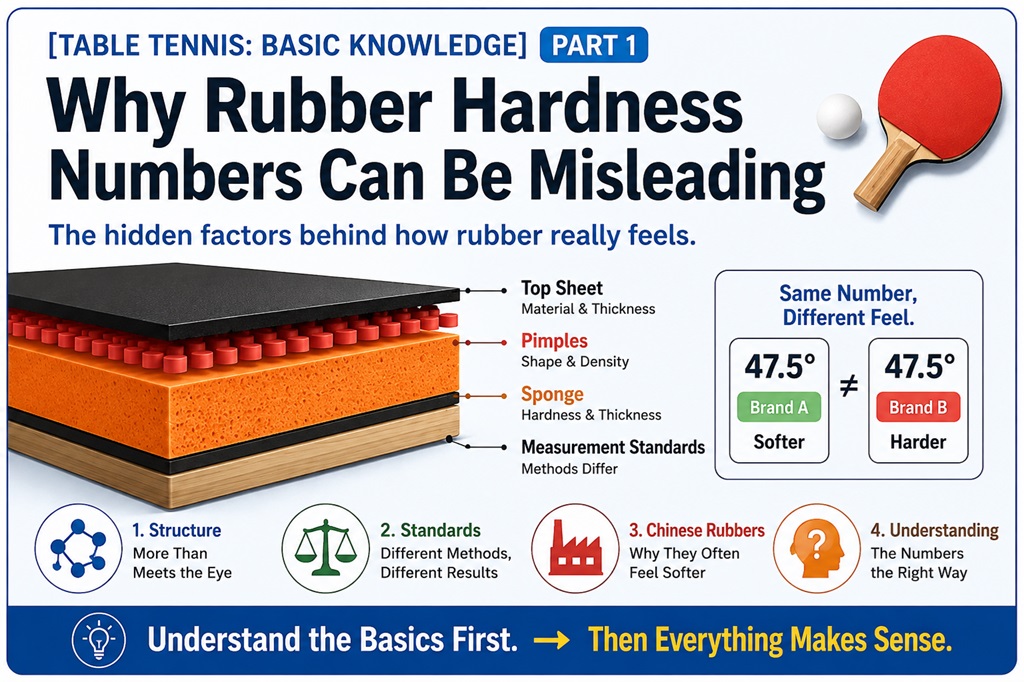
- Have you ever felt that rubber hardness ratings don’t actually help much when choosing new rubber?
- Even if two rubbers are both labeled “47.5 degrees,” the actual feel can be completely different.
- One major reason is simple:
most hardness ratings only measure the sponge itself. - In reality, impact feel is also heavily influenced by:
- top sheet structure
- pimple thickness
- pimple density
Why Choosing Rubber Is So Difficult
- There is no official conversion standard shared between manufacturers.
- As a result, hardness numbers cannot be compared directly across brands.
- Because of this, many players rely on:
- familiar brands
- online reviews
- recommendations from teammates
Beyond the Numbers
- Have you ever bought a rubber that looked perfect on paper, but felt completely wrong in actual play?
- This article explains the hidden structural factors behind rubber feel.
- Understanding these differences can help you choose equipment more logically and avoid expensive mistakes.
2.The Reality of Rubber Hardness: How Pimple Structure Defines “Feel”
The Limitation of Official Specs
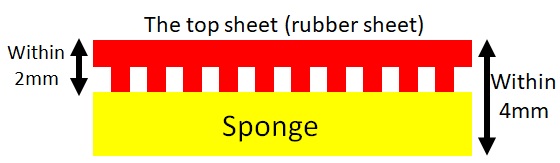
- Most manufacturer hardness ratings only measure the sponge itself.
- However, the actual feel of a rubber is not determined by the sponge alone.
- The structure of the top sheet also has a major influence on how the rubber feels during contact.
The Role of the Top Sheet
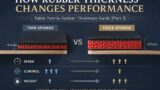
- As shown in the diagram below, the design of the top sheet greatly changes the overall feel of the rubber.
- The most important factor is the structure of the internal “pimples” (pips).
- Even when the sponge hardness is identical, differences in pimple structure can completely change the playing sensation.
Pimples as “Support Pillars”
- In inverted rubbers, the pimples are hidden underneath the top sheet.
- In short pips and long pips, they appear on the surface.
- These pimples function like structural support pillars.
- They control how force is transferred into the sponge during ball contact.
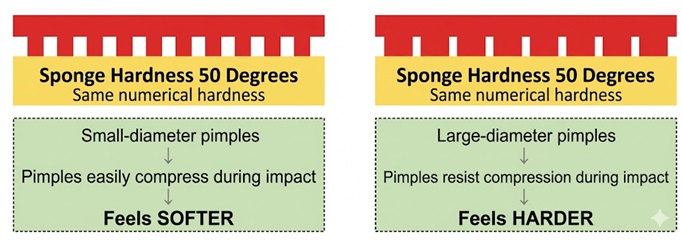
(1)Difference in “Springiness” Based on Pimple “Thickness”
Pimple Diameter and Rigidity
- As shown in the diagrams, the thicker the diameter of the pimples, the more resistant they become to bending upon impact.
- This increases the structural rigidity of the pimples as “support pillars”.
Impact on Feel
- Because the pimples resist bending, the ball does not “sink” into the rubber as easily.
- As a result, the overall impact feel of the rubber is perceived as “Harder,” even if the sponge hardness remains the same.
(2)The Impact of Pimple “Density (Spacing)”
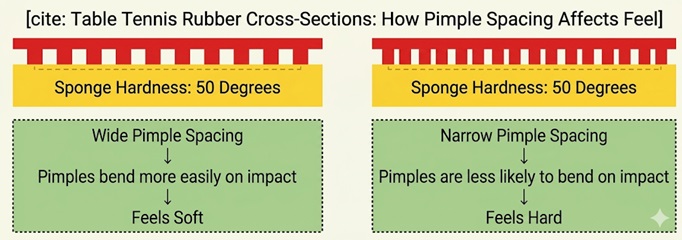
Pimple Density and Flexibility
- As shown in the diagram below, thicker pimples resist bending more during ball contact.
- This makes the pimple structure more stable and rigid.
- In other words, the pimples function like stronger support pillars.
Impact on Feel
- Because the pimples bend less, the ball cannot sink deeply into the rubber.
- As a result, the rubber feels firmer and harder during contact.
- This can happen even when the sponge hardness remains exactly the same.
(3)How Structure Dictates “Perceived Hardness”
What Makes a Rubber Feel Harder
- A top sheet with thick, densely packed pimples creates a firmer feel than the sponge hardness number suggests.
- Because the structure resists bending, the rubber feels more solid during contact.
What Makes a Rubber Feel Softer
- Thin pimples with wider spacing bend more easily during impact.
- This allows the ball to sink deeper into the sponge.
- As a result, the rubber feels softer and easier to “bite.”
Structural Differences Change Everything
- Even when the sponge hardness is identical, differences in pimple thickness and spacing can completely change how a rubber feels.
- The actual shape of the pimples also influences the playing feel.
3.The Current State of Differing Measurement Standards by Manufacturer
The Root of the Mismatch
- One major reason rubber hardness ratings often fail to match the actual feel is simple:
different manufacturers use different measurement tools (durometers). - In other words, brands are not measuring hardness using the same standard.
- Because of this, the same hardness number can feel completely different across brands.
Different Tools, Different Numbers
- Several global standards exist for measuring rubber hardness.
- The final hardness number changes depending on which measurement system is used.
- As a result, directly comparing hardness ratings between brands can be misleading.
(1)Why Hardness Numbers Cannot Be Compared
Why “50 Degrees” Does Not Mean the Same Thing
- Just because Brand A and Brand B both label a rubber as “50 degrees” does not mean the actual hardness is identical.
- Different brands use different measurement standards.
Different Standards by Region and Brand
- German-made rubbers (such as ESN products) typically use “German hardness,” which tends to produce higher numerical values.
- Butterfly uses its own proprietary measurement scale, often called the “Butterfly Standard.”
- Because these systems are different, the same number can represent a very different feel.
Multiple “Rulers” Exist
- In simple terms, each manufacturer uses its own “ruler” to measure hardness.
- This is one major reason why cross-brand hardness comparisons are so confusing.
(2)How to Use Online Rubber Reviews
Using Community Reviews as a Guide
- The internet is filled with independent rubber comparisons, player reviews, and shop playtest reports.
- These reviews can help you understand general trends across different manufacturers.
- They are especially useful when comparing rubbers that use different hardness standards.
The Limits of Unofficial Data
- However, most online information is still based on personal impressions and unofficial testing.
- No official conversion formula exists between different manufacturers.
- Online comparisons should never be treated as perfectly accurate.
Use Online Information Carefully
- Online reviews are useful as reference material, not as absolute answers.
- The final decision should always depend on your own playing style and feeling.
- Be careful not to rely too heavily on catalog numbers or online opinions alone.
(3)The Particular Difficulty of “Chinese Rubbers”
The Unique Scale of Chinese Rubbers
- Personally, I find the hardness ratings of Chinese rubbers (such as DHS) especially difficult to interpret.
- The “39-degree” or “40-degree” ratings used by Chinese brands represent a completely different scale from many other manufacturers.
- Because of this, direct comparisons with European or Japanese rubbers can be very misleading.
- Simple side-by-side comparisons based only on hardness numbers often do not work well with Chinese rubbers.
【Key Takeaways】
- Sponge hardness is not based on a universal standard. Each manufacturer uses its own measurement scale.
- Online reviews and test data should be used only as rough reference points.
- Hardness numbers alone are not reliable for direct cross-brand comparisons.
Continue to Part 2
In Part 2, we explore:
- the “thin top sheet × thick sponge” trend
- the 4.0mm regulation
- why modern rubbers often feel softer
- how to choose the right hardness for your swing

-320x180.jpg)




コメント