1. Introduction
As a player who mainly uses a Chinese penhold blade, I became interested in how blade weight affects performance. This led me to research the average weight of commercially available blades and publish a ranking of the lightest Chinese penhold blades.
If you’re interested, you can find the full ranking in the article below.

Heavy Chinese penhold blades also have many unique strengths. In this article, I present a ranking of the heaviest Chinese penhold blades.
For more about the advantages and disadvantages of heavy blades, see Section 6.
In this article, I define any Chinese penhold blade weighing 85 g or more as a heavyweight blade. Based on the 2026 catalogs and official manufacturer websites, I found 59 blades that meet this criterion.
To make the comparison easier, this ranking includes 23 Chinese penhold blades with an average weight of 88 g or more.
In my 2024 survey, 29 blades met the same criteria. In other words, the number of heavyweight Chinese penhold blades has decreased by six over the past two years.
One reason is that Avalox Chinese penhold blades, which were included in the 2024 survey, could not be found through Japanese retailers or official manufacturer sources this time. As a result, classic heavyweight models such as the P700 and P900 are no longer included.
In addition, several heavyweight blades have been discontinued over the past two years, further reducing the number of eligible models.
Now, let’s look at the heaviest Chinese penhold blades currently available, ranked by average weight.
2. Notes on the Comparison
(1) Manufacturers Included
This comparison includes nine manufacturers that either publish Japanese catalogs or provide average blade weight data on their official websites.
For Butterfly, I used the latest weight data available on its official website rather than its catalog. Since printed catalogs cannot be updated throughout the year, I believe this reflects the company’s commitment to providing the most accurate and up-to-date information.
DONIC and XIOM were excluded because their average blade weights are not published online. JOOLA, Killerspin, and Dr.Neubauer were also excluded because they do not appear to offer Chinese penhold blades.
Manufacturers Compared: 9
Butterfly, Nittaku, VICTAS, Yasaka, TIBHAR, Mizuno, STIGA, andro, JUIC
(2) Average Weight Notation
Manufacturers use slightly different formats to indicate average blade weight. For consistency, all values are treated as equivalent in this comparison.
Example (Average Weight: 80 g)
Butterfly: Average Weight 80 g
STIGA: Average Weight (g) 80 ± 5
(3) Scope of This Article
This is not a hands-on equipment review. Instead, it compares the average blade weights published in official catalogs and on manufacturers’ websites.
I have not personally tested every blade included in this ranking, so this article is not intended to evaluate playing characteristics or recommend specific models. Instead, it serves as a data-based comparison to help you choose a blade that suits your needs.
Note: I briefly comment on the playing feel of the blades that I personally own.
3. Ranking of the Heaviest Chinese Penhold Blades
Since many blades share the same average weight, they are grouped by rank in this ranking.
(1) 17th Place (88 g · 7 Blades)

Seven blades share an average weight of 88 g. Notably, every blade in this group is a composite blade. This suggests that composite blades are especially common in the 88 g weight class.
(2) 10th Place (89 g · 7 Blades)
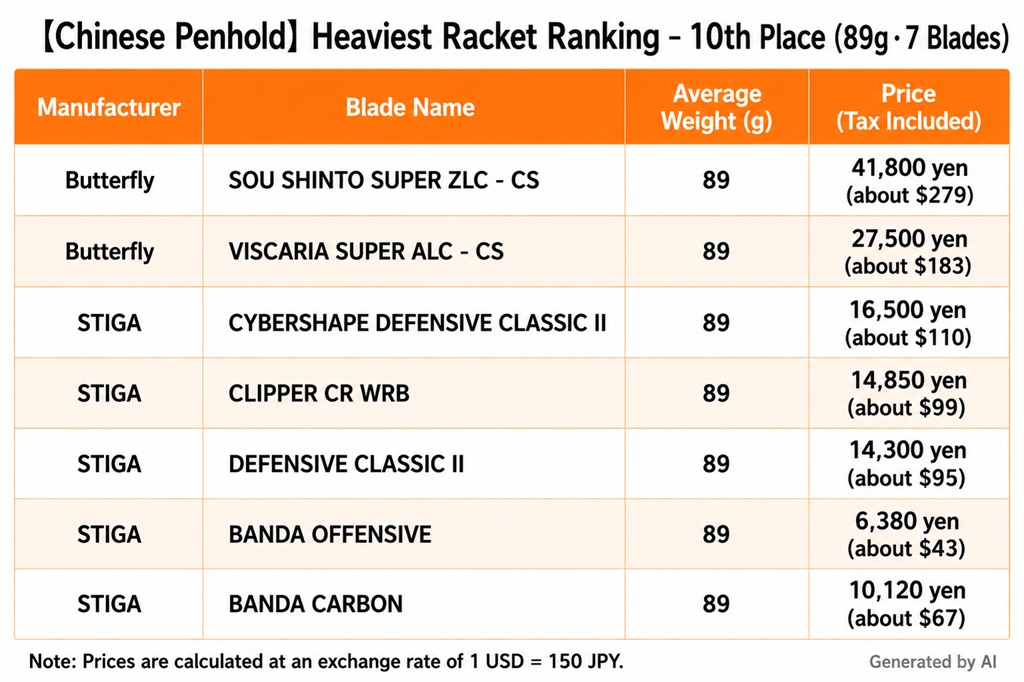
Seven blades share an average weight of 89 g. Four of them are all-wood blades—the two Defensive Classic II models, Clipper CR WRB, and BANDA Offensive. The remaining three are composite blades. Unlike the 88 g group, all-wood blades have a strong presence in this weight class.
(3) Tied for 5th Place (90 g · 5 Blades)
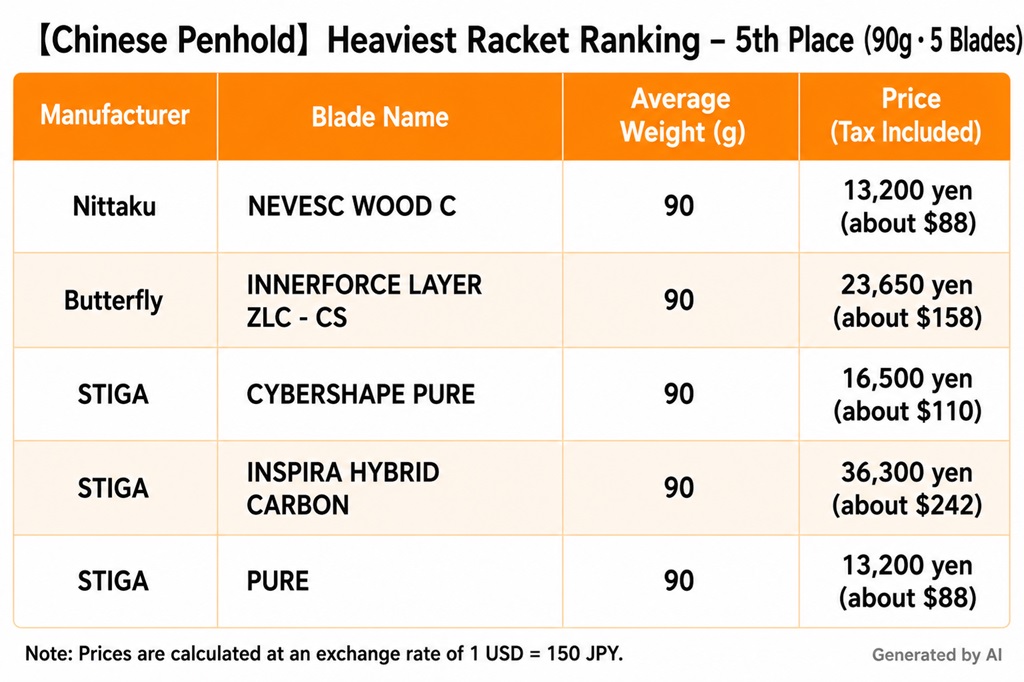
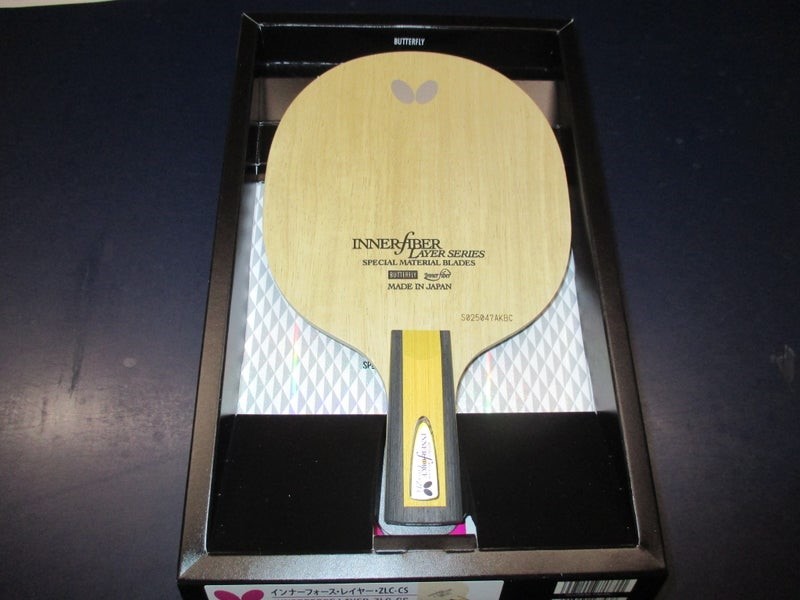
Five blades share an average weight of 90 g. This is an important milestone for heavyweight Chinese penhold blades. Three are all-wood blades, while the other two are composite blades, showing that blade weight alone does not determine the blade’s construction.
I own the Innerforce Layer ZLC – CS, and you can read my detailed hands-on review in the article below.
(4) 4th to 1st Place

All four blades in the top rankings weigh more than 90 g. Two are 7-ply all-wood blades (Goriki C and Clipper Wood), while the other two are composite blades. The 100 g Goriki C stands out by a wide margin, making it one of the heaviest Chinese penhold blades currently available.
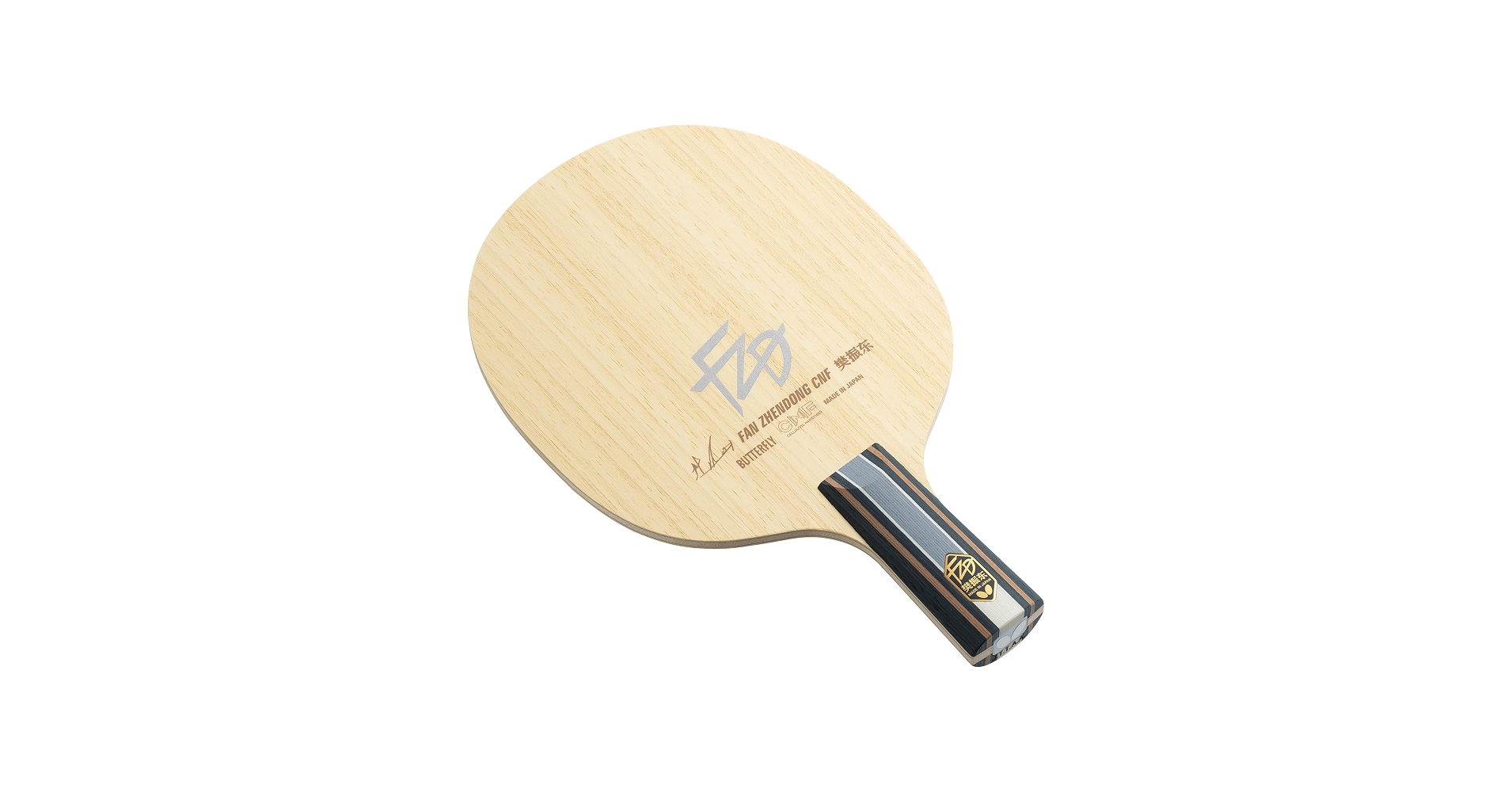
4th Place (91 g) Fan Zhendong CNF – CS (Butterfly)
Ranking fourth with an average weight of 91 g is the Butterfly Fan Zhendong CNF – CS. This composite blade features CNF (Cellulose Nanofiber), which Butterfly describes as combining excellent ball hold with high rebound. With an average weight of 91 g, it ranks fourth among all the blades surveyed.
Even after leaving the Chinese National Team, Fan Zhendong has continued to demonstrate his world-class ability by winning major domestic tournaments in China. As one of the sport’s biggest stars, he continues to inspire many players, making this blade an attractive choice for fans of his playing style.

3rd Place (92 g) Clipper Wood (STIGA)
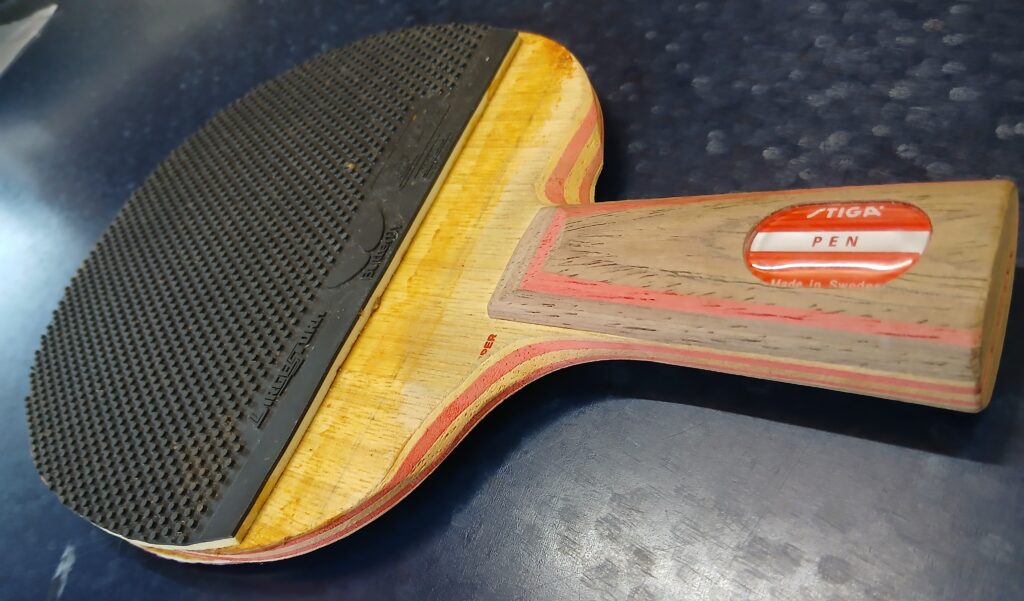
Clipper Wood is one of STIGA’s most iconic 7-ply all-wood blades and has remained a bestseller for many years. STIGA describes it as “the definitive 7-ply all-wood blade, offering outstanding speed and exceptional feel.” It is also well known as the blade once used by Chinese table tennis legend Liu Guoliang.
I also own this blade. It offers the solid feel and excellent speed that are typical of a 7-ply all-wood construction, and I find that it pairs especially well with softer rubbers. However, when fitted with inverted rubbers on both sides, the total racket weight easily exceeds 180 g, making it too heavy for me to handle comfortably. I now use it with lightweight large-ball rubbers for Japanese Large Ball table tennis.
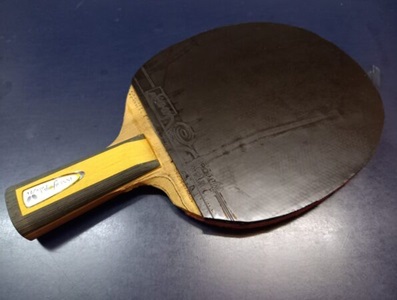
2nd Place (95 g) Dynasty Carbon (STIGA)
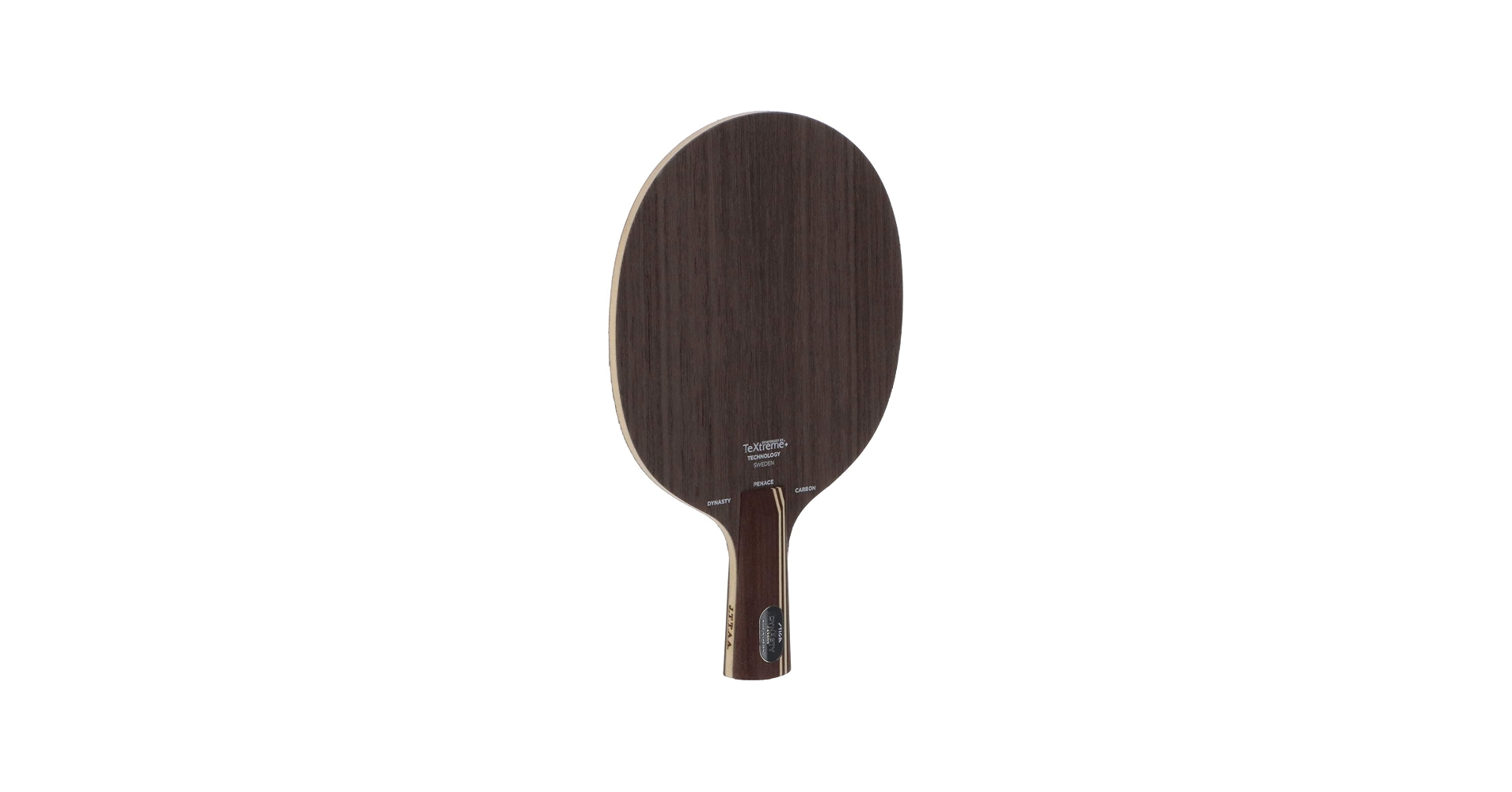
Ranking second with an average weight of 95 g is the Dynasty Carbon, a composite blade constructed with five wood plies and carbon layers. STIGA describes it as “a super blade that combines the speed of carbon with the feel of an all-wood blade.” With only two blades in this survey weighing 95 g or more, the Dynasty Carbon stands out as one of the true heavyweights among Chinese penhold blades.
Personally, I especially like its dark wood-grain design. The rich brown finish gives the blade a powerful, premium appearance that perfectly matches its heavyweight character.
Check the Latest Price of the Dynasty Carbon

1st Place (100 g) Goriki C (Nittaku)
Taking first place with an average weight of 100 g is the Goriki C from Nittaku. A 100 g Chinese penhold blade is exceptionally rare, and among the 23 blades surveyed, the Goriki C is the only one to reach the 100 g mark.
Nittaku promotes it with the slogan, “Individuality Is Your Greatest Weapon.” According to the catalog, its oversized heavyweight blade provides outstanding stability, making it easier to block even the most powerful attacks.
The Goriki Series was supervised and co-developed by Rokuro Sakuma, former head coach of Oji Club and a long-time Nittaku equipment advisor, who helped develop many Japanese national team players. Designed to provide extra power in situations where technique alone is not enough, the Goriki C is truly a blade with a unique character.
4. Relationship Between Blade Weight and Construction
You may be wondering, “Are heavy Chinese penhold blades mostly 7-ply all-wood blades, or are composite blades just as common?”
The table below classifies the highest-ranked blades by their construction.
.jpg)
The ranking shows a nearly even distribution among 7-ply all-wood, 5-ply + carbon, and 5-ply + fiber blades. This suggests that heavy Chinese penhold blades are not limited to 7-ply all-wood construction—many composite blades also belong to the heavyweight category.
Because 7-ply blades use more wood and additional glue layers, they naturally tend to be heavier. Many of them also offer the solid, powerful feel that players expect from all-wood blades.
Among the 5-ply composite blades, many of the highest-ranked models use carbon. While there are many types of composite materials, carbon is relatively heavy, so blades with carbon layers generally tend to weigh more when other factors are similar.
Another interesting finding is that the only two 5-ply all-wood blades in the ranking are defensive models (Defensive Classic II and Cybershape Defensive Classic II). Defensive blades typically have larger blade heads, which also contributes to their higher weight.
In other words, the weight of a Chinese penhold blade is not determined by its construction alone.The final weight is influenced by several factors, including the ply structure, the type of composite material, and the size of the blade head.
5. Song Huijia: A Player Who Mastered a Heavyweight Blade
A lighter blade is not always the better choice.
Keika Nakabayashi (formerly Song Huijia), one of the most accomplished female Chinese penhold players using the reverse penhold backhand (RPB), played with a racket weighing approximately 190 g, including the rubbers.
In Table Tennis Kingdom: Table Tennis Goods 2024 (p. 91), she explained her choice as follows.
“My forehand rubber is quite heavy, so I try to keep the blade as light as possible. Even so, the total racket weight exceeds 190 g. It feels heavy when I swing with my arm alone, but when I use my core, I can swing freely on both sides without noticing the weight.”
Her explanation makes sense from a technical standpoint. However, consistently using the core muscles during match play is not easy. Heavyweight rackets also place greater demands on the body, so they require solid technique and physical strength to use effectively.
Song retired from competitive table tennis after the 2022 All Japan Table Tennis Championships. Even today, she is remembered by many fans as one of the leading female players to master the reverse penhold backhand.
6. Pros and Cons of Heavy Chinese Penhold Blades
In this article, we’ve ranked the heaviest Chinese penhold blades currently available on the market.
However, a heavier blade is not always better, just as a lighter blade is not always the best choice. While additional weight can improve power and stability, it can also reduce swing speed and place greater strain on the body. Choosing the right weight is always a balance between these advantages and disadvantages.
If you’d like to learn more about how blade weight affects your playing style, be sure to check out the article below.

7. Conclusion
In this article, we analyzed the weights of 23 Chinese penhold blades and ranked them from heaviest to lightest.
Our findings show that heavyweight blades are not limited to 7-ply all-wood construction. Many carbon and other composite blades also fall into the heavyweight category. Even among 5-ply all-wood blades, defensive models with larger blade heads tend to be heavier than standard offensive blades.
There is no single “ideal” blade weight. The most important thing is to choose a blade that matches your physical strength, playing style, and personal preferences.
The four blades introduced at the top of this ranking are among the heaviest Chinese penhold blades currently available. If you’re looking for a heavyweight blade, be sure to check their latest prices.
If you’re interested in lightweight Chinese penhold blades, be sure to check out the article below.
Related Article
Average Weight of Shakehand Blades

Choosing the Ideal Weight for a Chinese Penhold Blade


コメント