
1. Introduction
For about 20 years, I have been developing my Reverse Penhold Backhand (RPB) technique using inverted rubber on the back side of a Chinese penhold or reverse penhold racket.
At the time, I believed that using short pips rubber for the RPB was not an option. However, after about two months of match-style practice and approximately 80 practice matches, I found that short pips rubber performed better than I had expected in many techniques.
Note: This test involved approximately 80 practice matches over a period of about two months.
Even now, several years after this test, my view has not changed: neither inverted rubber nor short pips rubber is inherently better. The right choice depends on your playing style and which type of rubber suits your game.
I have explained in detail in another article how to choose between inverted rubber and short pips rubber. If you are unsure which type is right for you, I recommend starting with that article.

As a follow-up to that article, I will share the characteristics, advantages, and disadvantages of each technique based on my experience using short pips rubber for about two months and playing approximately 80 practice matches.
2. The Rubber Used: Moristo SP (Nittaku) (Short Pips Rubber)
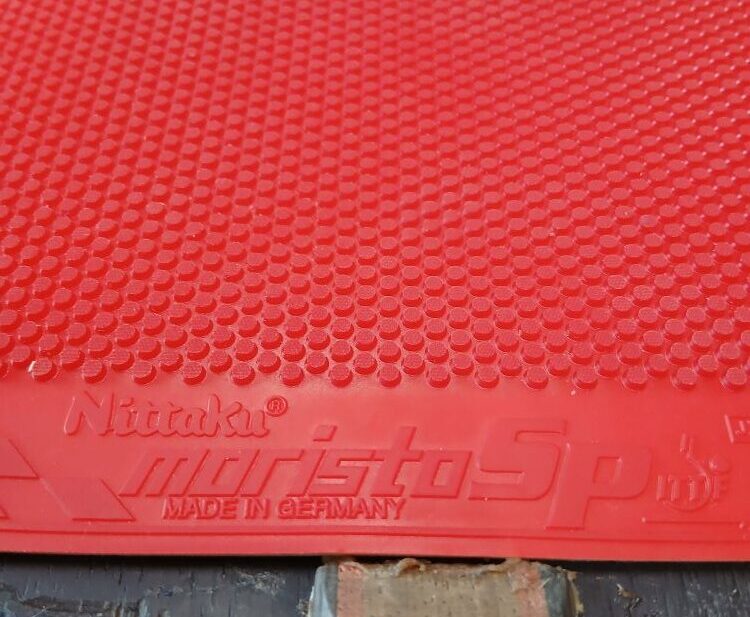
For this test, I used Moristo SP (Nittaku) as the rubber for my Reverse Penhold Backhand. It is a long-selling short pips rubber, also known for being used by Mima Ito on the backhand side of her shakehand racket.
You can check the current price and product details of Moristo SP below.

I explain why I chose this rubber in detail in the article below. Here, I will focus on my experience using it over approximately two months and 80 practice matches, including its advantages and disadvantages for each technique.

Now, let’s take a closer look at what I experienced with each technique.
3. Testing the Reverse Penhold Backhand with Short Pips Rubber
After using short pips rubber for my Reverse Penhold Backhand for about two months and playing approximately 80 practice matches, I found that each technique had its own distinct characteristics.
First, let’s take a look at the overall evaluation of each technique based on this test.
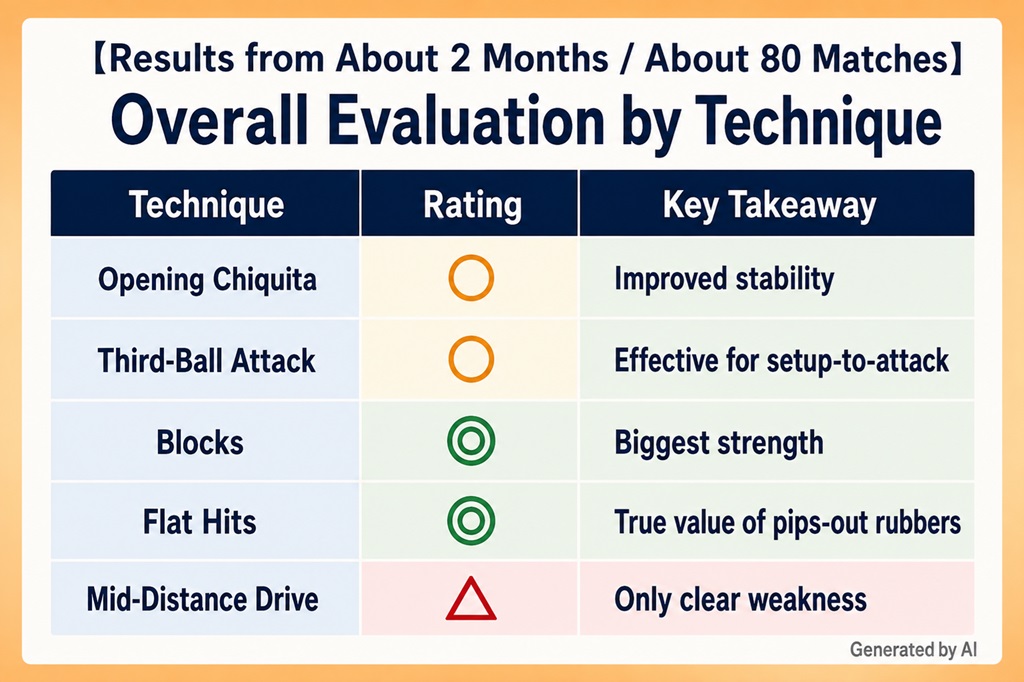
As you can see, short pips rubber works particularly well for blocking and flat hitting, and I felt a significant advantage especially when blocking. Chiquita receives, on the other hand, produced less spin but offered a high level of stability. Mid-distance RPB drives, however, remained a challenge.
It is worth noting that the Moristo SP (Nittaku) I used in this test is relatively easy to generate spin with compared with other short pips rubbers. Therefore, please keep in mind that the evaluations in this article are based specifically on my experience using Moristo SP.
The playing style discussed in this article is different from a style in which the racket is flipped during play, such as with a reverse penhold racket. This test assumes that the short pips rubber on the back side is actively used for attacking with the Reverse Penhold Backhand.
Now, let’s take a closer look at each technique.
(1) Over-the-Table RPB Chiquita Receive
In conclusion, the Chiquita receive is absolutely possible with short pips rubber.
Because short pips rubber is used, brushing the ball thinly to generate a lot of spin is difficult. However, you can still generate sufficient spin by contacting the ball more directly with the racket.
(2) RPB Third-Ball Attack (Drive)
At first, the third-ball attack was the technique where I felt the biggest disadvantage when using short pips rubber.
The reason was that it was difficult to play an RPB drive against a backspin ball that had been returned to my backhand side with a push after my backspin serve.
At first, I struggled to find a solution. However, by focusing on the following three points, I found that I could deal with the situation more easily than I had expected.
- Stop trying to win the point with the third-ball attack alone.
- Return the ball to a difficult position, using the same approach as an RPB Chiquita receive.
- Shift your focus to setting up a fifth-ball attack.
By focusing on these three points, I stopped trying to finish the point with a single RPB drive and became less tense. As a result, the overall flow of my play improved, and I felt that I was actually able to play better-quality shots.
(3) RPB Block
When using short pips rubber for my RPB, blocking was the technique where I felt the greatest advantage. In particular, I noticed the following two benefits.
(4) Flat Hitting
Personally, I consider flat hitting (a powerful stroke without adding spin) to be the second most important technique after the Chiquita receive when using the RPB.
Flat hitting is one of the techniques that makes the most of the characteristics of short pips rubber. The ball comes off the racket at high speed and tends to have a knuckle-like trajectory, making it very difficult for the opponent to handle.
Even without hitting the ball with 100% power, it naturally tends to produce a knuckle-like ball that puts plenty of pressure on the opponent. As a result, I was able to play without unnecessary tension and felt more relaxed mentally as well.
(5) Other Benefits
In addition to the benefits described above, I noticed several other advantages through my experience using short pips rubber.
- One of my practice partners commented that the Chiquita receive with Moristo SP was “difficult to return because the ball seemed to slide off the racket.”
- Although a Chiquita with short pips produces less change after the bounce, it can retain some of the spin from the opponent’s serve, creating an unusual and difficult-to-handle ball.
- The ball returned after a Chiquita receive tends to have a more predictable spin, making it easier to handle and allowing me to transition more easily into a fourth-ball attack.
- The large difference in spin between the inverted rubber on the forehand side and the short pips rubber on the backhand side can make it easier to force errors from the opponent.
(6) Disadvantage: Difficult to Play from Mid-Distance
While I have described many advantages so far, there are also some disadvantages.
- RPB drives become difficult from mid-distance. With my technique, once I moved away from the table, I could do little more than attempt a risky flat hit or play a safe ball to keep the rally going.
4. Important Considerations
So far, I have discussed the advantages and disadvantages of using short pips rubber for the Reverse Penhold Backhand. Finally, I would like to share a few important points to keep in mind when using it.
I do not recommend short pips rubber for players who have just started learning the Reverse Penhold Backhand.
If you want to use short pips rubber for the RPB, I recommend first developing a consistent feel for the ball that allows you to play stable RPB drives against backspin pushes to your backhand side.
I also tried short pips rubber at a time when my RPB drives were still inconsistent, but I was unable to use the rubber effectively at that stage.
If you are just starting to learn the RPB, I believe that developing your feel for the ball with an ultra-thin rubber is a shortcut to improving your technique.
I explain in more detail why I believe ultra-thin rubber can help accelerate your progress in the following article.

5. Summary
Here is a summary of my evaluation of each technique for reference.
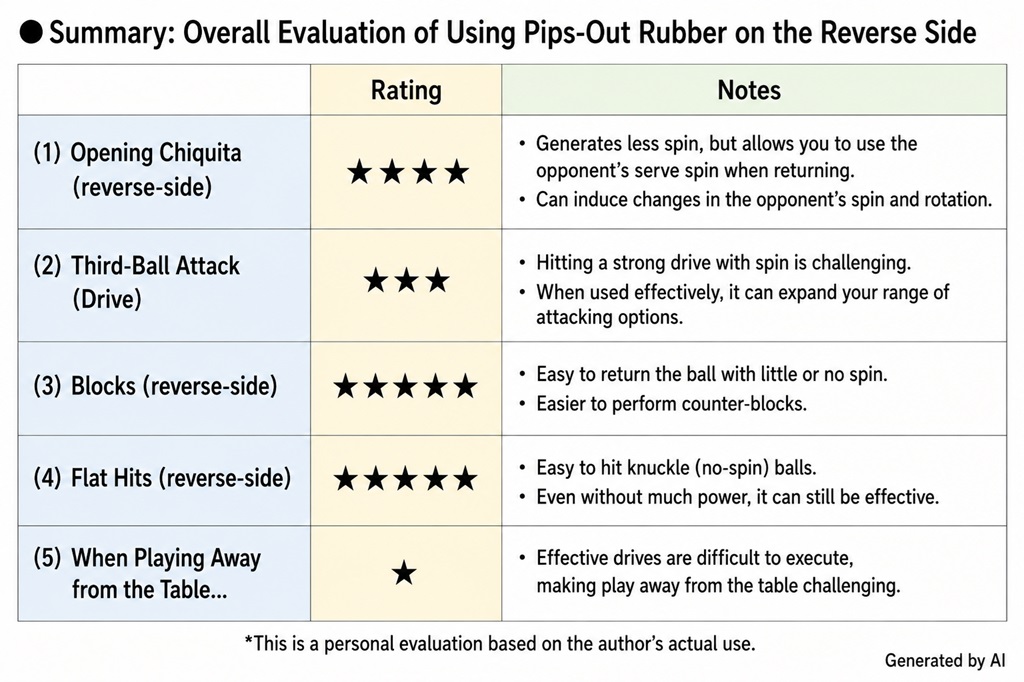
Through this test, I found that short pips rubber has great potential for the Reverse Penhold Backhand.
What impressed me most was the difference in spin and ball quality between the inverted rubber on the forehand side and the short pips rubber on the backhand side. These differences often disrupted my opponents’ timing and judgment, leading to mistakes I had not seen before.
After about two months, once I became comfortable using short pips, I was able to maintain almost the same win rate as when I used inverted rubber on both sides. I believe the tactical advantage created by the difference in spin also played a role.
In particular, combining the heavy spin of the forehand inverted rubber with the knuckle-like balls from the backhand short pips forced my opponents to constantly adjust to different amounts of spin. I believe this helped disrupt their judgment and allowed me to control the match at my own pace.
Another advantage was that few penhold players use the RPB extensively, and even fewer use short pips on the backhand side. As a result, many opponents had limited experience facing this style.
At the same time, this style is not simply about confusing opponents with variations. I found it particularly suitable for players who want to read their opponent’s reactions and control the flow of the match while switching between heavy forehand spin and knuckle-like backhand balls.
I found this style particularly suitable for players who prefer to control the match by disrupting their opponent’s judgment with differences in spin and ball quality, rather than simply trying to overpower them with heavy spin.
I eventually returned to using inverted rubber on both sides, but the experience I gained from this test continues to influence my playing style today.
Whether you prefer to attack actively or disrupt your opponent’s rhythm and control the match, the best rubber choice will be different. If you are unsure which type suits you, this article may also be helpful.
Related Articles
The Best Rubber for Learning the Reverse Penhold Backhand
What Happens When You Use Hurricane 8-80 Power for the RPB?

Top Players Who Use the Reverse Penhold Backhand

You can check the current price and product details of Moristo SP below.


コメント