【新刊】卓球裏面打法の極意、Kindleにて絶賛発売中!(Japanese Edition / English version coming soon?)

Max vs. 2.0mm Sponge: Which One Should You Choose?

※This site contains affiliate links. Please note that some visuals are created with the help of AI.

【Basics & Beginner Guides】
About the Author

Experience: 40+ years in Table Tennis (Insightful veteran's perspective).

Style: Penholder Attacker (Currently exploring "Uramen Daho" / RPB).

Focus: Deep analysis of global top players and the latest gear.

Mission: Capturing all aspects of the table tennis scene through a unique lens, providing insights to help you enjoy the game even more.

English Content Policy: Most articles are AI-assisted translations from Japanese. I apologize for any unnatural phrasing and appreciate your patience!

1.Introduction

Sponge thickness is a critical factor when choosing table tennis equipment.

Some players might select their sponge thickness without much thought.

For example, looking at the male players around me, almost everyone uses “Max” or “2.2mm” thickness for their forehand.

But can you truly say that this choice perfectly fits your playing style?

It’s not uncommon to see players who have used “Max” for years—without a specific reason—suddenly improve their quality of play just by trying a slightly thinner sponge.

As a self-proclaimed intermediate player, I recently tested the same rubber in both “Max” and “2.0mm” to re-evaluate the best choice. In this article, I’ll share my insights on selecting between these two. I hope you find this helpful until the very end!

【Notes for this article】

Note 1: Please note that sponge thickness labels vary by manufacturer. This article specifically focuses on comparing “Max” and “2.0mm” thicknesses.

Note 2: This article is written specifically for “Inverted Rubbers” (Smooth surface) and is intended for “Offensive Style Players.”

Note: While I have a separate comprehensive guide on general sponge thickness, this article will focus specifically on the comparison between “Max” and “2.0mm”.

2.Rubbers used for testing

Introduction of Rubbers Used for Verification

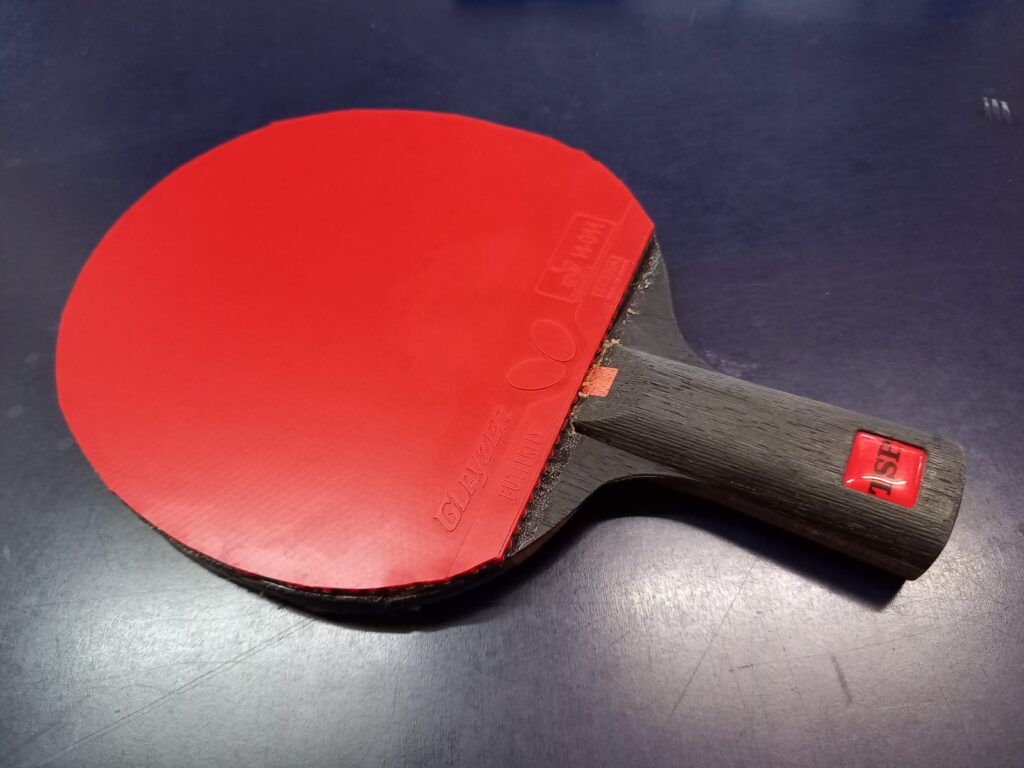
Rubber Used: Glayzer (Butterfly)

  • This is the rubber I use on the backhand side of my penholder racket.
  • While its performance is said to be slightly below high-end rubbers like Dignics, it is specifically designed for intermediate players to be more user-friendly.
  • However, the Butterfly Dignics series is quite expensive and can be hard to justify for many players.
  • If you are looking for a high-quality rubber that is more affordable, I personally recommend giving this one a try.

High-performance rubber that balances power and consistent arc.

  • Featuring the gray “Spring Sponge X,” GLAYZER offers exceptional dwell time and a highly durable top sheet.
  • The combination of this top sheet and the Spring Sponge X (designed with a hardness of 38) brings heavy spin and power to your shots.
  • It enables a stable, curved trajectory (arc), allowing players to hit consistent, powerful drives.
  • GLAYZER brings the joy of executing spin-oriented two-handed drives and counters to a wider range of players.

Source: Butterfly Official Website

Even if you don’t read Japanese, you can check out more detailed photos and specs via the link below!”

3.Rubber Weight Comparison

I compared the weights of the Glayzer rubbers I recently purchased.

  • The results showed that the “Thick” (Atsu) version was about 5g lighter in its uncut state.
  • While the “Thick” version is slightly lighter, it is clear that we cannot expect a significant reduction in total racket weight.
  • For reference, after cutting and applying the rubber to the racket, the “Thick” version was about 3g lighter in this case.
For my backhand, I opt for the “Thick” sponge size.

Sponge thickness can vary even among rubbers labeled with the same specs. Therefore, please keep in mind that the weight of the rubber also varies due to individual differences.

Even within the same product and thickness, inconsistencies exist. Because of this, some discerning players go as far as weighing each package on a scale at the shop before purchasing.

In my case, I always check the weight whenever a shop provides a scale.

4.Characteristics by Sponge Thickness

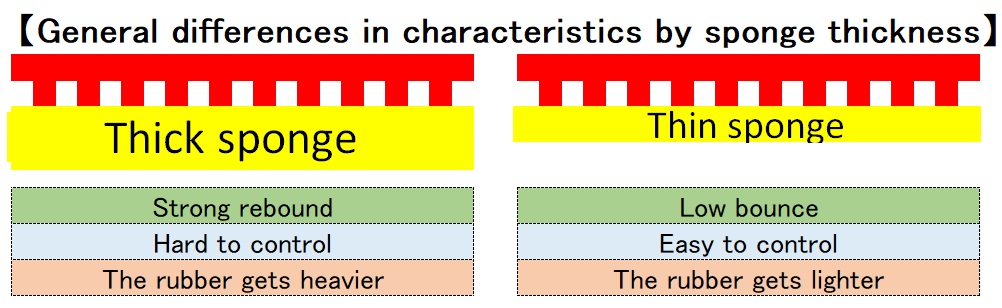
Please review the general characteristics of rubber based on sponge thickness below:

  • This comparison focuses on “Extra Thick” (Max) and “Thick” (2.0mm).
  • The differences may not be obvious enough for beginners to notice clearly.
  • However, once you reach a competitive level where you can advance in tournaments, these subtle differences become more apparent.
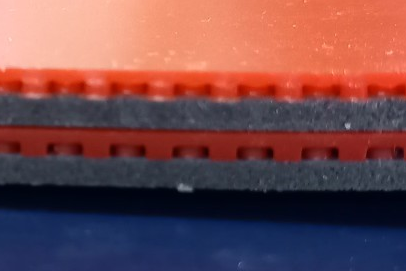
[Reference] Top: Extra Thick (Max) / Bottom: Thick

However, you can definitely feel the difference when actually playing!

5.Choosing Based on Your Playing Style

To decide whether “Extra Thick” (Max) or “Thick” (2.0mm) is better for you, you need to consider your current playing style or how you aspire to play.

  • I have provided examples of which thickness suits different styles, so please compare them with your own goals.
  • Please note that these are based on my personal views and experience.

(1)Who “Extra Thick” (Max) is best for:

  • You prioritize destructive power in your 3rd-ball attacks.
  • You want to dominate your opponent during topspin rallies.
  • You love an aggressive, all-out attacking style of play.
  • You have confidence in your fast swing speed.
  • You don’t mind occasional errors, as long as you’re hitting more winners.

(2)Who “Thick” (2.0mm) is best for:

  • You aim for consistent and stable service returns.
  • You enjoy the tactical game, mixing offense and defense to outsmart your opponent.
  • You value the “feeling” and touch of the ball at the point of impact.
  • You want to play carefully, minimizing unforced errors as much as possible.
  • You prefer placement and blocking over raw power to shut down your opponent’s game.

Advanced players can compensate for the drawbacks of “Extra Thick” or “MAX” (such as the difficulty in short-game control) through their superior technique.

Conversely, it is extremely difficult to compensate for the disadvantages of thinner rubbers (such as lack of speed and bounce) using technique alone.

For these reasons, you will find almost no advanced offensive players using rubbers thinner than “Thick.”

For your reference, here are the details of the rubber thickness I personally use and the reasons why.

Forehand: Extra Thick (Max)
【Reasons】

  • Confidence in my swing speed: It’s the one part of my game I truly trust.
  • Aggressive style: I love an all-out attacking game.
  • 3rd-ball focus: I prioritize the destructive power of the 3rd-ball attack.
  • Mid-distance power: I want to ensure my loops (topspins) remain powerful even when playing away from the table.

Backhand: Thick (2.0mm)
【Reasons】

  • Slow swing speed: My backhand (penhold backhand) swing speed is relatively slow.
  • Consistency first: I want to minimize unforced errors at any cost.
  • Accuracy over power: I prioritize precision over raw power for my backhand Chiquita (banana flick).
  • Placement over speed: I focus on ball placement rather than shot speed.

6.Conclusion

How did you find it? Did your desired playing style align with your current rubber thickness?

As I mentioned at the beginning, it is quite common for players to find that dropping down just one thickness level makes the rubber surprisingly easy to use and significantly improves the quality of their play.

Furthermore, changing the thickness of your backhand rubber can even alter the “feeling” of your forehand shots. If you feel your current rubber isn’t quite right, instead of switching to a different brand, try simply changing the thickness.

I wrote this article because I often find myself torn between “Extra Thick” and “Thick” when buying new rubbers. I hope this information helps you in your selection process!

Even if you don’t read Japanese, you can check out more detailed photos and specs via the link below!”

コメント

PVランキングも参加しています!

PVアクセスランキング にほんブログ村

Copied title and URL