【新刊】卓球裏面打法の極意、Kindleにて絶賛発売中!(Japanese Edition / English version coming soon?)

[Table Tennis: C-Pen] Exciting to Watch! Europe’s Top RPB Specialist: Felix Lebrun (France)

※This site contains affiliate links. Please note that some visuals are created with the help of AI.

【Pro Player Analysis】
About the Author

Experience: 40+ years in Table Tennis (Insightful veteran's perspective).

Style: Penholder Attacker (Currently exploring "Uramen Daho" / RPB).

Focus: Deep analysis of global top players and the latest gear.

Mission: Capturing all aspects of the table tennis scene through a unique lens, providing insights to help you enjoy the game even more.

English Content Policy: Most articles are AI-assisted translations from Japanese. I apologize for any unnatural phrasing and appreciate your patience!

1.Introduction

Have you ever heard of the French table tennis sensation, Felix Lebrun?

He is a “Penholder player,” a style that is exceptionally rare in Europe today. Felix has rapidly climbed the world rankings, establishing himself as one of the strongest penhold players on the planet.

While the backhand is often considered a weakness of the penhold grip, Felix overcomes this with his masterful use of the “Reverse Penhold Backhand (RPB).” His backhand play is so powerful and precise that it rivals even the best shakehand players.

Above all, his playing style is incredibly unique and fascinating to watch! In this article, I’ll be sharing my personal analysis and insights into what makes Felix Lebrun such a remarkable player.

2.About Felix Lebrun (As of late March 2026)

  • Nationality: France
  • Age: 19
  • Playing Style: Right-handed Penhold Attacker
  • World Ranking: No. 6

Felix is a sensational player who has consistently delivered strong results in the WTT Pro Tour and other major events. He made a significant impact by breaking into the Top 20 at the young age of 17 and has since maintained his position within the World Top 10.

His older brother, Alexis Lebrun, is a right-handed Shakehand Attacker (Age: 22, World Ranking: No. 14). Together, the Lebrun brothers are leading the resurgence of European table tennis.

*World Rankings as of March 30, 2026 (ITTF World Ranking)

3.Equipment (Chinese Penhold & Tacky Rubber)

Felix Lebrun was previously a sponsored player for another table tennis brand, but he is currently a TIBHAR contract athlete. As a result, both his blade and rubbers are TIBHAR products.

Blade: Felix Lebrun Hyper Carbon (TIBHAR)

Rubbers: Hybrid K3 (TIBHAR) – Used on both sides

Sponge Hardness: 53° (degrees)

Even if you don’t read Japanese, you can check out more detailed photos and specs via the link below!”

“For more detailed product specifications, you can visit the TIBHAR Japan official website. Their interface is very user-friendly and provides a great visual overview of the gear.”

“Even if it’s in Japanese, the layout is intuitive.”

TIBHAR JAPAN

●Racket Weight Analysis (Estimation)

Blade Weight: Approx. 85g (Based on TIBHAR Japan’s official average)

Rubber Weight: Approx. 50g per sheet (Total 100g for both sides)

Note: Since he uses hard, tacky high-tension rubbers on both sides with full coverage, each sheet is estimated to weigh around 50g.

Total Racket Weight: Approx. 190g (Estimated)

A total weight of 190g is considered quite heavy for a penhold grip.

While Felix Lebrun may appear slender at first glance, the fact that he swings a 190g racket with such ease and speed reveals his incredible core strength and explosive power.

4.Grip Analysis

Here’s an inside look at Felix Lebrun’s distinctive grip.

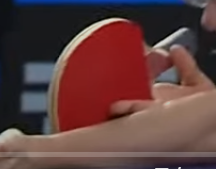
(1)Front Side (Thumb and Forefinger)

Felix appears to insert his thumb quite deeply into the blade. This setup is very reminiscent of Wang Hao, the legendary pioneer of the Reverse Penhold Backhand (RPB).

Analysis: This deep thumb grip significantly enhances the ease of RPB strokes. On the flip side, it makes traditional backhand blocks (shorthand) extremely difficult—nearly impossible—because it’s hard to get the right blade angle.

(2)Back Side (Middle, Ring, and Pinky Fingers)

On the back of the blade, Felix curls his three fingers to support the racket. This can be considered a fairly standard grip for modern penhold players.

5.Service (Serve)

(1)Forehand Serve Grip

His grip during the forehand serve is highly distinctive. He completely removes his thumb from the front of the blade, which he normally inserts deeply.

Analysis: This adjustment is likely intended to maximize the range of motion (ROM) in his wrist during the serve, allowing for more extreme angles and increased spin generation.

(2)Backhand Serve

Felix occasionally uses a backhand serve to change the rhythm of the game or during critical moments.

For instance, in the Men’s Singles Final of the “WTT Champions Montpellier 2024” on October 27, 2024, against Tomokazu Harimoto, Felix used his backhand serve once while trailing 6-9 in the 4th set. This tactical choice shows his ability to adapt under pressure.

Interestingly, his grip for the backhand serve appears to be fairly standard.

6.Receive (Return of Serve)

Let’s take a closer look at Felix Lebrun’s receiving tendencies during the Men’s Singles Final of “WTT Champions Montpellier 2024” against Tomokazu Harimoto.

Analysis: Return of Serve (Receiving Statistics)
Based on the Men’s Singles Final against Tomokazu Harimoto:

Total Receives: 43

Banana Flick (RPB): 4 times (9.3%)
※Against short serves.

Push / Stop: 26 times (60.5%)
※Against short serves.

Backhand Drive or Forehand Drive: 13 times (30.2%)
※Against long serves.

Personal Insights & Tactical Analysis

This data was personally quite surprising to me. Given Felix Lebrun’s exceptional skill with the Reverse Penhold Backhand (RPB), I expected him to rely heavily on the banana flick (chiquita). However, his game was primarily built around “pushes and stops.”

While these percentages naturally fluctuate depending on the opponent’s service, it appears that his baseline strategy leans heavily towards these precise, controlled returns.

My initial impression was that Felix always played aggressively from the very first ball. In reality, he frequently employs a sophisticated tactic: sending a push to a position where the opponent cannot swing fully, forcing them to make a sub-optimal opening drive, which he then punishes with a devastating counter-attack.

Furthermore, he typically reserved his RPB receive for serves that drifted long or were “half-long” (on the edge of the table). I observed very few instances of him using the over-the-table RPB flick against strictly short serves.

The remarkably low error rate in his “pushes and stops” suggests that his ability to read incoming spin is exceptionally high.

Why is this tactic so impressive?
From a player’s perspective, relying on “pushes or stops” as a primary receive is psychologically daunting. If the return floats even slightly, it often results in an immediate point for the opponent with a single powerful smash.

The fact that Felix consistently chooses this strategy proves he has absolute confidence in his “push and stop” technique—not only in its precision but also in his ability to neutralize the opponent’s spin.

7.Other Notable Characteristics

(1)Rapid Match Tempo

One of Felix Lebrun’s defining characteristics is his exceptionally fast match tempo. The interval between points is unusually short—whether serving or receiving, he is almost always ready before his opponent.

If you have experience in competitive table tennis, you know how uncomfortable it is to play against someone who dictates such a frantic pace. It prevents you from playing at your own rhythm and forces you into a reactive state.

This strategy highlights Felix’s high tactical intelligence. At this elite level, players are constantly planning several shots ahead. Felix manages to do this while maintaining a speed that overwhelms the opponent’s decision-making process.

A similar player would be Japan’s Sora Matsushima (Age: 18, Kinoshita Group). Both players maintain such a high tempo that their opponents are often seen gesturing for them to “Wait, wait!” just to catch a breath.

*I’ve included a link to their match at the 2026 WTT Star Contender below. If you’re interested, take a look at their incredible speed!

The Logic Behind His Speed
How can Felix maintain such an incredibly fast tempo? It’s not just about physical speed—it’s about his mental processing.

Extraordinary Tempo: He progresses through the game at an almost “abnormal” pace.

Instantaneous Prediction: This is only possible because he is predicting the next shot and formulating his tactics in a split second.

High Intellectual Agility: This proves he is an exceptionally intelligent player with a rapid “mental rotation” speed.
※Crucially, this is not something that happens by accident. It is a skill that can only be achieved if a player consciously trains this mental processing in their daily practice.

※日本国内からはご視聴いただけない場合があります。

(2)Ultra-High-Speed Pitch in the Close-to-Table Area

One of the biggest challenges for penholder players is the transition between forehand and backhand (reverse backhand). Lebrun, however, executes this transition with extreme fluidity. He stays close to the table, overwhelming his opponents with a relentless, high-speed pitch and seamless two-handed attacks.

Furthermore, as mentioned in point (1), his intervals between points are exceptionally short. Once he finds his rhythm, he becomes virtually unstoppable. He strikes before the opponent can regroup, creating what can only be described as “F. Lebrun World.” Once you are drawn into his pace, the match can be over in a flash, leaving you helpless against his otherworldly speed.

(3)Exceptional Mental Control

His ability to reset his mind is far beyond what you would expect from a 19-year-old. No matter what mistake he makes, he never dwells on it and immediately shifts his focus to the next point.

While he occasionally shouts after a missed shot, this seems to be his way of managing frustration. By releasing that energy, he resets his emotions instantly; a moment later, he is back in his stance as if nothing happened. In the match against Sora Matsushima, there were scenes where he let out a loud “Whoa!” in frustration, yet he appeared completely unfazed by the very next point. This “reset” is one of his most compelling traits.

I suspect he has a dedicated mental performance coach. It’s hard to imagine a 19-year-old achieving such rapid emotional recovery and maintaining such a frantic match tempo without professional guidance.

8.Conclusion

What do you think?

Initially, I started following Felix Lebrun simply as a player who uses the reverse backhand (RBP) technique. However, the more I watch his matches, the more I discover his other incredible strengths, and I have truly become a fan.

The presence of the Lebrun brothers—including his older brother, Alexis (a shakehand offensive player)—has transformed the French team into a formidable force in the world of table tennis.

Their success at the Paris Olympics was remarkable, with Felix securing a bronze medal in Men’s Singles and leading the French men’s team to a bronze medal in the Team event.

He is undoubtedly a player to watch closely in the coming years.

Thank you for reading!

コメント

PVランキングも参加しています!

PVアクセスランキング にほんブログ村

Copied title and URL